
CHAPTER 8: THE SECRATED RECKONING
“You always did know how to budget your shadows, David.”
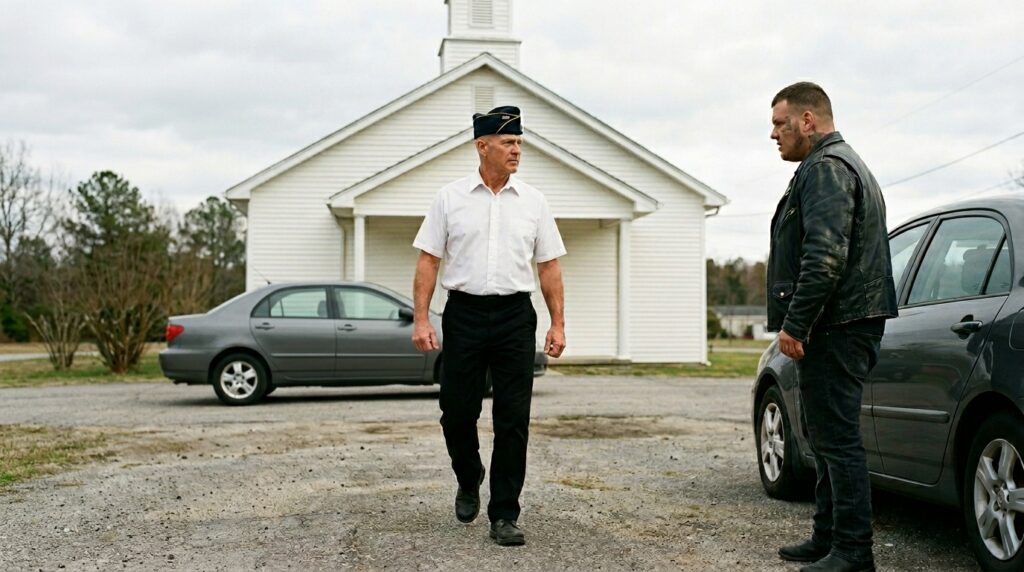
Colonel Vance’s voice didn’t echo. The heavy cedar beams overhead, soft with dry rot but dense enough to swallow sound, held the words flat against the floorboards. The front doors of the sanctuary hung open behind him, framing a narrow rectangle of desaturated gray dawn. The blue beam of a high-grade tactical flashlight sliced through the dark, tracking the rows of peeling wooden pews before settling squarely on the center pulpit where David stood.
David didn’t shield his eyes from the glare. His left hand rested on the altar’s edge, his fingers feeling the deep, splintered grain of the oak where decades of oil and grease from working hands had left a slick patina. In his right pocket, his knuckles ground against the blunt iron tractor bolt.
“The inventory under the floor belongs to the state, Vance,” David said, his voice coming out slow, regular as a grandfather clock. “The state closed the ledger in ’95. You’re holding a dead balance sheet.”
“The state doesn’t have an automated extraction protocol for assets they forgot they owned,” Vance replied. His boots made a wet, rhythmic crunch against the grit on the center aisle carpet as he advanced. He held the flashlight low now, its peripheral spill illuminating the gray lines of his face and the brass crest on his lapel. “Forty tons of specialized hardware from the 4th Logistics reserves doesn’t vanish because someone checked a box in Washington. It sits in the dark until someone with a crane comes to claim it.”
“You didn’t bring cranes,” David murmured, his gaze shifting to the side aisle where the stained glass windows showed the dark, idling silhouettes of the five-ton flatbeds. “You brought a clearing crew.”
“Because you were still here.” Vance stopped five paces from the altar rail, right where the floorboards had buckled from old rain leaks. He lowered the light completely, letting the room plunge back into a dark, suffocating gray. “Thomas thought he was saving the roof. He’s a small man; he thinks in terms of shingles and fuel oil. But you and I know that when an asset sits in a combat zone for thirty years without an audit, it becomes the property of the officer who kept it off the manifests.”
“I signed the final disposal manifest,” David said. His hand came out of his pocket, his thumb turning the iron bolt over in his palm. The rust flakes fell away, dry and sharp against his skin. “I listed every pallet as scrap iron. It was melted down, Colonel.”
Vance’s hand dropped to his side split jacket. “Then why did you anchor your church to the concrete cap of the secondary fuel bunker? Why did you spend thirty years checking the fence wire every Tuesday morning if there was nothing but old iron in the dirt?”
The silence that followed was heavy with the smell of sulfur from the well below and the cold, mineral scent of ancient limestone. It was the emotional weight of a thirty-year siege, a quiet war between two men who had spent their youth calculating the exact cost of human life in terms of gallons and tons. Vance wasn’t here for profit; he was here because his entire professional reality was built on the absolute necessity of a clean ledger, and David’s survival was the only unverified debit left on his sheet.
“Because the land needed a boundary,” David said simply. He stepped down from the pulpit, his boots making a dry, deliberate scrape against the altar rail. “If I didn’t hold the line here, the whole basin would look like your trucks—stripped down to the gray primer and sold by the pound.”
Vance didn’t monologue. He didn’t give a command to the men outside. With the efficient, unthinking precision of an old soldier whose muscle memory had outlived his uniform, he pulled the heavy sidearm from his coat. The steel slide cleared the leather with a clean, metallic clink.
But David had already calculated the distance. He didn’t drop to the floor; he didn’t swing the pry-bar. He slammed his heel down onto the loose floorboard at the base of the altar rail—the exact point where he had bypassed the manual interlock to the transformer below.
The mechanical connection, held under extreme spring tension by the iron tractor bolt he’d jammed into the housing earlier, snapped with a violent, concussive crack.
The backup battery banks in the vestry didn’t explode; they shorted out through the iron water mains, sending a sudden, brilliant flash of electrical arc-light through the floor registers right beneath Vance’s feet. The sudden glare was blinding, throwing massive, distorted shadows across the white altar cloth. In that split second of visual overload, David closed the gap.
His hand caught Vance’s forearm, his thumb pressing into the nerve cluster behind the wrist with the precise, functional leverage of his old MP training. The sidearm clattered onto the tarnished silver communion tray sitting on the rail, landing with a sharp, clear ring that sounded like a coin dropping into an empty offering plate.
David didn’t strike. He held the Colonel’s arm pinned against the oak rail, their faces inches apart in the returning dark. He could feel the heavy, ragged breath of the older man—not the breath of a mastermind, but the tired, dry rasp of an obsolete engine running out of oil.
“The ledger is closed, Colonel,” David whispered, his grip tightening until the brass insignia on Vance’s sleeve pressed into his own palm like a brand. “Go back across the creek.”
Vance stayed still for a long heartbeat, his fingers twitching against the oak rail. Outside, the low, rhythmic drone of the flatbeds began to stutter as the secondary fuel pumps, starved of the regulated current from the parish junction box, choked on the dirty diesel and died one by one. The silence returned to the valley, vast and indifferent, leaving nothing but the sound of the wind scraping the lime dust against the white wooden doors.








