
CHAPTER 14: THE FINAL COMPILATION
“The line is dead, David.”
Miller didn’t lift her eyes from the accordion file as he pulled his shoulder out of the trapdoor casing. Her dark gray suit jacket was completely coated in the fine white lime dust that had blown through the office window floor vents, turning the crisp wool charcoal into the faded gray of an old headstone. Outside, the generic sedan’s cooling fan gave one final, high-pitched rattle and cut out, leaving the afternoon silence thick, massive, and smelling of parched shale.
David laid the unpolished nickel key flat on the table, right over the line he had torn through the infrastructure manifest.
“The line isn’t dead,” David said, his hand sliding over the coarse canvas of his knee to rub away the damp rust sludge from the sub-floor valve. “The balance sheet just caught up with the location.”
Miller picked up the key. Her fingers traced the deeply notched vertical bits, her thumb catching on the rough edge where the brass stamping had been cut back in the depot bay. She turned the file folder flap over, revealing an old, purple ink stamp hidden inside the cardstock pocket: LEASE STATUS: TERMINATED BY ORDER OF LIQUIDATION OFFICE — OCT 1996.
She didn’t pack her file. She left the manila folder sitting open on the sun-bleached desk, the brittle pages fluttering slightly in the hot draft coming through the door planks. “You didn’t just wash the tanks out, Sergeant. You cut the drainage interlock to the rail spur. The surveyor just called the mobile unit. The bridge gate locks aren’t picking up the hydraulic signal from the node.”
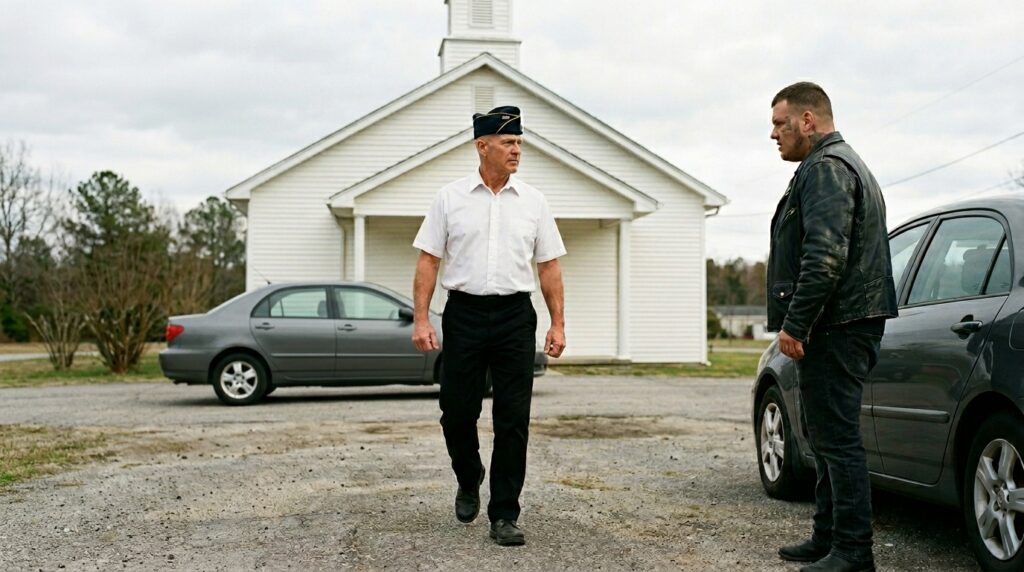
“The node runs on the water pressure from the lower line,” David said. He pulled the dark veteran cap from his belt line and set it squarely on his head, the shadow cast by the brim dropping his eyes into total obscurity. “Vance can leave his flatbeds on the county road until the tires rot into the gravel. He isn’t turning the lock without the head-pressure.”
The silence that settled over the parish house was structural—the heavy, unmoving weight of thirty years of compartmentalized history finally grounding itself into the foundation timber. Through the window, the white church walls looked starker under the horizontal glare of the setting sun, the peeling paint ribbons standing out like dry scabs against the grey pine beneath.
Deacon Thomas sat in the low corner chair, his old hands resting empty on his knees, his face completely gray in the desaturated room light. He didn’t look at the files, and he didn’t look at David. He looked at the floorboards, listening to the slow, rhythmic drip-drip-drip of the stagnant aquifer water leaking from the valve below into the lime dust of the cellar.
“The cooperative will have to haul through the north cut,” Thomas whispered, his voice thin as a dry weed. “It’s twelve miles longer on the tires, David. The smallholders won’t make the winter interest on that fuel bill.”
“They’ll make the winter because they still own the storage,” David said, his voice carrying the final, absolute density of an unyielding gate post. “Vance isn’t buying the lease, and the state isn’t chain-locking the road. The basin stays exactly as dirty as it was on Friday.”
Miller stood up, the manila file tucked firmly under her arm. She didn’t offer her hand, and she didn’t pick up the silver ink pen she’d left on the well-cover outside. She walked out to the sedan, her leather shoes making a sharp, final crunch in the gravel ruts before the cabin door slammed shut with a muffled, unyielding thud.
David walked out onto the porch after the gray car had vanished past the lime kiln ruins. The air was dropping its temperature fast now, the cold ridge draft beginning to stir the dry elderberry leaves along the western fence line. He reached down into his trousers pocket, his fingers settling around the old iron tractor bolt. It was cold again, the metal having shed his body heat the moment he stepped out into the open basin wind.
He looked down at his white shirt—the starch was gone, the chest ruined by gray lime streaks and the pink smudge of another man’s blood on the cuff. He didn’t go back inside to wash. He walked toward the broken iron gate, his boots finding the familiar ruts in the shale as he began the slow, unglamorous labor of splicing the rusted barbed wire back onto the posts before the dark could take the flats.








