
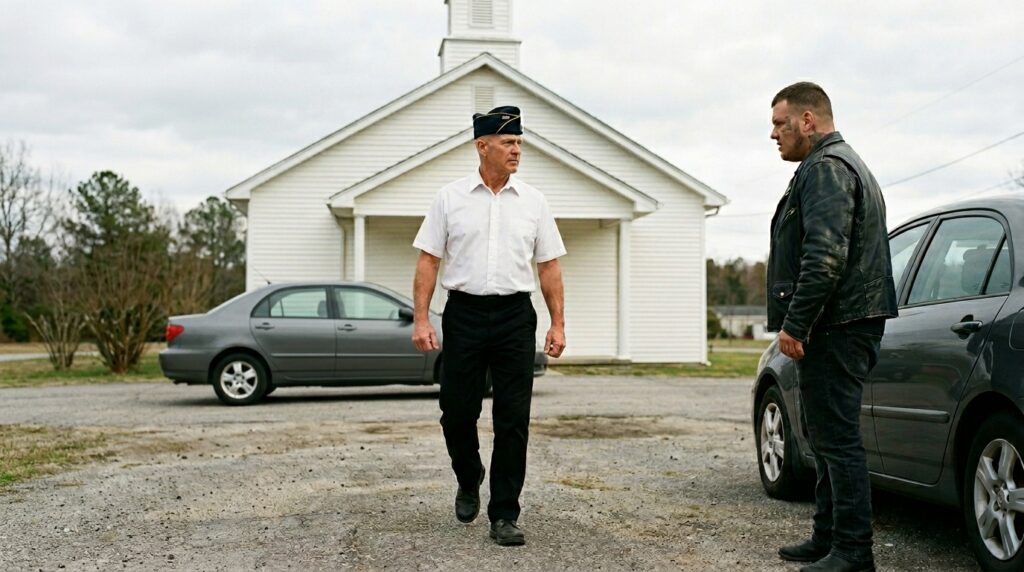
CHAPTER 16: THE BARTER ACCOUNTING
“You can’t pay a water main with barley, David.”
The match flared, casting a harsh, orange glow across Deacon Thomas’s face before dying down into a thin blue line on the sulfur tip. He was sitting on a low wooden bench in the dark vestry room behind the altar, his fingers buried deep in the unraveled wool of his sleeve. Beside him on the bare stone floorboards lay three canvas grain sacks, their mouths tied off with rough hemp twine that smelled of raw jute and stale warehouse dust.
David didn’t strike a second light. He stood by the small, arched window, his shoulder pressing against the pine frame where the old putty had dried into white, crumbly crystals. Outside, the dusk was turning the shale ridges into a single, desaturated line of gray.
“The mill across the county line doesn’t take federal credit sheets either,” David said, his voice level and dry. “They take thirty percent of the bushel at the hopper. That’s enough to keep the parish bakery running through October without touching the town fund.”
“The town fund is empty,” Thomas muttered, his voice dry as a dead leaf scraping across concrete. He reached behind the loose pine wainscoting near his heel, his hand coming away with a small, heavy object that clicked against the stone floor. It was an old brass-capped tallow jar, its surface green with copper rust, used decades ago by the depot maintenance crews to seal the hydraulic valves against the limestone moisture. “I found this behind the collection plates, David. Vance didn’t leave it here for the church. He left it for you. There’s forty-eight hundred dollars in old treasury vouchers inside. All stamped with your battalion logistics code.”
David didn’t reach for the jar. He kept his hands low, his fingers tracking the square head of the iron tractor bolt in his trousers pocket.
“The vouchers were canceled when the gate valve was turned, Thomas,” David said. “They’re nothing but scrap paper now. If you try to pass them at the county seat, the sheriff logs the serial numbers and the surveyor pulls the road easement before sunrise.”
“Then we have nothing,” Thomas whispered. He leaned his head back against the white-washed wall, his throat clicking as he swallowed the dry air. “We have twenty-eight people who can’t buy fuel for their tractors and a well that smells like an open oil pit. You broke Vance’s steering trucks, but you didn’t fix the interest on the debt.”
“The debt belongs to the infrastructure, not the parish,” David said. He walked across the narrow room, his boots making no sound on the seasoned timber. He knelt by the grain sacks, his calloused thumb slicing through the twine of the nearest bag. He pulled out a handful of the winter wheat—the kernels were small, hard as pebbles, gray with the fine lime silt that blew off the north cut bypass. “This is what stays here. We don’t trade on Vance’s ledgers anymore. If the sheriff blocks the bridge, we haul the grain through the wash-outs by hand. We pay each other in labor until the state crosses the county off the tax map.”
Thomas looked up, his eyes wide in the dark, reflecting the faint blue glare of the horizon through the high window. “That isn’t a parish, David. That’s a siege.”
“It’s what’s left when the salvage crew finishes the audit,” David said, his grip on the grain tightening until the hard husks bit into the bruise across his knuckles. He stood up, leaving the brass tallow jar sitting untouched on the stone floor, his ears already picking up the high-pitched hum of a belt-driven alternator moving slowly along the southern perimeter fence line.








