
CHAPTER 21: THE QUARRIED ALIGNMENT
The cold iron chisel didn’t ring; it gave a dull, frozen thud as the winter frost turned the limestone blocks into brittle plates that cracked along their natural bedding planes.
David didn’t stop to wipe the white stone dust from his eyelashes. He swung the short-handled drilling hammer with his right hand, his bruised knuckles stiff and purple under the gray wool mittens he’d cut the fingers out of. The morning air coming off the scrub flats was sharp enough to freeze the breath inside his nostrils, leaving a silver rime across the collar of his old denim coat.
“Set the wedge lower, Thomas,” David said, his voice level and flat, carried away instantly by the whistling northern draft.
Behind him, the church foundation sat propped on four temporary oak cribbing blocks. The white wooden siding was gone from the lower two courses, exposing the raw, weathered pine sills that had been hidden since ’94. The sills were caked with the dry, powdery remains of the gray lime slurry that had dried during the autumn subsidence, the old watermark visible as a thin, crusty ridge two inches above the current stone line.
Deacon Thomas didn’t look up from the gully. He was kneeling on a sheet of frozen corrugated iron, his small hands bracing a two-foot block of raw limestone they’d hauled up from the north cut wash-out on a hand-barrow. His face was a sharp, desaturated mask of cold, his skin looking like old ledger paper that had been left out in the rain.
“The cooperative trucks can’t haul another load of stone this week, David,” Thomas whispered, his breath coming in short, white plumes that vanished into the rafters. “The north cut is frozen solid. Old man Miller says the tires are splitting on the shale ruts before they can reach the ridge.”
“We have enough on the bank to finish the corner,” David said. He struck the chisel again. A clean, three-inch flake of limestone sheared away, exposing a fresh, gray vertical face that smelled faintly of ancient sea bottom and sulfur brine. “The corner holds the sill. If the corner is plumb before the ground heaves in January, the floorboards won’t pop when the trucks use the bypass.”
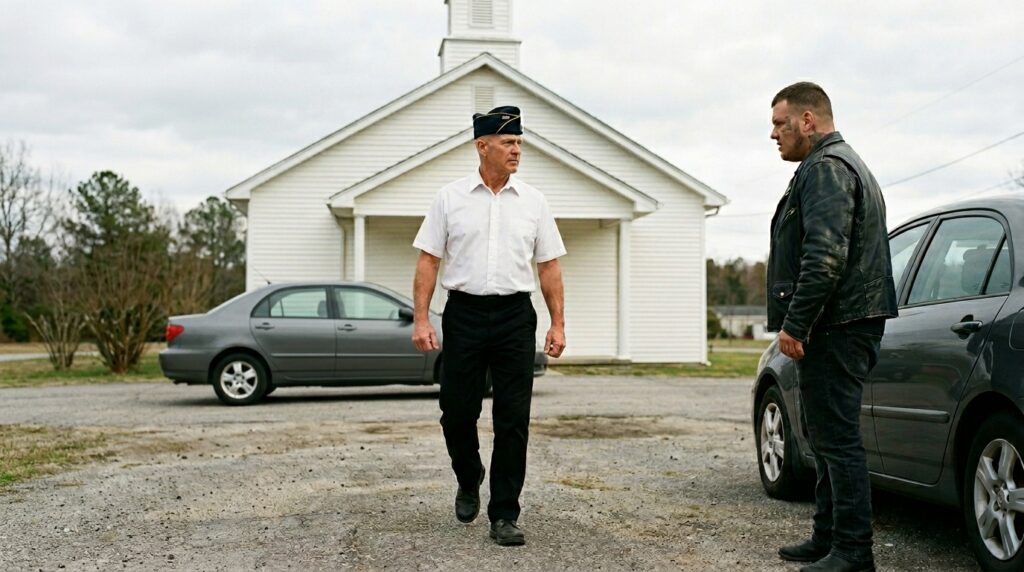
He stepped back from the footing, his boots making a dry, granular crunch in the frozen shale dust. He didn’t have his dark veteran cap on today; he wore a thick wool watch cap pulled low, shading his eyes into a cold, dark crease.
Across the road, where the iron gateposts had been cleared away, the county asphalt was empty. The deep, parallel ruts Vance’s flatbeds had gouged into the road shoulder were filled with gray ice now, the surface hard as iron and slick with frozen silt. The world had gone quiet, the large machines and the state sedans having pulled back across the river before the first frost, leaving the valley to its own geometry.
David reached into his pocket, his fingers tracking the square head of a new iron bolt he’d found in the cooperative scrap bin—not the old tractor bolt he’d lost under the floorboards, but a blunt, heavy piece of structural iron that smelled of cold machine grease. The sanctuary was smaller now, stripped of its white paint and its official leases, reduced to thirty feet of raw limestone and twenty-eight people who had to cut their own stone just to keep the roof from sliding into the ditch.
“Grab the iron bar,” David said, his hand coming out of his pocket to take the weight of the sledge again. “We have three more blocks to set before the light leaves the flats, and the frost is already locking the mortar.”
He didn’t wait for the deacon to pull himself up from the iron sheet. He turned back to the footing, his boots planted in the gray mud of the ditch, his mind tracking the slow, regular thud of a distant ax cutting firewood along the creek line.








