
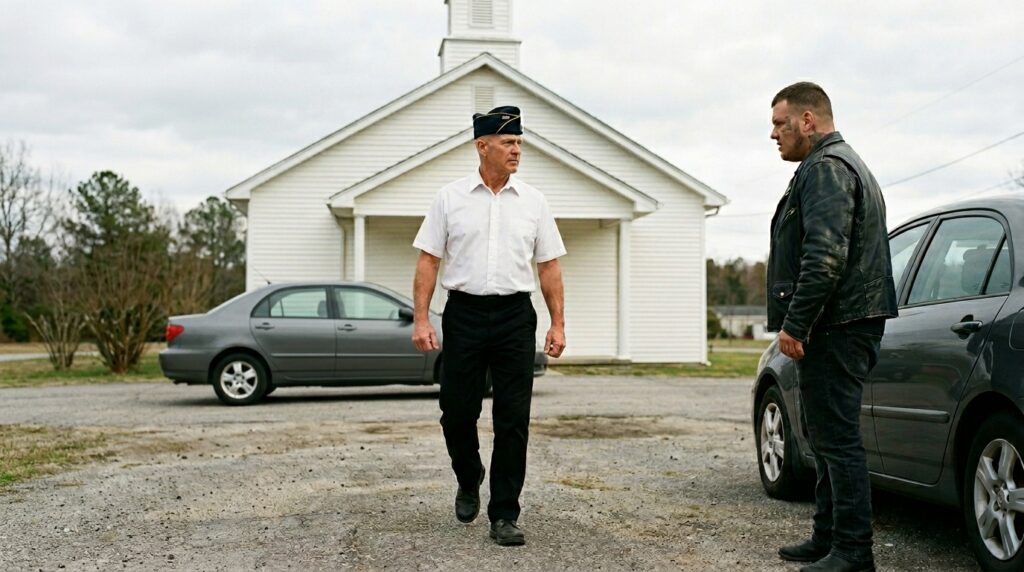
CHAPTER 7: THE BLACKOUT ARCHITECTURE
The electrical alcove beneath the parish hall’s north foundation smelled of dead wasps and cold slate. David pressed his back against the rough limestone wall, the coarse lime dust scratching through the cotton of his shirt as he slid toward the main commercial disconnect box. Outside, the rhythmic snip-snip of high-tensile wire cutters chewing through the overhead lines vibrated through the structure’s structural iron beams.
He reached out in the absolute blackness. His fingers, calloused and mapped by years of physical maintenance, found the cold vertical handle of the three-phase industrial breaker. The iron casing was thick with orange corrosion that flaked off under his fingernails, leaving a bitter, metallic powder on his skin.
This grid wasn’t a standard public service link. It was an old industrial feeder line left over from the defunct limestone quarry project of ’94, routed through a heavy oil-cooled step-down transformer bolted straight into the church’s sub-floor. David didn’t pull the switch yet. He waited, his ears tracking the heavy, rhythmic thud of boot heels directly on the floorboards above his head.
Vance’s reclamation crew had entered the parish office.
“Check the floor vents,” a muffled voice commanded from above. The wood groaned under a heavy, disciplined stride. “The Colonel wants the archive crates from the ’95 inventory. If the old man didn’t bury them in the cemetery, they’re under the floorboards.”
David took the iron tractor bolt out of his pocket. He didn’t use it as a weapon; he used it as a shim. He jammed the blunt iron threads deep into the mechanical interlock sleeve of the transformer housing, locking the manual bypass armature in the closed position. Then, with a single, short thrust of his heel, he slammed the main high-voltage disconnect handle downward.
The contactors separated with a deafening, metallic clack that sounded like a rifle shot inside the stone vault.
A blue, blinding arc of electrical fire flashed within the steel cabinet, illuminating the damp corners of the foundation for a fraction of a second. The smell of hot copper and bitter, scorched ozone filled the alcove instantly. Upstairs, the sudden, violent surge pulled eighty amps of current directly through the auxiliary generator link Vance’s men had tried to hook up, shattering the portable unit’s voltage regulator with a loud, wet pop.
The entire church perimeter went black. The low-frequency rumble of the office light fixtures died, replaced by a dense, unyielding silence that smelled of dead oil.
“Power’s down!” a voice shouted from the hall above. “The transformer blew out from the inside! Get the flashlights up!”
David didn’t wait for the beams to penetrate the floor vents. He moved through the darkness of the crawlspace, his hands guiding him along the rusted iron water mains that fed the baptismal pool. He knew every structural failure in this foundation; he knew which joists were soft with dry rot and which iron supports could bear weight.
As he reached the narrow access hatch leading into the rear vestry, his hand brushed against the transformer’s mounting plate. Even in the dark, his fingers registered the shape of a stamped brass serial tag bolted to the iron sleeve. It wasn’t a public utility identification marker. His fingers traced the raised letters, reading the crisp, unweathered stamping by touch alone: PROPERTY OF US ARMY LOGISTICS COMMAND – FOURTH BATTALION DESIGNATION.
The cold grit in his throat felt like sand. The church hadn’t been built on simple public land; the foundation itself had been anchored onto a de-registered military fuel depot framework from thirty years ago. The deacon hadn’t just laundered cash; he had been paying the maintenance fee on a sealed government asset that Vance had spent three decades trying to erase from the federal ledger.
David shoved the hatch upward, the dry pine boards creaking as he stepped into the pitch-black corridor behind the altar. Outside, the glare of tactical flashlights began to cut through the stained glass windows, throwing jagged, desaturated patterns of blue and red light across the white wooden pews.
He could hear Vance’s boots on the exterior gravel, slow and unhurried, moving toward the front doors. The dark wasn’t an obstacle to the Colonel; it was an environment he had spent his entire life management-tracking. David tightened his grip on the pry-bar, his body heat rising against the cold starch of his collar as he stepped out from behind the pulpit to meet the sound of the iron latch clearing the door frame.








