
CHAPTER 20: THE UNRUSTED BALANCE
The limestone bulkhead didn’t burst; it sheared with a dry, grinding scream that forced a cloud of grey mortar dust through the gaps in the floor ventilation grates. Above them, the church floorboards gave a sharp, splintering pop as the center aisle settled another two inches into the limestone shelf.
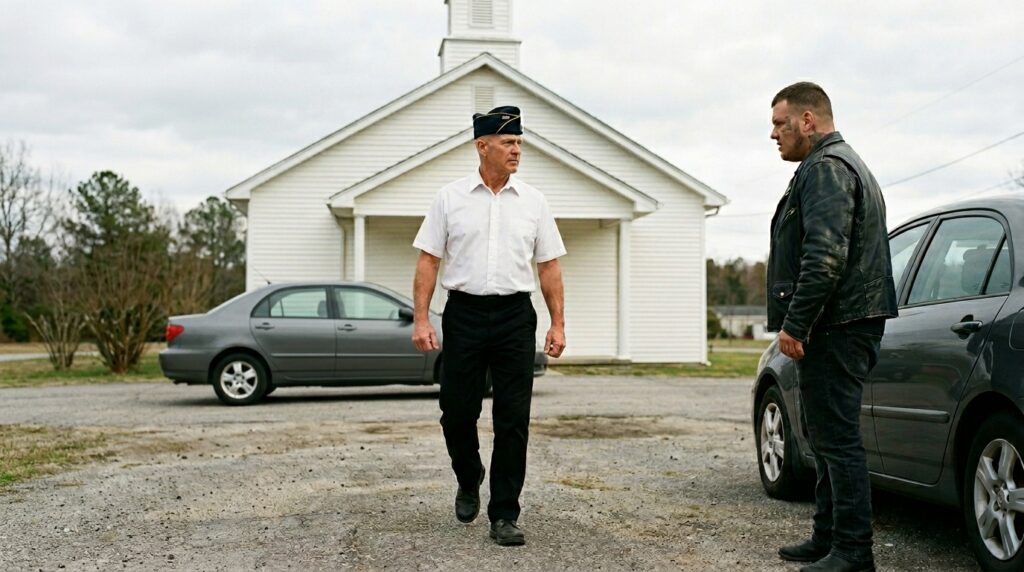
David didn’t pull his hands from the jammed armature. His boots were buried to the ankles in the cold, thick lime slurry rising from the subterranean floor, the watery mud smelling heavily of sulfur and rotten zinc. Across the flooded crawlspace, Colonel Vance stood motionless, his heavy canvas coat soaked through at the hem, his eyes tracking the gray tracks of liquid mortar running down the structural iron beams.
“The inventory is locked, Colonel,” David said, his voice level, carrying the flat cadence of an executioner’s log. “The pressure is gone.”
Vance took a slow step forward, his feet making a wet, heavy splash in the gray mire. He didn’t look at the jammed valve; he looked at David’s hands, where the purple bruise across the knuckles was white under the pressure of his grip. “The structural cap was rated for twenty years, David. We both knew the ledger was running on borrowed cement when we turned the keys over in ’95.”
“The parish stayed on the land,” David said. He reached down into the mud, his calloused fingers wrapping around the square head of the old iron tractor bolt. The threads were stripped bare now, the red scale completely replaced by a smooth, grey coat of lime paste. “They didn’t buy your surplus, and they didn’t run your collection house. They grew the wheat.”
“They ran on the scrap we left in the fire shed, Sergeant,” Vance replied, his voice dropping into the quiet, rhythmic register of an old field officer whose logistics lines had been cut at the border. “Every axle pin they used to haul the sacks came out of the 4th Logistics surplus. You didn’t build a sanctuary, David. You built a salvage pen, and you used my manifests to keep the fence posts from sagging.”
A sudden, concussive crack traveled through the limestone shelf beneath their knees.
The sub-surface water main, jammed into the mechanical interlock sleeve, buckled completely under the weight of the settling hill. The iron pipe split length-wise, a violent, lukewarm spray of sulfuric water hitting the stone wall with a loud, hissing roar that instantly filled the crawlspace with grey mist. The water level rose three inches in a dozen heartbeats, swirling around the base of the dead transformer.
David didn’t reach for the ladder. He braced his shoulder against the iron water main, using his own weight to hold the splitting timber joint against the shifting wall. Through the rising steam and mortar dust, he could see the underside of the main well ledger cover hanging from the joist above Vance’s shoulder. The wood was rotten, but the stamped metal indentation remained visible—the canceled federal reclamation lease number from 1996, matching the numbers on the files Miller had left on the desk.
The final accounting was clear. The baseline truth wasn’t an extraction or a defense; it was a mutual containment. Vance had spent three decades trying to reclaim the inventory to hide the structural failure of the ’95 cap before the state discovered his private salvage line. David had spent thirty years patching the wire to keep the town from finding out that the white church was the only thing stopping the hill from sliding into the irrigation ditches. They were both targets on the same ledger, tied to the same rotten timbers by a common scar.
“The line is closed, Colonel,” David shouted through the hiss of the water. He pulled the nickel key from his pocket and threw it into the gray silt around the transformer base. “Get your men off the bridge.”
Vance didn’t pick up the nickel. He stood in the gray darkness, the light from the deacon’s lamp above casting his long shadow across the white lime mud like a vertical slash. He gave a single, rigid nod—the formal, unyielding signal of a commander acknowledging a terminal report. He turned toward the masonry exit, his boots making a heavy, drag-shuffling sound through the rising water as he crawled out into the yard, leaving the dark below to the old sergeant and the water.
David stayed by the valve until the grinding in the stone stopped. The water didn’t rise further; it began to drain out through the floor fractures, sinking deep into the limestone aquifer where the old ledger mush was already turning to silt. When he finally climbed out of the trapdoor into the parish office, the noon sun was cutting a sharp, desaturated rectangle through the door planks.
Deacon Thomas was gone from the corner chair. The office desk was empty, the manila folders and the green filing box missing from the sun-bleached wood. Through the open window, the sound of the gasoline engine had died away, replaced by the low, regular rumble of the three-ton farm trucks moving slowly along the northern bypass road, their gears grinding with a heavy, productive iron clatter as they hauled the first load of winter wheat toward the mill.
David walked out onto the porch, his boots leaving gray, pasty tracks on the dry cedar boards. He didn’t wash his hands, and he didn’t adjust his cap. He reached into his trousers pocket, his fingers settling around the empty space where the tractor bolt had been. His hand came out empty, his palm rough, grey with lime, and lined with old scars that would never clean out. He walked toward the western fence line where the barbed wire was still sagging, his eyes locked on the horizon where the road met the sand.








