
CHAPTER 5: THE DUSTY RECKONING
“They’re crossing the creek wash,” Thomas whispered. The old shotgun barrels clicked against the corrugated iron siding, his hands shaking so violently the metal rattled like dry teeth.
David didn’t look at him. He stood by the broken side door, his boots planted firmly in the lime dust. The vibration came through the concrete floor first—a deep, low-frequency tremor that made the ancient grease-cans on the shelves dance and ping against each other. Then came the smell. It was the heavy, sulfurous stench of unrefined diesel, burning hot and dirty through the rusted manifolds of work trucks that had seen too many miles on backroads.
The four vehicles emerged from the heat haze like gray iron beetles. They weren’t standard commercial rigs. They were old five-ton military flatbeds, their civilian paint jobs peeling away in sheets to reveal the drab, matte-olive undercoats beneath. The lead truck had a massive steel push-bumper welded onto the frame, covered in orange-red oxidation that flaked off in long, bleeding streaks as it bounced over the ruts.
The convoy ground to a halt right at the church gates, their air brakes letting out a synchronous, deafening shriek that sounded like metal being torn apart on a lathe.
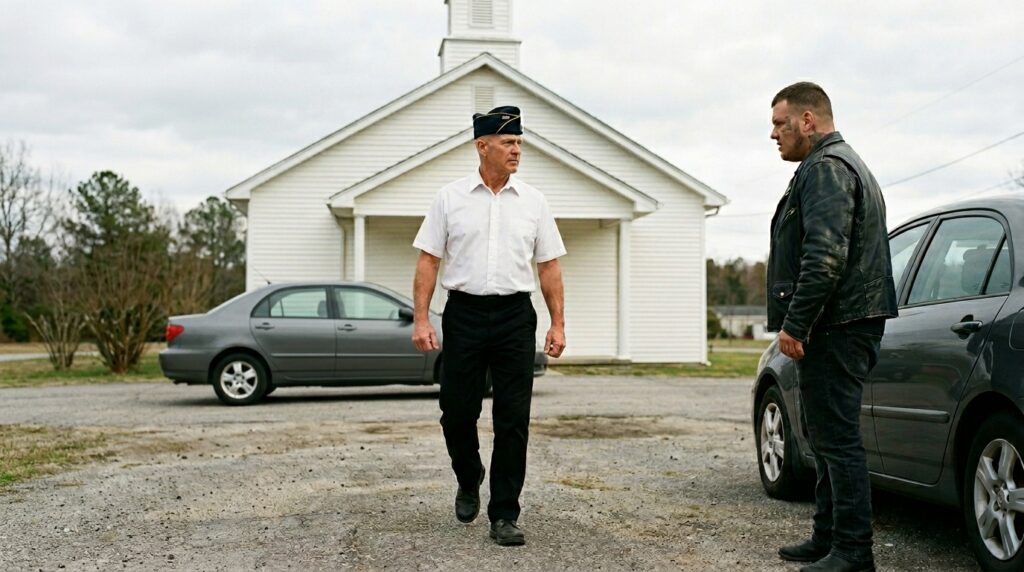
David stepped out into the open courtyard. The wind had picked up, sweeping across the shale hills, carrying a stinging grit that pelted his face and left a gray layer on his white dress shirt. He watched the lead truck’s cabin door groan open.
A man climbed down from the high seat. He wasn’t Miller. This man was older, his face lined with the sharp, deep creases of a person who had spent his life under canvas and high-altitude sun. He wore a faded, oil-stained utility coat, but his posture was flawless—rigid, unyielding, a perfect mirror of David’s own reflection. On his shoulder was a weathered patch, the thread frayed down to the backing, but the outline remained clear: the three-bar standard of a Colonel.
“Thirty years, David,” Colonel Vance said. His voice was a quiet rasp, easily cutting through the low rumble of the idling diesel engines. He stopped ten paces out, his boots sinking into the loose gravel where David had dropped the enforcer the day before. “You always did have a habit of digging in where the soil was worst.”
David felt the cold weight of the brassard clip in his hand, his thumb tracing the green oxidation. “The battalion was deactivated in ’95, Vance. You’re running a graveyard shift.”
“The battalion is exactly where I left it,” Vance countered, his eyes tracking the peeling paint of the church walls, his expression completely devoid of warmth. “On the ledger books. Everything has a salvage value, David. The trucks, the storage sheds, the people. The state wanted this basin forgotten. I just bought the rights to do the forgetting.”
“You used Thomas to squeeze them dry,” David said, his fingers tightening around the old iron tractor bolt in his trousers pocket. The metal was dead, cold, and heavy.
Vance let out a short, mirthless laugh that sounded like dry husks scraping together. “Thomas is a pragmatic man. He understood that a roof needs pillars, and pillars cost iron. But you… you always were the one element I couldn’t balance on the spreadsheet. You walked away from the logistics depot with forty tons of non-inventory hardware in your head. I couldn’t let that asset sit out here in the dust.”
The trucks behind Vance revved simultaneously, a cloud of thick, black soot billowing from their vertical exhaust stacks, blotting out the pale morning sun. From the beds of the flatbeds, men began to drop down onto the gravel—disciplined, quiet, carrying heavy iron pry-bars and bolt cutters. They didn’t move like criminals; they moved like a reclamation crew clearing out a junked yard.
David looked past Vance’s shoulder, his gaze locking on the lead truck’s steering column. Hanging from the ignition loop was a set of rusted, military-issue identification tags—David’s own missing tags from his final tour, items that had disappeared from the base headquarters the night he took his discharge papers.
The reality hit him with the slow, crushing friction of a landslide. This wasn’t an expansion of a predatory enterprise. It was an extraction. Vance had spent months grinding the local parish into pieces for the sole purpose of creating an ignition point—a conflict loud enough to pull David out of his silent routine and back onto the grid where his past could be permanently audited and closed.
“The inventory is settled, Colonel,” David said, his voice dropping into a register that was completely flat, completely empty of fear. He took one step forward, his boots crushing a piece of fallen iron wire beneath his heel with a crisp, final snap. “The threshold stays exactly where it is.”
Vance didn’t draw a weapon. He simply raised his left hand, his fingers forming a sharp, decisive signal that the drivers behind him understood instantly. The lead truck’s engine roared, the transmission grinding with an iron shriek as the heavy tires began to churn through the gravel, heading straight for the white church doors.








