
CHAPTER 15: THE NORTH CUT MODIFICATION
The iron sledgehammer hit the anvil block with a dry, concussive clink that traveled straight through David’s elbows and into his teeth. Beneath the chassis of Miller’s uncle’s grain truck, the dirt was cold, smelling of ancient crankcase leakage and parched shale that had never seen a winter rain.
“Hold the pry-bar steady, Thomas,” David muttered, his voice muffled by the low clearance of the oil pan.
The deacon didn’t answer with words. The iron bar in his thin hands gave a rhythmic, metallic chatter against the leaf-spring hanger. Thomas’s face was inches from the rusty frame rail, his gray wool cardigan already ruined, dark with streaks of black grease that had dripped from the truck’s auxiliary transmission housing. He was breathing hard, his chest rattling like a loose fan-belt under his shirt.
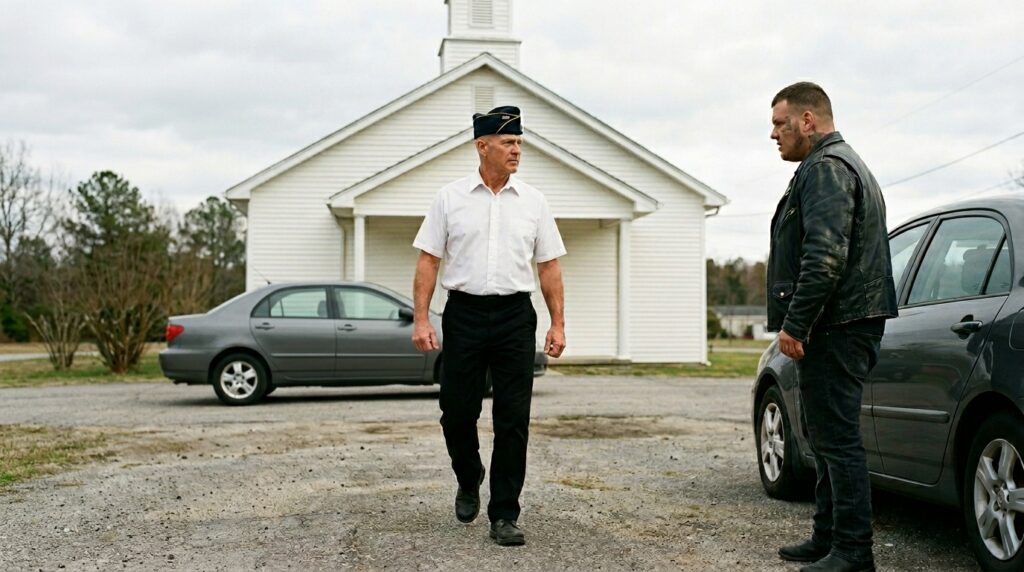
David adjusted his stance in the dirt. He was wearing an old, oil-soaked denim jacket today over his gray work trousers, the white dress shirt from Sunday tucked away in the church vestry like a uniform from a war that had moved across the river.
The task wasn’t standard vehicle maintenance. The old three-ton farm trucks of the cooperative had been built to run on the flat, hard-packed asphalt of the county highway. To clear the twelve miles of unpaved limestone shelf along the north cut—where the ruts were deep enough to high-center a tractor—the front axles needed to be raised two inches, and the steering knuckles had to be shimmed with whatever scrap iron could survive the impact.
David picked up a thick steel washer he’d cut from the hinges of the storage shed bypass door. It was pitted, rough with red zinc oxidation, but the thickness was right. He drove it into the steering column gap with three short, functional blows of a ball-peen hammer.
“The clearance is up,” David said, sliding out from under the oil pan, his boots dragging through the shale dust. “Tighten the U-bolts until the threads bottom out, then wedge a second nut behind them.”
The farmer, old man Miller, was standing by the truck’s rear duals. He didn’t look at the raised frame; he was turning a heavy, weathered hydraulic jack over in his grease-stained hands. The steel cylinder was stamped with a row of five vertical notches—the identical marking David had found on the nickel key inside the church vault.
“This didn’t come from the cooperative store, David,” Miller said, his thumb tracing the notch work. “My boy found three of these jacks in the back of the town fire shed last winter. They were locked in a grease-crate with the state road stamps.”
“They’re standard supply items,” David said, his hand sliding into his pocket to find the iron tractor bolt. “They function the same regardless of who stamped the ledger.”
“They don’t function the same when the county sheriff is sitting at the crossroads with an inspection log,” Miller countered, pointing a grease-blackened finger toward the northern ridge where the shale road twisted into the scrub flats. “The sheriff doesn’t care if the wheat reaches the mill, David. He cares about the weight-limit on the bypass. He’s already turned back two rigs from the lower creek because their identification tags didn’t match the agricultural cooperative listings.”
David looked down at the brass serial tag on the jack cylinder. It wasn’t an agricultural tool; it was a high-capacity field lift from the ’95 logistics reserve—the same inventory Vance had tried to extract with his flatbeds. The enterprise hadn’t just infiltrated the church books; its hardware had been distributed throughout the parish for ten years, woven into the very machinery the town used to harvest its bread. The town was running on the salvage of its own executioner, and the audit was moving closer to the gate with every mile they hauled.
“Load the trucks to eighty percent capacity,” David said, his voice dropping into the flat, final cadence of a logistics sergeant on a supply route. “If the sheriff checks the springs, tell him the balance is logged under the parish emergency fuel lease. If he wants the manifest number, tell him to come to the white gate and ask me.”
He didn’t wait for Miller to answer. He turned back toward the tools, his calloused fingers picking up a rusted adjustable wrench that had been sitting in the dirt since the morning shift began, his mind tracking the dust cloud rising from the county ridge where the first state vehicle was clearing the river bend.








