
CHAPTER 2: THE CORROSION OF SACRED GROUND
“You shouldn’t have laid hands on him, David.”
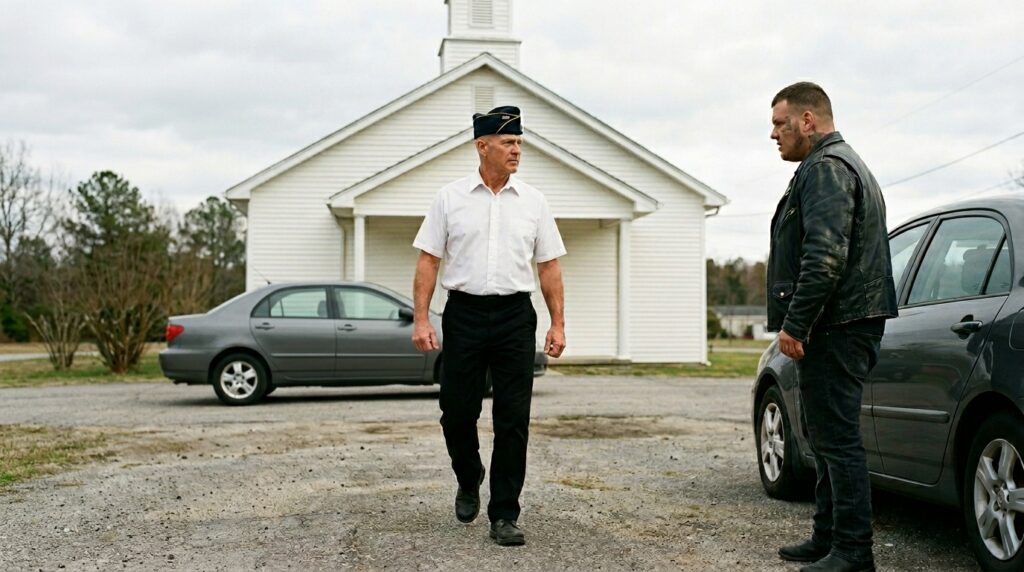
The voice didn’t come from the gravel where the enforcer had crawled back into his dark sedan, leaving a slick of black oil and a pair of deep tire ruts in the parched earth. It came from the shadow of the white church doors. Deacon Thomas stood there, his fingers tucked into the pockets of an oversized wool cardigan despite the sweltering valley heat. The wool was fraying at the cuffs, the gray threads thin and caked with the fine, microscopic silt that blew off the abandoned lime kiln up the road.
David didn’t look up from the well-pump. He pressed his weight down on the iron handle. The metal was pitted, rough with patches of red scale that scraped against the palm of his hand with a sharp, dry screech. It took three heavy strokes before the pump bit, spitting a violent, rusty brown stream into the dust before clearing into something lukewarm and transparent. He held his knuckles under the stream, watching the thin pink ring of another man’s blood dissolve and sink into the thirsty ground.
“He was on church property,” David said. His voice carried the dull weight of a grinding stone. “The gate was closed.”
“Property lines don’t keep the rain off, and they don’t stop the bank,” Thomas said, stepping down onto the cracked concrete apron. His boots made a dry, scraping click against the grit. He looked toward the county line, where the highway vanished into a shimmering lake of heat distortion. “That boy belongs to Miller’s crew. They don’t lose arguments, David. They just buy the judge who handles the eviction.”
“Let them try.” David pulled his hand from the water, wiping his palm across the thigh of his trousers. The fabric was coarse, stiff with salt and old sweat. He turned his attention to the roadside where the sedan had been idling. A small puddle of transmission fluid was already baking into the gravel, iridescent and toxic. But it wasn’t the oil that kept his eyes fixed; it was the memory of the leather-bound logbook he’d glimpsed through the glass. The corner of the cover had been scarred by a distinct three-line stencil—the marking of the 4th Logistics Battalion. His old branch. An outfit that hadn’t deployed a logistics unit in thirty years, let alone sent one to rot in a dying agricultural basin.
Thomas let out a dry, rattling cough that sounded like pebbles in a tin can. “You think because you wore that uniform you can just draw a line in the sand and call it a fort? Look around you, David. Look at the paint on these walls.”
David looked. The stark white exterior of the church was peeling in long, curling ribbons, exposing the gray, weathered pine beneath like old skin coming off a bone. The sun was eating the structure piece by piece, just like the predatory loans were eating the smallholdings along the creek. Every fence line in the parish was sagging; every tractor was being run on bootleg agricultural diesel and prayer.
“The church is paid for,” David said, his fingers tightening around the rusted iron pump handle until the metal bit into his skin. “We cleared the mortgage back in ’24.”
Thomas didn’t answer right away. He reached out, his hand settling on the church’s wooden door frame, his thumb tracing a deep fracture in the timber where the foundation had settled an inch into the limestone shelf. There was a strange, guarded stiffness in the old man’s shoulders—the posture of a sentry who knew the password had changed but hadn’t been told the new one.
“Leases change, David,” Thomas murmured, his eyes tracking a crow that circled low over the dry irrigation ditch. “Sometimes the people who hold the paper don’t live in the county. Sometimes they don’t care about the name on the door.”
“Who holds it, Thomas?” David stepped away from the well, the distance between them shrinking until he could smell the mothballs and old tallow on the deacon’s sweater. “The boy said the parish pays. Who are we paying?”
A heavy, transactional silence settled over the courtyard. A gust of wind caught the rusted iron gate, swinging it an inch until the latch ground against the post with a dull, metallic groan. Thomas looked down at his shoes, his mouth working silently as if he were calculating the exact cost of every word before letting it cross his teeth.
“You go digging in the dirt around here,” Thomas whispered, his voice catching on the dry air, “and all you’re going to find is old iron and teeth. Go home, David. Wash that shirt. Come back for Sunday service and leave the road to the people who own it.”
The deacon turned, the heavy oak doors groaning on their hinges as he retreated into the cool, dark belly of the sanctuary, leaving David alone with the heat and the smell of sulfur from the well. David stood still for a long moment, his hand resting on the pocket where the iron bolt lay cold against his skin. He didn’t go home. He walked toward the highway, his boots sinking into the soft tar of the shoulder, his mind locked on the stencil in that dark sedan. The enforcer would come back, or someone bigger would take his place. He needed to find that car before it reached the county line.








