
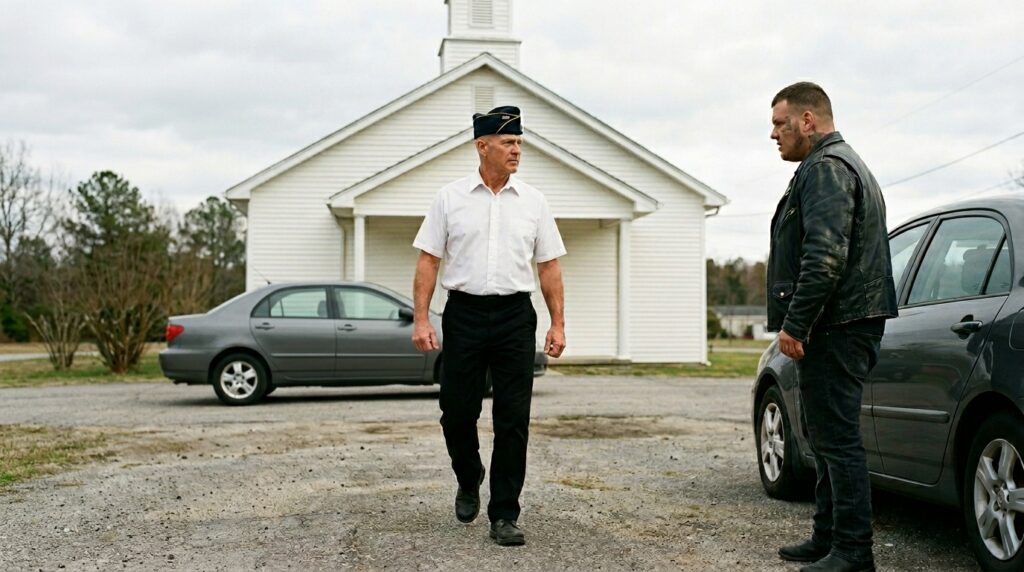
CHAPTER 17: THE BORDER PERIMETER
“Turn the engine off, Sheriff.”
David didn’t raise his hand to block the red and blue strobe light bouncing off the peeling white planks of the church eaves. He stood precisely where the rusted iron gate latch had been ground into the gravel by Vance’s trailing trucks. The night had turned sharp, the high valley wind cutting through his denim jacket, bringing the bitter, dry scent of alkaline dust and elderberry sap from the dry creek bottom.
The lawman didn’t move his hand from the wheel of his four-wheel-drive cruiser. The vehicle sat idling, its exhaust pipe spitting a sour, pale mist that dissolved instantly into the freezing dark.
“I have three duplicate manifest sheets from the county clerk’s office, David,” Sheriff Briggs said, his voice coming through the cracked window like gravel shifting in a tin pan. He reached across the console, pulling a single white paper slip from a metal citation book. The corner was marked with a wet, fresh municipal tax-lien stamp, the purple ink dark under the dashboard dome light. “Vance’s salvage outfit filed an injunction at the district court before they crossed the river. They aren’t claiming the hardware under the floorboards anymore. They’re claiming the right-of-way on the water line.”
David took two steps forward, his boots making a dry, crunching click against the limestone grit. He could see the duplicate manifest through the glass—the column headings were a precise, carbon-copy match of the ’95 logistics ledger sheets he’d dropped down the well shaft.
“The water line follows the public easement,” David said, his voice dropping into the flat, unyielding register of an outpost guardian. “The county signed the maintenance lease back when the lime kiln went dry.”
“The county sold the lease to Sovereign Supply three hours ago to cover the regional node deficit,” Briggs countered, shoving the car door open. The iron hinge gave a long, high-pitched scream that cut through the whistling wind. He stepped onto the road shoulder, his leather belt creaking under the weight of his sidearm and heavy flashlight. “I’m not here to pull your fence posts, David. But I have an order to gate-chain the well-head until the state inspector verifies the inventory volume. If the valve is turned down in the cellar, the county considers it property destruction.”
“The valve stays exactly where I set it,” David said. His hand went into his pocket, his knuckles grinding against the hard, square edges of the iron tractor bolt. The metal was cold now, completely dead to his touch.
Thomas emerged from the side alcove of the parish house, his wool cardigan pulled tight across his chest, his boots shuffling through the gray dust. He didn’t look at the sheriff; he looked at the purple ink stamp on the white paper slip in Briggs’s hand.
“They’re going to block the grain trucks at the bridge anyway, aren’t they, Briggs?” the deacon asked, his voice shaking until his teeth clicked on the cold air.
The sheriff didn’t answer right away. He looked past David toward the darkened windows of the sanctuary, where the red light of his cruiser’s strobes painted the glass like wet ink. “Vance has two heavy wreckers parked at the rail spur. If the well doesn’t feed the lower repository tanks by morning, the pressure drop is going to cave the old limestone vault under the north road. If the asphalt drops six inches, the county closes the bypass for structural hazard. Nobody hauls wheat across the line then.”
The equation was complete, every balance line checked and verified. Vance hadn’t lost his footing when his flatbeds were turned back; he had simply used the state’s own infrastructure bureaucracy to force David into a corner where his restraint was the very tool destroying his sanctuary. If he held the boundary, the town starved on its own side of the river. If he gave up the well, the old logistics battalion inventory became Vance’s property, and the white church would be nothing more than a private salvage depot.
“We haul on foot then,” David said, his voice carrying the final, absolute weight of an anchor dropping into shale. He didn’t look at the sheriff’s order. He turned his back on the red strobe glare, walking toward the equipment shed where the iron pry-bars were stacked against the wall. “Thomas, get the grease-buckets out of the hall. We have twelve miles of wire to splice before the sun hits the ridge.”
Briggs didn’t pull his sidearm, and he didn’t drive his cruiser into the courtyard. He stood by the open door of his car, his leather belt creaking in the wind as he watched the old sergeant walk into the shadows of the broken gate, the desaturated gray landscape of the basin swallowing the outline of the white church until nothing was left but the sound of the wind scraping the lime dust against the timber.








