
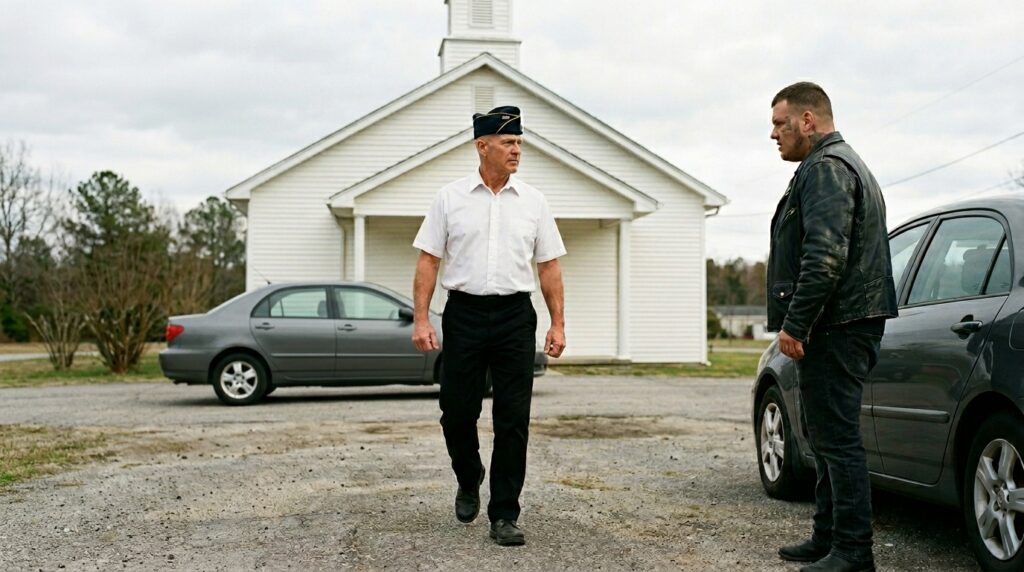
CHAPTER 19: THE SHIFTING FOUNDATION
The dry pine beams overhead didn’t just creak; they let out a short, hollow bark that sounded like an old dog jumping down from a high wagon.
David stood in the center aisle of the nave, his boots balanced on the seam where the center runner carpet met the rough limestone chancel steps. The vibration didn’t come from the road; it rose straight out of the bedrock, a slow, greasy grinding of stone on stone that made the heavy cast-iron floor registers ping inside their iron sleeves.
He knelt, his calloused palm flattening against the floor boards. The timber was cold, but the iron register grate near his knee was hot, vibrating with a high-frequency buzz that smelled sharply of stale sulfur water and burnt oil from the crawlspace below.
With a sharp, metallic clink, the iron register grate snapped neatly across its center line, a fresh, silver hairline fracture splitting the molded floral pattern right down the middle.
“David! The baptismal pool is empty!”
Deacon Thomas was shouting from the rear vestry door, his voice thin, rattling against the high rafter joists. He held an old kerosene hurricane lamp, the glass chimney blackened on one side by a high, dirty flame. The light threw jagged, jumping shadows across the white-washed walls, illuminating the long ribbons of peeling paint that had begun to drop from the ceiling like dead leaves.
David didn’t go to the pool. He stepped down into the electrical crawlspace hatch behind the pulpit, his boots finding the rungs of the ladder by habit alone.
The air inside the foundation vault was thick, pressurized, smelling of wet mortar and old lime that had been trapped under the floorboards since the ’95 deactivation. The oil-cooled transformer casing was dead, but the sub-surface stone wall behind it—the heavy limestone bulkhead that capped Designation 40-B—was weeping. A thick, grey slurry of liquid lime and sand was bubbling from the mortar joints, running down the stone face in pale, iridescent tracks that collected in a pool around his ankles.
The pressure drop in the lower balancing tanks was pulling the well water out of the limestone shelf faster than the pump could supply the head-pressure. The hill was settling into the empty cistern spaces Vance had tried to clean out.
David took the heavy iron tractor bolt out of his jacket pocket. The metal threads were choked with grey paste now, the red scale completely rubbed away by the constant friction of the sub-floor gate valve. He braced his shoulder against the rotting cedar frame of the main main, his fingers locking onto the manual armature handle he’d jammed into the housing on Sunday.
The valve wouldn’t turn backward. The internal gates had buckled under the weight of the shifting shale above the vault, locking the mechanical linkage into a single, permanent distortion.
“It’s settling from the south side, Sergeant.”
The voice didn’t come from the ladder. Colonel Vance stood at the edge of the masonry opening, his gray baseball cap missing, his hair silver and flat against his skull in the dim spill of the deacon’s lamp. He wasn’t carrying a sidearm or a manifest folder. He wore a heavy, grease-covered canvas work coat, his sleeves rolled up to reveal forearms that were thick with old scar tissue and white lime dust.
David didn’t lift his pry-bar. He kept his weight on the jammed armature, his breath slow, his eyes tracking the fresh cracks spreading across the limestone bulkhead behind the Colonel’s shoulder. “The bridge is still locked, Vance. Your trucks aren’t moving the iron across the creek.”
“The trucks are uncoupled,” Vance said, his voice level, carrying the flat cadence of an officer who had already accounted for the loss on the spreadsheet. He stepped down into the gray water around the transformer base, his boots making a heavy, wet splash that echoed off the stone vault. “The surveyor pulled the easement at noon, David. The state isn’t chain-locking the gate; they’re declaring the entire ridge a structural subsidence zone. By tomorrow morning, the county road doesn’t exist on the state maintenance map. We’re both sitting on a junked ledger.”
David looked at the brass serial tag on the transformer housing, the raised letters of the 4th Logistics Battalion fading under the grey coat of lime slurry. The final layer of the mystery was bare. Vance hadn’t targeted the parish to clear the old inventory; he had been trying to drain the lower vault before the structural failure of the ’95 cement cap dragged his own private scrap operation down into the shale shelf. They were two old men holding opposite ends of a broken lever, trying to balance a debit that had been written into the stone before the town had even run out of water.
“The line stays turned down, Colonel,” David said, his fingers tightening around the rusted iron bolt until his knuckles clicked in the dark. “If the road goes into the creek, the smallholders use the north cut bypass. We aren’t opening the valve to clear your yard.”
Vance didn’t reach for the linkage. He stood in the gray mud, his hands dropped into his coat pockets, his eyes fixed on the silver fracture running through the iron register grate above their heads. “The north cut is already sliding, David. The culvert dropped another three inches while you were hauling the sacks. We have twelve hours before the church wall follows the pipeline down into the wash.”








