
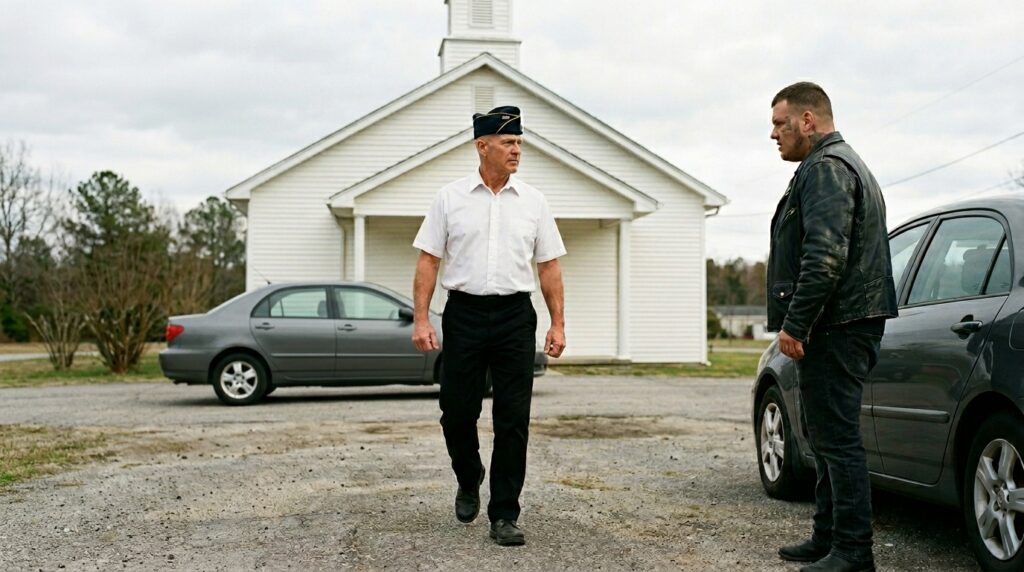
CHAPTER 10: THE RUSTED PULPIT
“The hymnals are ruined, David.”
Deacon Thomas didn’t look at the pulpit when he spoke. He was down in the third row, his small, blue-veined hands sorting through the water-logged pages of the old cloth-bound books. The heavy copper wires David had blown in the crawlspace had sweated through the floorboards, leaving a damp, iron-scented mist that had warped every timber in the nave. The pine pews were cold, slick with a fine coating of gray soot from the auxiliary generator’s brief, catastrophic failure.
David adjusted the stiff collar of his white dress shirt. The fabric felt restrictive, tighter than it had on Friday. He looked out over the assembly—twenty-eight people, fewer than half the standard congregation, their faces desaturated by the grey light filtering through the cracked stained glass. They sat in small, isolated clusters, their shoulders hunched into heavy canvas work coats, their boots caked with the white lime mud of the courtyard.
They weren’t looking at the altar. They were looking at David’s hands.
The skin across his right knuckles was dark, a purple-black bruise where the steering knuckle of the five-ton truck had kicked back against his pry-bar. It was an unvarnished marker of violence on a day meant for clean linen, a hard debit line visible to every family that had spent the last three months watching their property deeds disappear into Vance’s ledger.
“We will use the old texts,” David said, his voice dropping into the empty spaces of the sanctuary like shale sliding down a chute. “Page forty-two. The psalm for the boundary.”
No one turned a page. The silence in the room wasn’t the silence of prayer; it was the quiet, calculated stillness of an outpost waiting for the secondary perimeter to collapse.
At the back of the room, near the shattered entry doors that had been hastily blocked with two cross-braced pine planks, sat an empty bench. Someone had carved a series of jagged, vertical marks into the seasoned timber near the aisle seat—not a local name, but the long, nine-digit federal serial code that Vance’s logistics battalion had used to mark surplus infrastructure before the deactivation. The wood around the scratches was fresh, the white pine stark against the dark stain of the bench.
“David,” a man in the fourth row called out. It was Miller’s uncle, an old dry-land farmer whose tractor had been sitting in the equipment shed under a lien for six weeks. His fingers were stained with transmission fluid, the black grease permanently worked into the cracks of his skin. “Vance’s flatbeds are parked down by the rail spur across the river. They aren’t loading gravel, David. They’re waiting on the county surveyor to sign the public easement.”
“The easement is closed,” David said, his hand resting flat on the unvarnished oak of the pulpit. He felt the iron tractor bolt in his pocket click against his keys as he shifted his weight. “The property line was verified by the district court in ’24.”
“The district court doesn’t have an engineer on the payroll,” the farmer countered, his voice rising, scraping against the damp rafters. “Vance has two rigs sitting on the county bridge right now, checking the weight limit on the structural iron. If he drops those trucks across the river, the cooperative can’t haul the winter wheat to the mill. We’re locked in our own yard, David.”
Thomas stood up slowly, the water-damaged hymnal dropping back onto the pew with a dull, wet thud. He looked at David, his mouth working silently, his eyes wide with the frantic, exhausting calculation of a clerk who knew the final balance was already short. “We have to sign the temporary authorization, David. If we give them the storage sheds, they leave the bridge open. That’s what the surveyor told me at the crossroads.”
David looked down at the deacon, then at the twenty-eight pairs of eyes waiting for a tactical retreat. This was the true friction of the sanctuary—not the kinetic impact of the trucks against the iron gate, but the slow, corrosive willingness of a community to compromise its boundaries one inch at a time just to keep the heaters running for another month. They wanted him to be the sovereign protector, but they wanted the protection to be clean, to cost nothing more than a few signatures on a piece of official paper.
“The storage stays,” David said. His voice didn’t rise, but it carried the absolute, unyielding density of a concrete bunker cap. “If you give them the sheds today, they’ll ask for the well-pump on Tuesday. By next winter, you’ll be buying your own water out of the back of Vance’s tankers at two dollars a gallon.”
He stepped down from the pulpit, his boots making a hard, rhythmic strike against the floorboards that echoed through the dark nave. He walked down the center aisle, past the rows of soot-stained wood, straight toward the back row where the fresh serial code was cut into the bench. He didn’t look back at the altar or the deacon. He reached the pine planks blocking the door, shoved his shoulder against the timber, and stepped out into the blinding white glare of the courtyard, his mind tracking the sound of a strange, high-idle gasoline engine coming up the highway from the south.








