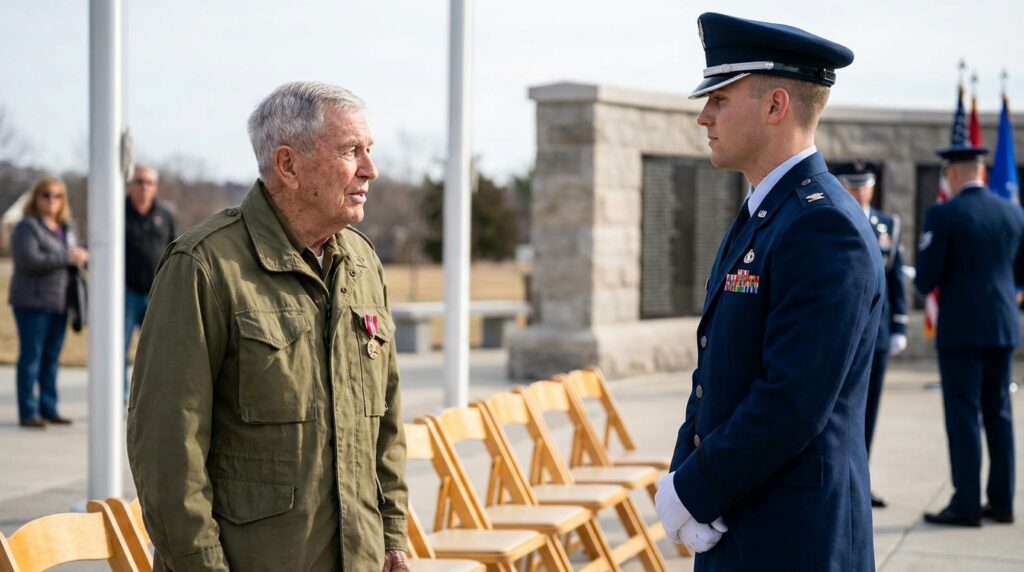
CHAPTER 1: THE PERIMETER RUG
“Step out of the queue, sir. The registration lane is closed to non-ticketed personnel.”
Preston Vance did not look up from the glass screen of his tablet. His index finger made short, precise swipes across the surface, illuminating a matrix of names, corporate table allocations, and military ranks. He spoke with the automatic, flat efficiency of a man who viewed human beings as obstacles to a clean spreadsheet. Around them, the lobby of the civic center smelled of expensive wool coats, floral arrangements, and rain tracking off the pavement outside.
Arthur Vance did not move. He kept his boots firmly planted on the edge of the plush burgundy carpet that marked the entrance to the main ceremonial hall. His hands were buried deep inside the pockets of his olive field jacket, his thumb steady against the cold, scarred edge of the brass lighter he kept tucked away. The fabric of his sleeves was stiff, clean, and faded to the exact shade of river moss. To the people passing him—the state representatives in tailored gray suits and the young junior officers whose shoulder boards caught the track lighting above—he was a gray fixture, an unpolished stone in a room full of glass.
“My name is on your list,” Arthur said. His voice was low, devoid of urgency, carrying the flat cadence of the midwestern plains.
Preston finally lifted his eyes. His gaze was diagnostic, taking in the frayed hem of Arthur’s collar, the lack of a laminate VIP pass, and the absolute lack of deference in the old man’s posture. Preston took a half-step forward, shortening the distance between them to use his height as a quiet leverage point.
“Sir, I run the entrance layout for the entire foundation,” Preston said, his voice rising just enough to turn the heads of a major general’s administrative staff waiting behind them. “If your name were on the registry, the digital terminal would have pinged when you cleared the exterior metal detector. It didn’t. This hall is reserved for registered dignitaries and honorees only. The public memorial is on the lower level near the concourse.”
The junior officers in the line behind them stopped talking. The silence grew outward from the velvet rope, cold and infectious. Arthur looked at Preston’s hands—the manicured nails, the pristine silver watch strap that shifted against a crisp white cuff. He didn’t see an enemy; he saw an unseasoned clerk who had never learned how to look at a man’s shoulders to measure his weight.
“Check the physical manifest,” Arthur said. He reached slowly into his interior breast pocket and pulled out a thick, legal-sized manila envelope. The paper was old, the edges reinforced with yellowing cloth tape. “The office in St. Louis sent the paperwork through the local liaison. It doesn’t use the code on your screen.”
Preston didn’t reach for the envelope. He let his tablet slide into the crook of his left elbow and tapped his communication headset twice. “Front gate security to the East entrance. We have a boundary issue with an unlisted individual blocking the VIP lane.”
The crowd shifted backward slightly, creating a five-foot crescent of clear tile around Arthur. No one spoke. A captain in dress whites adjusted his belt, his eyes fixed on the floor. Preston turned back to his screen, his posture rigid, completely dismissing the old man standing on the line. But when Arthur’s fingers uncurled from the manila envelope, a small, laminated plastic card slipped from the seam, fluttering face-down onto the glass screen of Preston’s digital terminal. It wasn’t an invite. It was a current-issue base clearance pass, but the name printed in red ink across the top did not belong to Arthur Vance.