CHAPTER 5: THE REVERBERATION CHAMBER
The amber light inside the main ceremonial hall didn’t warm the air; it only made the shadows between the rows of chairs look deeper. Arthur Vance kept his eyes focused on the center aisle, tracking the polished grain of the oak floorboards. Behind him, the double doors clicked shut with a heavy, magnetic thud, sealing out the lobby’s ambient noise. The absolute stillness of the room felt structural, an artificial vacuum designed to deaden the sound of incoming boots.
He walked toward the front row, his movements measured, his left hand slipped loosely back into his field jacket pocket. He no longer had his brass lighter to ground him, but his mind had already shifted into a cold, diagnostic assessment of the room’s geometry. Six aligned chairs on the raised platform. A single brass microphone stand. To his left, General Miller’s limp created an asymmetrical rhythm against the floorboards—two light steps, one heavy drag.
“The seats are cleared, Arthur,” Miller said, passing him to take a position near the lower step of the stage. He dropped his scuffed leather document case onto a small side table. The flap swung slightly open, the white adhesive edge of the intelligence agency label catching the sharp amber down-light. “We didn’t bring the public in for this part. The foundation wanted an audience, but I truncated the schedule.”
Arthur stopped at the edge of the platform. He didn’t look at the stage; he looked at the leather case. “You didn’t truncate it for the foundation, Thomas. You truncated it because the manifest I carried from St. Louis isn’t a historical archive. It’s an active ledger.”
Miller didn’t deny it. He stood perfectly square, his lined face catching the hard side-lighting from the wings. “The ledger became active the second Donald Vance opened the vault forty-eight hours ago. The board members outside think this is a routine correction for a clerical oversight from nineteen-seventy-one. They want a clean photo, a handshake, and a signed release for their endowment archives.”
“But Donald didn’t find a clerical oversight,” Arthur stated, his voice flat, a low vibration in the empty hall. “He found the extraction logs from the border post. The ones that list thirty-four names that never appeared on the official casualty rolls.”
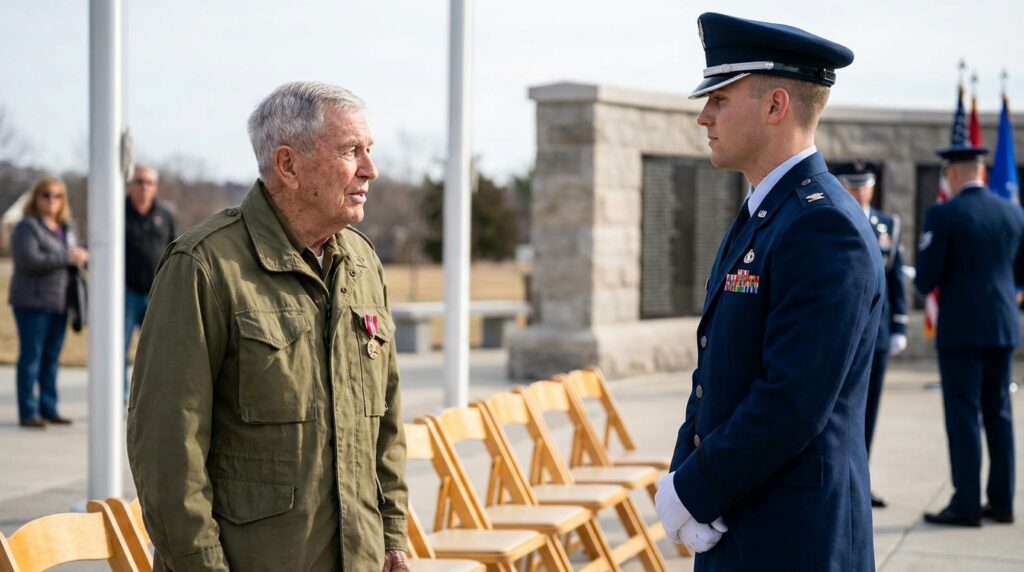
The young Uniformed Service Member stepped onto the carpeted platform from the left wing, carrying a small, velvet-lined presentation box. His white gloves were spotless, but his fingers held the edges of the box with an intense, calculated grip that didn’t match the rehearsed ease of a standard military escort. As he set the box down on the small table next to the microphone, the metallic contents shifted with a dry, heavy rattle—a sound that lacked the distinct ring of solid silver.
Arthur’s eyes narrowed slightly, tracking the specific weight of that rattle. He had handled enough field ordnance and survival gear to know the density of standard-issue decorations. The object in that box was too heavy; it had an added mass beneath the pinned ribbons.
“The presentation is ready, General,” the sergeant said. His voice was steady, but his eyes didn’t make contact with Arthur’s face. He kept his gaze fixed precisely one inch above Arthur’s left shoulder, hitting a rigid, artificial stance that felt less like tradition and more like a tactical hold.
“Preston is still outside trying to trace the digital loop,” Arthur said, turning his head slowly toward Miller. “He thinks I’m a security breach. But his software didn’t lock the terminal because the name was mismatched. It locked because the system detected a document signature that still holds active command authorization over the supply lines in Sector Four. My signature.”
Miller reached into his pocket and pulled out Arthur’s brass lighter, setting it down next to the presentation box. The metal clicked against the wood, a sharp, clean sound that seemed to draw the final boundary line across the scene.
“The authority doesn’t exist on paper anymore, Arthur,” Miller said softly, his voice dropping into a guarded, transactional cadence. “The extraction post was buried under three tons of concrete in seventy-three. But the logic of the orders remains. The agency needs the original manifest you carried today. They need the physical carbon copies with your ink signature to finalize the redaction files. That’s the price for the medal.”
Arthur looked at the sergeant, then back at Miller. The chess board was fully visible now. The public humiliation at the velvet rope hadn’t been an accident of civilian arrogance; it had been the first layer of an administrative filtration system. If he had broken under Preston’s pressure, if he had left the envelope behind or allowed security to escort him to the holding alcove, the physical records would have been isolated without a three-star general ever having to enter the room.
“You didn’t come here to honor the battalion, Thomas,” Arthur said, his hand tightening into a fist inside his empty pocket. His voice was a cold draft through the quiet room. “You came to buy the signature back before the logistics office realizes what Donald actually pulled from the vault.”
The sergeant took a half-step closer to the presentation box, his white-gloved fingers resting just an inch above the velvet edge, his weight shifting forward as the silence in the hall turned thick and absolute.