CHAPTER 6: THE RETRACTED FORCE
The sergeant’s hand suspended over the velvet presentation box did not shake, but the weave of his white glove stretched taut against his knuckles. The silence inside the hall had expanded until it possessed a heavy, physical density—the kind of stillness that precedes a kinetic breach.
Arthur looked down at the velvet bed. The service medal sat pinned to its backing, but the silver star at its center caught the amber down-lights with an unnatural, flat refraction. It was too thick by half. Within the small, hollow space between the silver face and the mounting clasp lay a microscopic storage cell—the digital kill-switch for the remaining unredacted databases of Sector Four.
“The signature isn’t for sale, Thomas,” Arthur said. His voice was very low, an unhurried drawl that cut through the vacuum of the room with the steady scrape of iron over stone. He didn’t look up at General Miller’s chest ribbons; he kept his eyes on the leather case on the side table, tracking the broken line where the missing lower hinge pin had left the raw internal lining exposed.
General Miller took a slow, deliberate breath, his shoulders shifting beneath the weighted epaulets of his service dress uniform. The left-sided hitch of his posture became more pronounced as he stepped closer to the microphone stand, his leather boots dragging across the floorboards with a dull friction.
“If the carbon files leave this building, Arthur, the names on that manifest will enter the public record within twelve hours,” Miller said, his voice dropping into a tight, diagnostic whisper that barely cleared the edge of the stage. “The logistics network will reconstruct the entire transit chain from seventy-one. They will trace the destination coordinates for those thirty-four men. You think you’re protecting a legacy, but you’re opening a vault that was meant to stay beneath the concrete.”
“I’m keeping the books straight,” Arthur replied. He reached forward with a slow, mechanical precision, ignoring the sergeant’s sudden defensive shift. His weathered fingers didn’t touch the heavy medal; instead, he reached past the velvet box, his hand closing around the old, torn manila envelope containing the carbon sheets. The paper felt stiff, cold, and heavy with the dust of the St. Louis archive. “The families of those men were told the records were lost in a warehouse fire. They weren’t lost. They were archived under an assumed procurement index so your foundation could draw funding from the recovery appropriations.”
The sergeant did not strike. He stood locked in his ninety-degree snap, but his eyes flicked toward Miller, waiting for the silent drop of a wrist or a tilt of the chin that would signal an intervention. Arthur observed the distance between them—exactly forty-four inches. He knew the timing required for a white-gloved hand to cover that space. He had spent his youth training men to close distances faster than a trigger could reset.
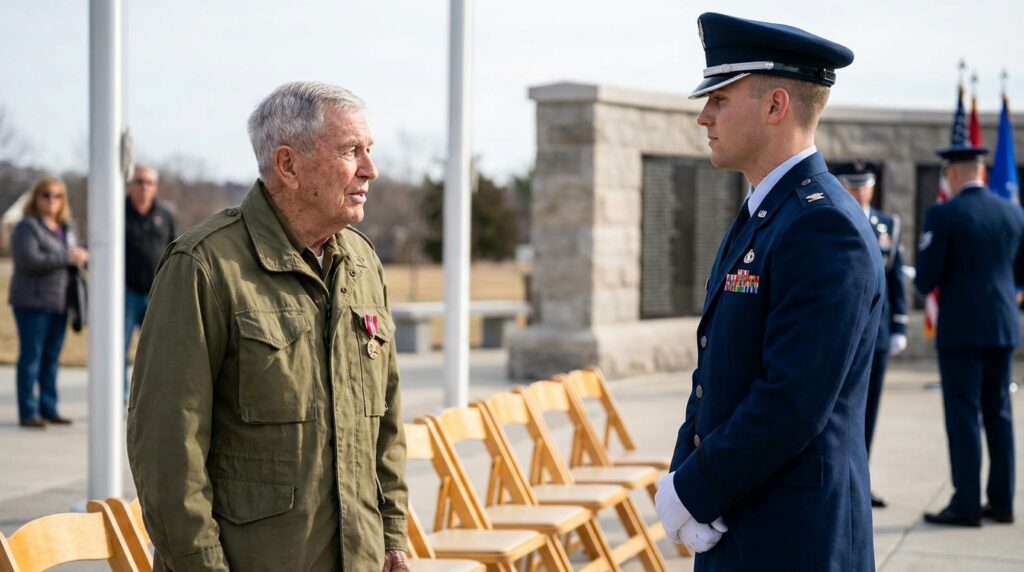
“The signature stays on the manifest, Thomas,” Arthur said, sliding the heavy packet into the deep internal breast pocket of his olive field jacket. The stiff canvas flattened against his chest, a solid, protective shield over the raw ink of 1971. “And your agency can keep the silver.”
Miller did not command the guards. He stood perfectly still by the side table, his hand resting near Arthur’s old brass lighter. The lines around his eyes looked deeper under the amber side-lighting, the stark, sharp illumination exposing the tactical exhaustion of a man who had spent his career managing secrets that had already outlived their operational utility.
“You won’t clear the exterior gate layout, Arthur,” Miller said, his voice devoid of anger, settling into a flat, professional assessment. “Preston has already initiated the system-wide audit code. The moment you step back onto the perimeter rug, the civilian security network will flag the manual entry override as an unverified security breach. They don’t need my authorization to lock the outer turnstiles.”
“They won’t lock them,” Arthur said, his voice flat and unyielding as he turned toward the center aisle. He adjusted the collar of his faded moss-green jacket, the rough fabric scraping against his lined jaw. “Because Donald Vance didn’t just pull the file for me. He pulled the server logs for the regional logistics division. He knows exactly who signed the electronic release for the foundation’s endowment last month. If the gate doesn’t clear when my boots hit the tile, the procurement audit goes to the federal oversight committee before the general’s staff finishes their lunch.”
The silence returned, absolute and unpunished. Miller did not call out. The sergeant stayed on the platform, his white gloves dropping back to his sides as Arthur turned his back on the stage, the aligned ceremonial chairs remaining empty and silent in his wake.
Arthur walked down the center floorboards, his boots making a steady, rhythmic click that echoed into the rafters of the empty hall. He didn’t look at the walls; he didn’t look at the high, polished glass of the upper view-galleries. He focused entirely on the heavy double doors at the far end of the transit lane.
When he pushed the brass handles outward, the cold, halogen glare of the registration lobby hit him like a physical draft. Preston Vance was still standing behind the glass partition, his fingers frozen over a dead terminal screen, his face entirely pale as the automated velvet ropes parted smoothly before Arthur’s advance. The security guards in charcoal gray uniforms stepped back into the shadows of the concrete pillars, their hands remaining clear of their duty belts, their eyes tracking the slow, upright stride of the old man in the faded olive jacket.
Arthur did not look at them as he cleared the exterior threshold. He stepped out into the rain, his fingers dipping into his pocket to touch the empty space where his lighter used to sit, his face settling into the cold, diagnostic calm of a commander who had just held the line one final time.