CHAPTER 2: THE COLD CORNER
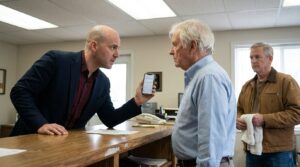
The plastic card hit the glass with a sharp, hollow click. It lay there, face-down, its modern barcode catching the harsh glare of the halogen track lighting above the registration desk. Preston Vance’s fingers froze a centimeter above his screen. The reflection of the red ink bled across the polished surface, cutting a clean, hard line through the digital grid of names.
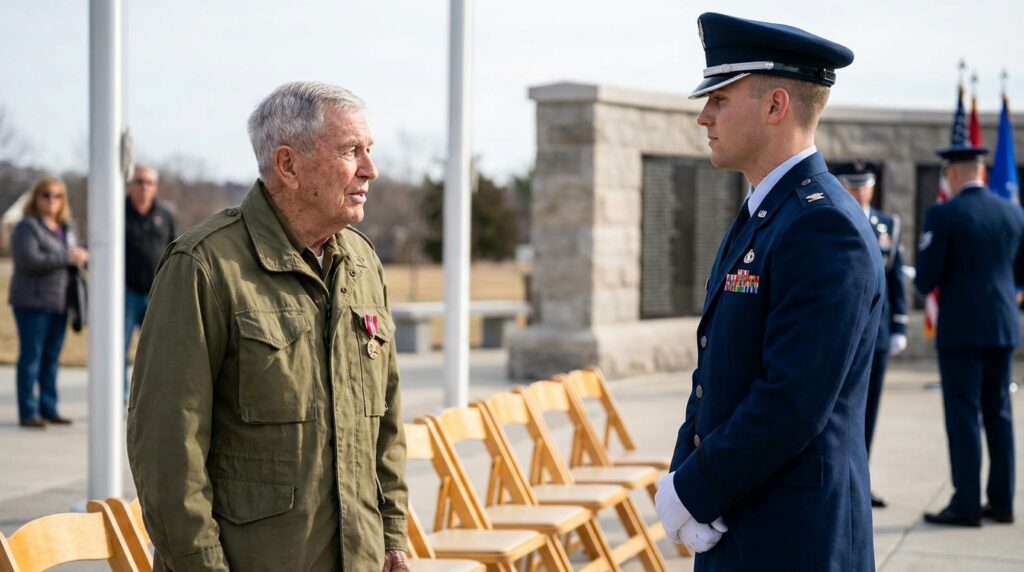
Arthur did not lean forward to retrieve it. He stood perfectly still, his weight evenly distributed across the balls of his boots, his hands remaining deep within the pockets of his olive field jacket. Through the heavy cotton lining, his thumb traced the cold, metallic edge of his brass lighter. He timed Preston’s breathing. Four short, shallow inhalations before the young man’s shoulders locked into a rigid, defensive square.
Preston used the tip of his luxury pen to flip the card over. The movement was fast, a sharp twitch of irritation masked as clinical inspection. When the name face up registered, Preston’s jaw tightened, the muscles along his jawline flaring beneath his smooth skin.
“Where did you get this?” Preston’s voice dropped into a sharp whisper, the corporate hospitality completely stripped away. He glanced toward the major general’s staff waiting behind Arthur, his eyes flicking like a cornered animal evaluating lines of sight. “This is an active-duty command clearance for Sector Four. And the name isn’t yours.”
“I told you to look at the paperwork inside the envelope,” Arthur said. His voice remained a flat, low rumble, a blunt instrument against Preston’s rising panic. He didn’t blink. He watched the way Preston’s thumb twitched against the edge of his sleek tablet—a clear tell of an administrative operator whose system had just encountered an unresolvable error code.
“This card belongs to a Captain Donald Vance,” Preston muttered, his voice tightening as he leaned over the desk, attempting to obscure the card from the view of the junior officers behind them. “That’s an active procurement officer with the regional logistics division. This event is under strict federal oversight, sir. Carrying mismatched, high-level credentials into a secure perimeter isn’t just a scheduling conflict. It’s a breach.”
Arthur observed the sharp angles of the registration desk, the way the glass partition created a physical barrier designed to make the civilian feel small, processed, and subservient. He knew the geography of desks like this; they were built by institutions to shield small men from the consequences of their choices.
“Then call the captain,” Arthur said softly. “Ask him who gave it to him.”
Before Preston could answer, the heavy tread of rubber-soled boots echoed against the marble floor. Two security guards cut through the crescent of the waiting crowd. Their uniforms were crisp, dark charcoal gray, their duty belts heavy with nylon pouches, cuffs, and the black polymer grips of their sidearms. They didn’t look at Arthur’s face; they looked at his jacket, his hands, and the space between his feet, calculating the physical effort required to move an old man who looked like he had rooted himself into the floorboards.
“Mr. Vance,” the lead guard said, addressing Preston while keeping his eyes locked on Arthur’s right shoulder. “We have a boundary issue?”
“Anomalous credentials,” Preston said, his confidence returning the moment the gray uniforms flanked the desk. He tapped the laminated card with his pen. “The individual is presenting non-transferable active-duty clearance passes that do not match his civilian identification. Clear the lane, please. Take him to the holding alcove behind the press risers until we can verify the source of the duplication.”
The lead guard took a step forward, his hand rising in a standard, non-threatening gesture meant to guide a compliant body away from a public space. “Sir, let’s step out of the queue. Walk with us.”
Arthur didn’t shift his stance. He let his gaze drift from Preston to the guard’s hand, noting the tension in the officer’s forearm, the way the fingers hovered near the retaining strap of his holster. It was an entry-level tactical posture, full of unearned certainty. Arthur let his hands remain in his pockets, his posture loose but unyielding.
“The envelope,” Arthur said, his eyes returning to Preston, cutting through the young man’s administrative shield like a cold draft. “Open it. If you have the intellect to run this floor, you have the intellect to read a standard manifest. It takes thirty seconds. Your security team can wait thirty seconds.”
“The system doesn’t require manual overrides from unverified sources,” Preston snapped, his face flushing a dark, blotchy red beneath the track lights. He picked up the manila envelope by its corner, handling it as if it were contaminated linen, and tossed it into the plastic bin behind his chair. “We don’t read paper here. Everything is encrypted. Everything is logged. Your paperwork is thirty years out of date, and your pass belongs to a man who actually has a right to be in this room.”
Behind Arthur, the crowd remained suspended in a heavy, cautious silence. A young lieutenant colonel narrowed his eyes, his gaze shifting from the faded moss-green of Arthur’s field jacket to the old manila envelope sitting in Preston’s trash bin. The atmosphere in the lobby had changed; it was no longer an administrative delay. It was a calculated extraction in progress.
Arthur felt the lead guard’s fingers brush against the thick canvas of his right elbow—a subtle, testing pressure meant to gauge his resistance. Arthur didn’t pull away, nor did he lean into it. He simply lowered his center of gravity by a fraction of an inch, converting his lean, elderly frame into a dead weight that would require a public, unseemly struggle to dislodge.
“Thirty seconds, Preston,” Arthur repeated, his voice dropping an octave, carrying the distinct, gravelly resonance of an old officer who had spent decades commanding men through the roar of diesel engines and mortar fire. “Open the envelope, or look up from your screen and watch the door. Because the man who signed that digital pass is already parking his car.”
Preston’s hand froze over his headset button. The sharp click of the security guard’s radio cut through the quiet, a burst of static that made the receptionist at the adjacent counter flinch.