
CHAPTER 1: THE WEIGHT OF THE UNIFORM
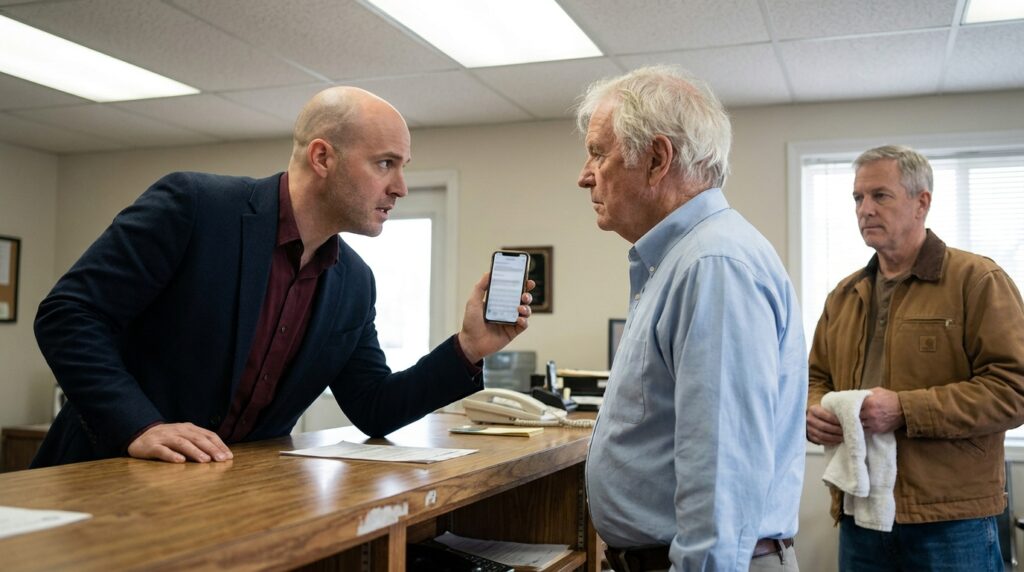
“You’re taking up space where real men should be sitting, old man.” The words didn’t travel; they dropped heavily onto the Formica table like a wet handful of gravel.
Caleb did not blink. He kept his eyes fixed on the ceramic rim of his mug, where the dark, bitter pool of roadside coffee had gone completely still. Outside, the midday heat was baking the state highway into a desaturated ribbon of melting asphalt, but inside the booth, the air smelled exclusively of burnt fat, old vinyl, and the sharp, sour tang of young iron.
The man leaning across the table was wide—built from the kind of heavy, low-rent muscle that came from tossing dry-wall sheets and drinking cheap domestic lager after five o’clock. His dark overshirt was unbuttoned at the cuffs, revealing wrists thick with grease-stained hair. He was leaning far enough forward that Caleb could smell the peppermint tobacco rotting on his breath.
“I asked you a question,” the boy said, his index finger coming down with a dull thud against the laminated wood, right beside Caleb’s thumb. “The cap. You think because you found it in a surplus bin it gives you the right to sit here during the noon rush while people with actual work to do are waiting for a seat?”
In the next booth, the boy’s companion—shorter, wearing a brown jacket that looked too warm for July—shifted his weight. The legs of his chrome chair gave a brief, metallic screech against the grit on the tile floor. “Leave it, Wayne,” the friend muttered, his eyes darting toward the grease-filmed window. “The ham loaf’s coming out anyway.”
“No,” Wayne said, his voice dropping into that rhythmic, rhythmic register of a man who had decided his own grievance was a form of public service. “I’m tired of looking at ’em. Sitting around on the county’s dime. Acting like they own the air.”
Caleb finally raised his head. The movement was slow, a deliberate pivoting of the neck that felt like the shifting of an old iron gate on ungreased hinges. His spine, however, did not slump. Beneath the faded green cotton of his jacket—a coat that had lost its tracking numbers before Wayne’s father had gone to his first prom—Caleb’s shoulders remained square, set at a precise ninety-degree angle to the edge of the booth.
He reached out. His hand was spotted with liver marks, the skin over the knuckles as thin and dry as parchment paper, but when he pointed his own index finger back at Wayne, the hand did not shake. The tip of his finger stopped exactly one inch from the bridge of the young man’s nose.
“You may laugh now,” Caleb said. His voice wasn’t loud—it had the dry, whistling quality of wind moving through a rusted culvert—but it carried a flat, command-level weight that made the waitress behind the counter freeze with her glass pot suspended over a saucer. “But you’ll regret judging too quickly.”
Wayne’s mouth twitched, his face darkening with the sudden, ugly heat of a bully whose target hadn’t shrunk. He began to straighten, his shoulders bunching beneath the dark overshirt, his hand clenching into a mallet of bone and calloused skin. “What did you say to me, you old—”
“That’s enough.”
The voice came from the aisle, heavy and deadened by the institutional authority of thirty years on the county payroll. A thick hand, clad in the long-sleeved dark wool of the sheriff’s department, came down firmly on Wayne’s shoulder. The fabric of the deputy’s sleeve was stiff, the metal star pinned to the chest catching the yellow glare of the overhead fluorescent tube. Sheriff Miller didn’t look at Wayne; his eyes, small and gray under his cropped hair, were fixed entirely on Caleb.
“Show the man the respect he deserves, Wayne,” Miller said. The command was dry, delivered without any anger, which made it twice as absolute. “Get your coat and get out to the truck.”
Wayne’s posture broke. The sudden influx of institutional weight seemed to drain the oil from his joints. His hand dropped from the table, his eyes darting from the star on Miller’s chest to the steady, unblinking glare of the old man in the green jacket. “Sheriff,” he stammered, “he was just—”
“I know what he was doing,” Miller said, his thumb hooking into his leather utility belt, right above the heavy walnut grip of his sidearm. “And I know who he is. Move.”
The silence in the diner was total now, save for the rhythmic, dry tick-clack of the pocket watch inside Caleb’s breast pocket—a sound that caught on every third beat with a faint, metallic scrape. Wayne muttered something low into his collar—a submissive, “Understood, sir”—before turning on his heel and pushing through the screen door, his friend trailing behind like dust in a wake.
Sheriff Miller waited until the screen door slapped shut twice against the frame. Then, with a slow, heavy deliberation, he turned back to the booth. He didn’t offer a smile. He simply reached up, his fingers touching the brim of his campaign hat in a gesture that was less a greeting and more a formal recognition of rank.
“The quarry road’s washed out near the culvert, Commander,” Miller said, his voice dropping so the waitress couldn’t hear. “But that’s not why I’m here. They found the lock on the gate broken this morning. The old lock. The one you kept the key for.”
Caleb’s hand went slowly to his breast pocket, his fingers closing around the cold, heavy shape of the brass watch that had long since stopped telling the correct time.








