
CHAPTER 9: THE DAWN BLOCKADE
The iron rungs of the upper ladder didn’t get warmer as Caleb climbed; they simply shifted from the slimy grease of the deep vault to the dry, chalky grit of the surface shelf. When his hand broke the plane of the hatchway, the air that hit his face was cold and thin, carrying the sharp scent of wild mustard and diesel exhaust from the highway corridor.
Caleb hauled his frame over the lip of the concrete pad, his joints giving off a dry, hollow pop that sounded like a dry branch snapping underfoot. He didn’t brush the gray limestone mud from the knees of his trousers. He stood straight, his fingers automatically reaching up to adjust the brim of his canvas cap, pulling it down until his white hair was tucked safely beneath the faded green stitch.
Behind him, Wayne stumbled out of the hole, his dark overshirt torn at the shoulder, the iron pry-bar balanced across his palm like a blunt staff. The boy was squinting against the early light—a flat, desaturated slate-gray that was rising over the eastern ridge like a bruise.
“Caleb,” Wayne muttered, his voice dropping into his chest as he looked toward the primary quarry gate. “That’s not the county pool.”
Three hundred yards down the aggregate lane, where the chain-link fence met the asphalt of the state highway, the road was gone. It had been replaced by a wall of high-clearance utility rigs and dark, unmarked cruisers parked grille-to-grille across the gravel lane. The rotating light-bars weren’t the familiar blue and gold of the county department; they were flat, white strobes that cut through the valley mist with a rhythmic, clinical pulse.
Men in heavy, stiff-collared canvas coats were already moving along the ditch line, their boots sinking into the wet clay as they strung yellow high-visibility tape from the post tops. They didn’t carry the standard leather utility belts of rural deputies. They carried modular nylon vests, their chests stenciled with the white, block letters of the District Mitigation Enforcement Division.
Sheriff Miller climbed out of the hatch last, his uniform cap missing, his gray hair plastered to his forehead by the subterranean sweat. He took one look at the cruisers and his hand drifted instinctively toward his empty holster before dropping to his side like a dead weight.
“They aren’t state investigators, Caleb,” Miller said, his teeth clicking slightly against the cold. “Look at the plates on the lead rig. Those are municipal bankruptcy units. The state treasury didn’t send an auditor. They sent a receivership board.”
Caleb took two paces forward, his boots crunching rhythmically against the sharp flint of the aggregate. His eyes, small and cold beneath the shadow of his brim, tracked the movement of a tall man in a dark trench coat who was walking up the center of the lane. The man didn’t look at the limestone pits or the machinery; he was looking directly at a digital tablet held in his gloved left hand.
The chess board hadn’t just changed; it had been cleared away while they were down in the cistern. The call Caleb had placed from the diner hadn’t triggered a regulatory intervention; it had accelerated a corporate foreclosure that had been signed into the county ledger six months prior. The town council’s injection project wasn’t a secret plan to cheat the system—it was the final, desperate attempt to trigger an insurance buyout before the state took physical possession of the entire water table.
“Wayne,” Caleb said, his voice dropping into that flat, command-level weight that had quieted the diner line. “Give the bar to Miller.”
“What?” Wayne bared his teeth, his grip tightening on the iron. “Caleb, those bastards are locking down the access road. My dad’s trucks are supposed to be on the ridge by six.”
“Your dad’s trucks aren’t moving today,” Caleb said, his gaze fixed on the man in the trench coat who had just reached the perimeter of the crusher shed. “And neither are we. Put the iron down before they log it as an active resistance.”
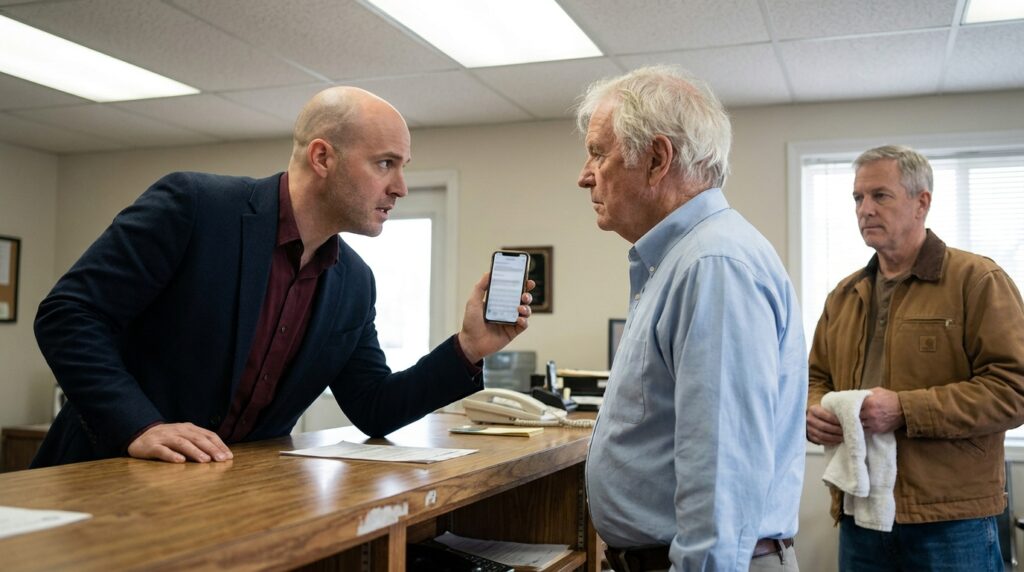
The man in the coat stopped five feet from Caleb’s boots. He didn’t offer a badge or a greeting. He looked at Caleb’s faded green jacket, his eyes drifting over the stenciled laundry numbers on the collar before checking the screen of his tablet.
“Caleb Vance?” the man asked. His voice had the dry, synthetic neutrality of an insurance adjuster reading a claims manifest. “Retired Logistics Commander, Third District?”
“I’m Vance,” Caleb said.
The man tapped the screen once with his stylus. “I have a federal mitigation writ signed by the district supervisor at four-thirty this morning. As of this hour, this site, including the subterranean drainage grids under Sector Four, is under state receivership. No municipal personnel or local residents are permitted within the perimeter.”
He looked past Caleb toward the sheriff, his expression completely blank. “Sheriff Miller, your department is being relieved of local enforcement duties for the duration of the audit. Your cruiser keys are to be turned over to the transport detail at the gate.”
Wayne took a step forward, his chest heaving under his dark overshirt, but Caleb reached out with a singular, spotted hand and caught the boy by the forearm. The grip was impossibly tight—old muscle and dry bone locking like a vise around the young man’s wrist.
“We’re leaving,” Caleb said to the investigator, his voice flat as the limestone shelf. He didn’t look at the writ or the tablet. He turned his back on the shaft, his boots turning toward the old Ford idling near the bank of crushed stone. “The valve in the lower gallery is shut. If you want to turn it back on, you’ll need a different silver key than the one I’ve got.”
The investigator didn’t call after them. He simply watched as the three men walked down the aggregate lane, their shadows stretching out long and thin across the gray mud of a valley that no longer belonged to the people who had built its roads.








