CHAPTER 1: THE RECKONING OF SILENCE
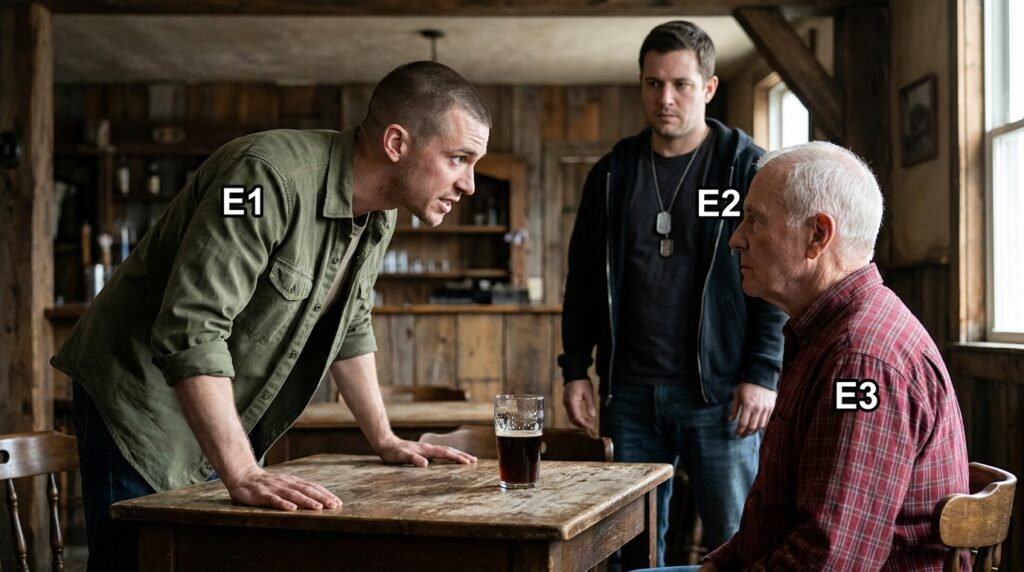
“You keep acting like that, but nobody here believes you anymore,” the kid says, his knuckles going white against the grain of the scarred oak table.
He is twenty-eight, maybe less. He has the freshly scrubbed look of a junior specialist who still thinks the uniform is a shield instead of a target. His shoulders are thrown forward, his lean frame leaning deep across the center line, trying to cast a shadow over my glass. On his utility shirt, the fabric is stiff, smelling of commercial laundry starch and unearned certainty. Behind him, the thicker one with the trimmed beard stands like a sandbag, arms crossed over a dark hoodie, his dog tags making a tiny, metallic click every time his chest rises.
I do not move my hands from the wood. They rest flat, palms down, the calluses around my knuckles catching on the rough, uneven splinters of the tavern table. The amber light from the hanging Edison bulb above us catches the edge of my silver signet ring, its crest worn down to a smooth, unreadable blur by forty years of friction.
“I’m still waiting for a real answer,” the kid presses, his voice dropping an octave to carry across the low hum of the ceiling fan. He thinks he’s commanding the room. He thinks the five regulars sitting at the counter—the ones who have stopped watching the television to look at us—are his audience. “Don’t look away now.”
I don’t. My eyes are locked onto the bridge of his nose, right between his eyebrows, where a small twitching muscle betrays the fact that he is working too hard to maintain his snarl. In the field, a man who leans that far forward is already off-balance; a quick upward snap to the throat would put him on his back before his companion could clear his elbows from his pockets. But this isn’t the tree line outside Hue, and the manila folder sitting under my left elbow contains three decades of administrative legacy that cannot be dirtied by a boy’s ignorance.
The wooden beer glass sits precisely between us, cold and stationary. A ring of condensation has formed around its base, soaking into the dry wood of the table. The room has gone perfectly quiet now. The bartender has stopped wiping the copper draft taps, his rag hanging limp from his fingers.
The kid believes he is protecting something sacred. I can see it in the rigid line of his jaw—he thinks I am a ghost story told by civilians to buy free drafts. He wants a ledger. He wants names, dates, and operational codes that were burned in an incinerator at Fort Meade before his mother was old enough to drive.
“That’s exactly what everyone expected you to say,” he sneers, though I haven’t given him a single syllable. He starts to straighten up, his shoulders shifting back as if he’s won a small perimeter action by default. His companion moves an inch to the left, his boot heel scraping against the linoleum floor.
The silence between us stretches, thick and heavy with the smell of stale rye and dry earth. I let him take his breath. I let him think the space belongs to him. Then, I lean back just an inch, my spine finding the solid, unyielding back of the wooden chair.
“I’m finished arguing with you,” I say. My voice doesn’t rise above the sound of the air conditioning unit rattling in the window behind me, but it hits the table with the dead weight of an iron latch falling into place.
The kid’s mouth opens slightly, his eyes narrowing as the lack of resistance catches him completely exposed. Before he can find his footing, the heavy brass latch on the tavern’s front door gives a sharp, metallic crack, and the cold evening air cuts straight through the amber warmth of the room.