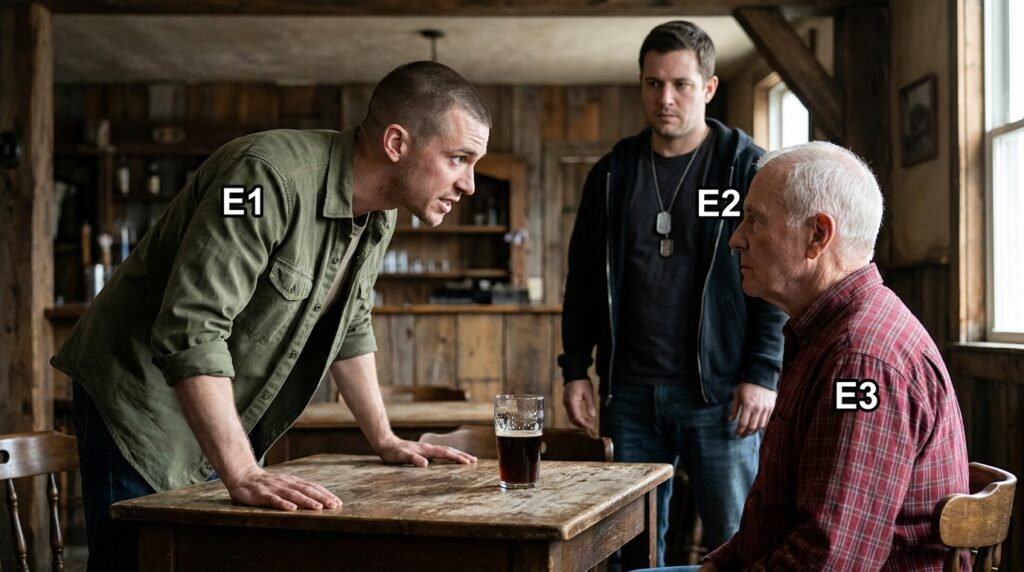
CHAPTER 6: THE SILENCE OF THE ARCHITECT
“The line is dead, Garret,” I said, my voice dropping into the frozen hollow left by the power grid’s sudden collapse.
The General did not pull his hand back from the table. His fingers remained splayed against the varnished oak, but the leather of his glove was trembling—a high-frequency vibration born of sheer, systemic shock. Through the frosted glass of the window, the red and blue emergency light bars did not strobe anymore; they had frozen into solid, static bars of dead violet that stained the parking lot ice. Inside the headsets of the tactical operators, the metallic whine had dissolved into a flat, empty hiss that sounded like sand falling onto glass.
Time did not move at its regular pace. In the dim, amber twilight of the failing Edison filaments, every movement was elongated, stripped of its velocity by the absolute gravity of the reversal. The lead operator took one slow, staggering step backward, his hand fumbling with the dead control box at his hip, his fingers tracking the useless plastic ridges with the clumsy panic of a man who had suddenly lost his sight.
“This is an unlisted installation,” Garret whispered. The administrative drone was entirely gone, replaced by the dry, rasping breath of an officer whose entire tactical interface had been reduced to cold silicon and scrap metal in less than five seconds. “The routing relays are decoupled from the public net. You can’t execute an override from a civilian booth without an active terminal link.”
I lifted my right hand from the oak, my fingers leaving five pale, clear ovals in the thin layer of dust beside the Title 10 seizure warrant. The silver signet ring didn’t flash; it held a dull, steady gleam that matched the exact hue of the steel split-pin resting between us.
“I didn’t need a terminal link, General,” I said, my voice dropping beneath the low, rhythmic rattle of the window pane as the cold wind outside began to rise. “The routing relays aren’t decoupled. They were built on top of the original five-digit framework I stamped into the bedrock of this county forty years ago. Every encrypted trunk line your battalion laid down this morning is just another branch growing out of the trunk I planted.”
The operators didn’t look at Garret for orders anymore. They looked at the dead indicators on their vests, then back at the solid, unmoving frame of the table. The institutional shield that had protected their arrogance since they left the airfield had been peeled away, leaving nothing but the raw, unyielding physics of a room they no longer controlled.
Garret slowly straightened his spine, his knuckles lifting from the wood with a faint, sticky pull. His wire-rimmed spectacles were entirely dark now, reflecting only the hollow silhouette of the dead searchlights outside. The power dynamic hadn’t just shifted; it had imploded into the floorboards. He had entered the tavern with twelve rifles and a red stamp to seal a political liability, only to discover that his entire division command structure was currently hanging from a single thread that ran beneath my left boot.
“Stand down, son,” I said, the title hitting his silver stars with the cold, unyielding weight of an iron latch dropping into a groove. “You’re speaking to the man who wrote the tactical doctrine you failed to follow this morning. The review board at nine tomorrow isn’t canceled. It’s just under new management.”
The General’s mouth opened slightly, his jaw freezing mid-motion as the true scope of the Layer 2 reality settled into his calculation. He wasn’t dealing with a retired civilian spinning old stories for a free draft; he was sitting across from the ghost author of his entire operational reality. The manila folder he had stolen was an empty hull—a piece of administrative bait designed to draw his active-duty command structure within range of the baseline kill-switch.
Behind him, the entryway door gave a soft, slow creak as the wind pushed it open an inch, letting a thin line of freezing air slide across the linoleum floor. The absolute silence of the small-town veteran space closed back around us, heavy with the smell of stale rye, cold earth, and the distinct, bitter tang of static ozone from the blown tactical circuits.
“What do you want?” Garret asked, his voice barely rising above the whistle of the draft.
I reached out, my fingers wrapping around the cold, grooved base of the octagonal wooden glass, setting it precisely over the crimson ink of his useless seizure warrant.
“I want you to walk out of my perimeter,” I said quietly, my eyes locking onto the center of his forehead with an unbroken, final gaze that left no room for negotiation. “And when you report to the desk tomorrow morning, you tell the department that the silence is still working.”
He didn’t answer. He turned on his heel, his movements slow, heavy, and completely stripped of the mechanical cadence that had brought him through the door. The tactical stack followed him out into the dark, their boots dragging against the wood as they retreated into the dead, unlit night.
True strength didn’t need to bark to prove it had teeth. It just had to wait for the room to go cold.