CHAPTER 3: THE STRATEGIC PARALLEL
“Virginia is humid this time of year, Colonel,” I said, my voice remaining level as the door’s latch settled into its final, metallic rest. “The air here has more grit. It reminds a man of what he’s actually working with.”
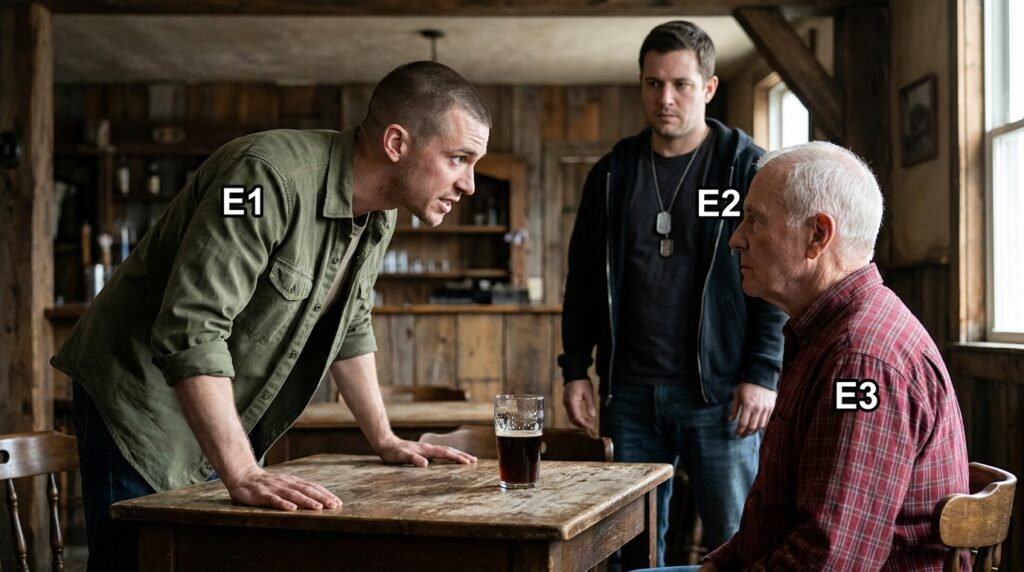
Colonel Vance did not pull out the chair. He kept his gloved hand resting flat on the cold, varnished oak of its backrest, his fingers curling slightly over the top rail. He was assessing the geometry of the table, his tactical eyes registering the exact distance between my left hand and the manila folder. Under the harsh illumination of the hanging bulb, the silver eagles on his shoulders cast narrow, blade-like shadows down his sleeves. He had the rigid posture of a man who spent his life projecting authority to hide the fraying edges of his command.
“You haven’t changed the signature blocks on your internal correspondence since ninety-four,” Vance murmured, his gaze dropping to the corner of the folder where a heavy steel split-pin bound the thick stack of papers together. “The administrative clerks at the division desk didn’t recognize the routing stamps when the courier dropped this off. But I did. There are only two people left in the logistics command who use a three-letter prefix for a standard field reprimand.”
I turned the wooden beer glass precisely ninety degrees to the left, watching the condensation slide down the dark, octagonal grooves. “Then you already know why I didn’t send it through the encrypted terminal. Digital lines leave an echo. Paper only burns.”
Vance’s jaw tightened. He finally pulled the chair back, the wooden legs making a short, sharp shriek against the floorboards before he dropped his weight into the seat. He didn’t lean forward the way the specialist had; he sat perfectly erect, arms resting along the armrests, minimizing his physical profile while trying to maximize his psychological leverage. He was a veteran of the bureaucracy, an adversary who understood that an unwritten threat was far more dangerous than a raised voice.
“Miller is a good soldier,” Vance said, his eyes drilling into mine. “He’s young, he’s aggressive, and he’s fiercely protective of his unit’s legacy. He thinks you’re a fraud because your name isn’t on the public rosters for the ninety-two campaign. He doesn’t know how the black-box budget handled personnel assignments back then.”
“He doesn’t know because he hasn’t been taught how to look past the ink,” I replied, my hand remaining motionless beside the folder. “He thinks the uniform makes him an arbiter of truth. That’s a training failure, Colonel. Your training failure.”
Vance pulled a small, silver pen from his upper pocket, the click of its spring-loaded mechanism echoing sharply in the quiet tavern. He tapped the blunt end against the oak table, a rhythmic, maddening cadence that matched the slow rotation of the ceiling fan above us. “If that file leaves this room, the entire structural integrity of the Third Battalion collapses before the fiscal review on Friday. You’re holding an administrative execution order for my executive officer. The ridge wasn’t a tactical failure; it was a supply-line bottleneck. The reprimand is a decoy to shield the political appointments at the department level.”
There it was. The decoy secret, dropped onto the wood like a spent casing. Vance believed the file was purely an institutional cudgel meant to dismantle his command structure for a budgetary infraction at the ridge. He thought he had diagnosed the boundary of my operational intent. His entire counter-strategy was built on the assumption that I was here to clean up an administrative mess for the oversight committee in Virginia.
I let him harbor that conviction. I reached down, my thumb catching the edge of the manila folder and flipping the cover back just enough to expose the first page.
Under the dim amber glow, a peculiar ink stamp was visible on the lower margin of the internal backing sheet—a double-bordered oval emblem featuring a stylized transit grid, stamped twice in fading purple ink. It sat directly beneath the standard classification markings, its sharp edges slightly blurred by the cheap fiber of the paper. Vance’s eyes darted down to it, his pen freezing mid-tap. He recognized the stamp as an antique operational clearance marker, but his mind immediately categorized it as an old administrative artifact from the depot’s founding days. He didn’t see the structural blueprint hidden within the grid lines. He didn’t realize that the oval wasn’t a security clearance at all; it was an architectural validation stamp from the original, unlisted office that had designed the very communication protocols his battalion used to coordinate their movements.
“Your executive officer signed the fuel manifests three weeks before the first mortar track was delivered to the ridge,” I said, my voice dropping into a cold, transactional rhythm. “He knew the weight limits on the northern access road wouldn’t support the weight of the armored trailers. He chose to look at the promotion schedule instead of the topography.”
“The department ordered those movements,” Vance countered, his voice rising slightly before he checked himself, his eyes flicking toward the bartender who was now systematically cleaning the far end of the counter with exaggerated focus. “If you break my XO, the command structure splits down the middle. The young men like Miller—the ones who actually have to carry the rifles—will lose the only leadership they trust. Is that what your legacy looks like, sir? Ruining a frontline unit to settle a thirty-year-old bureaucratic ledger?”
“True discipline isn’t maintained by hiding the rot behind the ranks, Colonel,” I said, my fingers pressing lightly against the purple ink stamp on the paper, feeling the slight indentation where the metal die had bitten into the wood pulp. “It’s maintained by ensuring the foundation can bear the weight of the mistakes.”
Vance stood up slowly, the silver pen vanishing back into his pocket with a smooth, practiced motion. He adjusted his utility cap, his fingers setting the brim exactly parallel to his brow line. The shadow returned to his face, hiding the deep, dark pockets of exhaustion under his eyes.
“The review board convenes at nine tomorrow morning,” Vance said, his voice dropping into a flat, formal pronouncement. “If that folder isn’t on the desk by eight, the military police will execute an administrative recovery warrant for state property. I can’t protect you from that, sir. Not even with your retirement rank.”
He turned and walked toward the door, his boots striking the floor with that same mechanical, double-beat cadence. As his hand reached for the brass latch, he paused, his profile silhouetted against the dark glass of the window.
“The world changed after you left the basement in Virginia,” he said without looking back. “We don’t live in the silence anymore.”
The door clicked shut, the cold air rushing in once more to swirl the dust motes around the amber bulb. I sat alone at the table, my hand moving from the paper back to the cold grain of the wooden glass. The colonel had his strategy mapped out, but he was still playing on a board I had drawn before his first promotion.