CHAPTER 2: THE ANCHOR IN THE SHADOWS
The brass latch didn’t just rattle; it cracked against the strike plate like a primer cap igniting in an empty chamber. The draft that followed it was thin and carried the distinct, sharp scent of aviation fuel and wet asphalt from the tarmac three miles north.
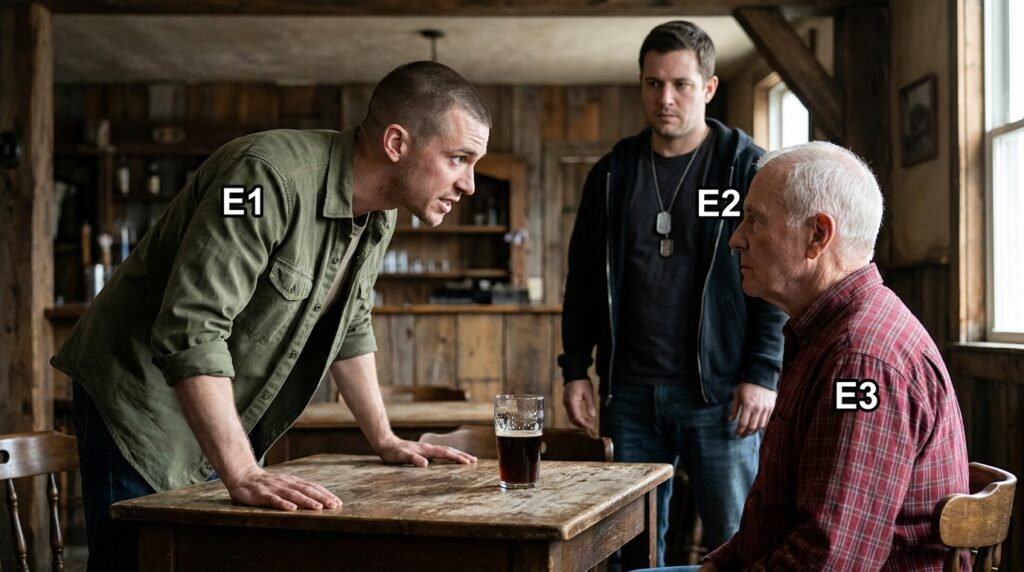
The kid—E1—didn’t spin around immediately. His discipline was just good enough to keep his eyes on me for one more second, searching for the reaction he hadn’t earned. His shoulders remained locked, the olive utility fabric bunched up at his shoulder blades like a tight harness. But his companion, the sturdier one in the dark hoodie, shifted his weight instantly. The small brass dog tags hanging against his chest gave a faint, rhythmic rattle as he cleared his hands from his front pocket, his eyes darting toward the threshold where the shadows from the entryway met the amber spill of the tavern.
“You think that’s an end to it?” the kid muttered, his voice dropping below the register of the wind coming through the door. He didn’t look back at the entrance yet, but his hands left the wood of the table, his fingers curling into tight, hollow fists at his sides. “A name on a piece of paper don’t clear the field. Not after what happened at the ridge.”
I didn’t answer him. I reached down with my right hand, my fingers wrapping around the cold, grooved base of the octagonal wooden beer glass. It was heavy, a solid chunk of milled oak that had been stained so dark it looked like cast iron under the low bulb. As I lifted it an inch to clear the condensation ring, my thumb brushed against a small, rough indentation on the underside—a crude, five-digit serial stamp that the tavern owner thought was a manufacturer’s mark. It wasn’t. It was an old logistical routing code from the 501st Ordnance Depot, a detail I’d noted thirty years ago when this place was still an unmapped briefing hut.
The kid’s eyes tracked the movement of the glass, his gaze sharp and calculating, trying to read a tell in the steady positioning of my wrist. He was looking for fear, or perhaps the sudden bravado of an old man who thinks he’s about to be rescued by a civilian crowd. He didn’t see either. He only saw the slow, deliberate physics of a hand that had held heavier tools than an administrative file.
“The ridge was six months ago, Specialist,” I said, my voice flat, hitting the narrow space between us before the sound of boots on the linoleum could drown it out. “And your commander didn’t leave his perimeter because of a bad map. He left it because he didn’t know how to read the silence before the mortar track opened up.”
The kid stiffened, his face draining of the ruddy color the beer had given it. The mention of the ridge was a live wire; it was the decoy secret his entire unit had been hiding behind to explain away their recent administrative suspension. He thought he was here to expose a fraud, but the manila folder resting under my left elbow didn’t contain my old discharge records. It contained the raw, unredacted after-action logs of his own squad’s failure—a file currently marked for a formal Article 15 review that his colonel had been trying to intercept all week.
Behind him, the sturdier companion finally took a step back, his boots making a dry, sticky sound against the floor as the figure from the doorway stepped fully into the light.
The air in the room didn’t just cool; it seemed to thin out. The regulars at the counter didn’t turn back to the television. The bartender stayed perfectly still, the white rag in his hand frozen halfway down the copper draft line. Every eye in the place was fixed on the shape now standing by the coat rack—a high-ranking silhouette whose utility cap sat perfectly level, the silver insignia at the center catching the direct gleam of the Edison bulb like a small, polished tooth.
The kid didn’t turn around until the heavy heel-iron of the newcomer’s boots struck the transition strip between the entryway rug and the main room. It was a precise, double-beat stride that anyone who had spent more than six weeks in basic training could identify without looking up.
“Specialist Miller,” the voice came from the shadow behind them. It wasn’t loud, but it had the hollow, resonant weight of an empty oil drum being struck with a wrench. It was an voice that had spent twenty years overriding the roar of diesel generators and low-flying rotors. “Identify your current detail.”
The kid’s posture didn’t just change; it disintegrated and reformed in a micro-second. The aggressive forward lean vanished, his spine snapping straight with a sudden, rigid jerk that looked almost painful. His arms went flush against his dark trousers, his fingers flattening out along the seams as he tried to clear the space he had just been crowding. Beside him, the companion in the hoodie went equally stiff, his chin lifting until his throat was exposed to the light.
“Sir,” the kid barked, his eyes staring straight ahead at the wood paneling of the back wall, completely bypassing my face now. “Assisting with local logistical transport from the airfield, sir.”
The officer stepped out of the gloom. The uniform was immaculate, the camouflage pattern sharp and dark, free of the grease stains that covered the kid’s utility shirt. On his collar, the silver eagle of a full colonel gleamed under the amber light. He didn’t look at the kid. He didn’t look at the companion. His eyes were fixed entirely on the corner of the heavy oak table where my manila folder sat, its edges slightly frayed under the weight of my forearm.
I didn’t rise. I kept my seat, my hand still resting against the cold grain of the table, my fingers maintaining their light grip on the base of the wooden glass. The colonel took three more measured steps until he was standing directly at the flank of the table, his shadow completely cutting off the kid’s light.
“You’re three miles outside your sector, Specialist,” the colonel said, his gaze never shifting from my face. The skin around his eyes was lined with the gray fatigue of a man who hadn’t slept since the operational review began on Tuesday. “And you’re occupying a space that doesn’t belong to your unit.”
The kid didn’t answer. His jaw was locked so tight the muscle beneath his ear looked like an iron wire. He could feel the shift in the room’s atmospheric pressure, the sudden, total collapse of his leverage. He still thought this was about the ridge. He still thought the folder contained the evidence that would break his career. He didn’t know that the real threat wasn’t the paper in the file, but the old man who had sat in the dark thirty years ago and decided how many men his unit would be allowed to lose before the command structure was dismantled from the top down.
“Leave the room,” the colonel murmured, his voice dropping into a register that was almost gentle, though the edge beneath it remained razor-sharp. “Both of you. Now.”
The kid hesitated for a fraction of a second—a tiny, imperceptible hitch in his breathing that only someone who had spent decades watching men break under pressure would notice. Then, he turned on his heel, his boots clicking in a tight, mechanical arc as he and his companion moved toward the exit without a single backward glance.
The heavy door closed behind them, the latch clicking home with that same dead iron weight. The colonel remained standing by the table, his cap cast in shadow, his eyes fixed on mine as the silence of the tavern closed back in around us.
“You should have stayed in Virginia, sir,” the colonel said quietly, his hand coming down to rest on the back of the empty chair across from me.