CHAPTER 4: THE LIQUIDATION OF LEVERAGE
The silence Vance left behind didn’t last five minutes.
It began as a low, structural vibration in the soles of my boots—the deep, synchronized thrum of heavy-duty diesel engines idling in the gravel lot outside. Then the light changed. The dull amber glow of the hanging Edison bulbs was instantly annihilated by sharp, blinding shafts of white halogen searchlights that cut through the frosted tavern windows, sweeping across the room like blades. The scarred oak tables and old leather booths were suddenly sliced into stark, shifting geometric fragments of brilliant white and pitch black.
The regulars at the bar didn’t just quiet down; they froze. The bartender dropped his glass-wiping rag entirely, his hands slowly rising to press flat against the copper bar rail as the distinctive, high-pressure hiss of air brakes settled right outside the threshold. This wasn’t a routine patrol check. This was a multi-vehicle tactical box-in.
The front door didn’t click open this time. It was hit with a calculated, mechanical force that drove the brass latch straight into the drywall behind it.
Three men in charcoal-gray tactical vests cleared the frame in a standard low-profile stack, their movements precise, rapid, and completely fluid. The high-gloss white lettering of the Military Police insignia across their chests gleamed under the strobing blue and red light bars reflecting off the parking lot ice. Their weapons weren’t holstered; they were carried at a strict, low-ready presentation, muzzle vectors sweeping the corners of the room before locking down the exits.
“Secure the perimeter counter,” the lead element barked, his voice muffled by the rigid throat-mic buckled around his neck. “Nobody touches a terminal. Nobody moves their hands from the surface.”
Behind the stacked fire-team stepped a figure whose presence immediately altered the remaining atmospheric pressure in the room. He didn’t wear the standard field utilities Vance had sported. He wore the crisp, razor-creased service dress of a General officer, the heavy black wool overcoat pinned with the two silver stars of a Major General. It was Garret, the active installation commander. His face was a hard mask of grey stone, his eyes small and dead behind wire-rimmed spectacles that caught the strobing emergency lights like spinning coins.
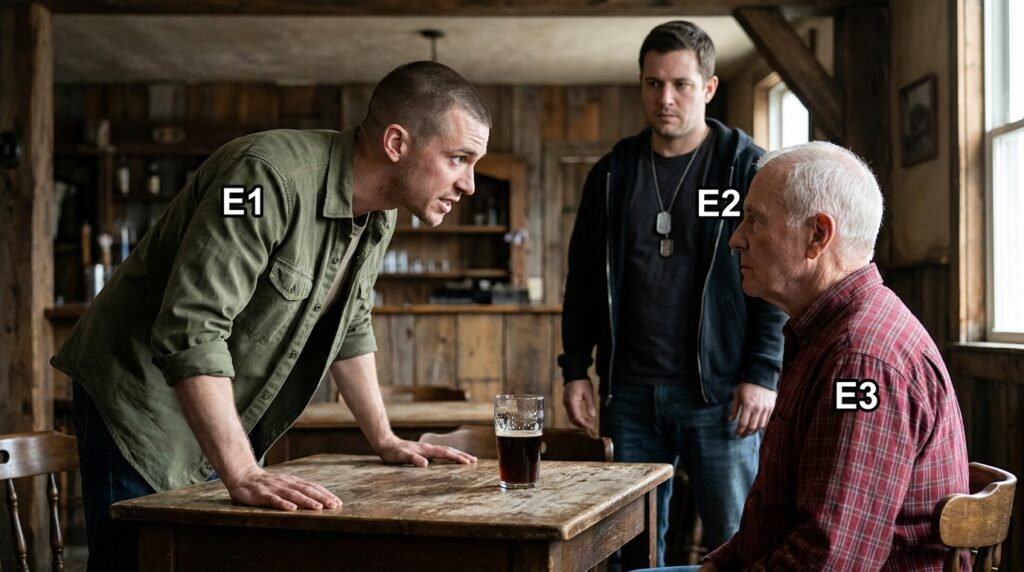
He didn’t look at the bartender. He didn’t acknowledge the regulars. His boots struck the floorboards with a heavy, unyielding cadence that stopped exactly two paces from the edge of my heavy oak table. The three tactical operators formed a rigid semi-circle behind him, their shadows lengthening across the wood until they completely swallowed my glass.
“You’ve been a difficult man to locate, sir,” Garret said. His voice was thin, dry, and entirely devoid of the institutional deference Vance had shown. He didn’t reach for a chair. He stood over me, his hands leather-gloved and clasped tightly behind the small of his back.
I didn’t lift my palms from the table. I kept them flat against the wood, my index finger resting less than an inch from the manila folder. “The map hasn’t changed in forty years, General. If you had trouble finding the coordinate, you should have checked the baseline routing logs.”
Garret’s eyes flicked down to the folder, then back to my face. A sharp, unpleasant smile touched the corner of his mouth. “The baseline logs are currently being archived. Along with every scrap of paper you brought out of the Virginia repository.”
He signaled with a slight nod of his chin. The lead tactical operator stepped forward, reaching into his vest to pull out a single sheet of heavy, cream-colored bond paper. It wasn’t a standard administrative summons. Across the top header, a thick, crimson ink stamp read: Title 10 Emergency Seizure — Sovereign Exclusion Domain.
The operator laid the sheet flat on the wood, directly over the beer glass’s condensation ring.
“Vance is a provincial bureaucrat,” Garret said, his voice dropping into a hard, rhythmic drone that signaled an absolute end to negotiation. “He thinks in terms of local reprimands and squad-level suspensions at the ridge. He came here trying to salvage an executive officer’s career because he thinks that’s the extent of the damage. He doesn’t see the architecture.”
My eyes tracked the red stamp on the paper. The code sequence listed beneath the Title 10 citation wasn’t a logistical case number for a supply-line failure. It was an active federal blackout directive—an intervention order that completely bypassed the standard regional courts-martial and regulatory review boards I had calculated into my strategy. The local administrative leverage I held—the fuel manifests, the XO’s signed directives, the structural proof of the Third Battalion’s negligence—was instantly rendered useless. The system wasn’t entering a legal dispute; it was executing a total administrative liquidation.
“The folder stays with my detachment,” Garret murmured, his gloved hand finally coming down onto the center of the manila cover, his fingers pinning the cardboard to the table with a heavy, crushing pressure. “The review board at nine tomorrow morning has been canceled by direct command of the department. There is no ledger to fill out, old man. There is no audience left to watch you turn the keys.”
I looked at his gloved fingers, then up at the sharp, glinting edges of his spectacles. The calculation had failed. The operational parameters I had relied on for the past three decades had been overwritten by a younger, more ruthless iteration of the hierarchy—one that didn’t care about institutional rules or legal consistency. They were simply going to take the paper, seal the room, and erase the boundary entirely.
“You think you’ve contained the sequence because you brought twelve rifles and a red stamp, General?” I asked, my internal monologue frantically scanning the room’s physical geometry, searching for a secondary line of calculation that didn’t exist. For the first time since ninety-two, the space wasn’t responding to my movements.
“I know I’ve contained it,” Garret replied, his face remaining entirely static as the operator behind him stepped closer, his hand moving toward the heavy nylon strap of his weapon casing. “Because the man who taught me how to isolate a perimeter used to sit in your exact chair. Collect the file.”
The operator’s fingers closed around the edge of the manila folder, the heavy paper creaking as it was lifted from beneath my arm, leaving nothing but the cold, empty grain of the oak table between us.