CHAPTER 1: THE COLD ANCHOR
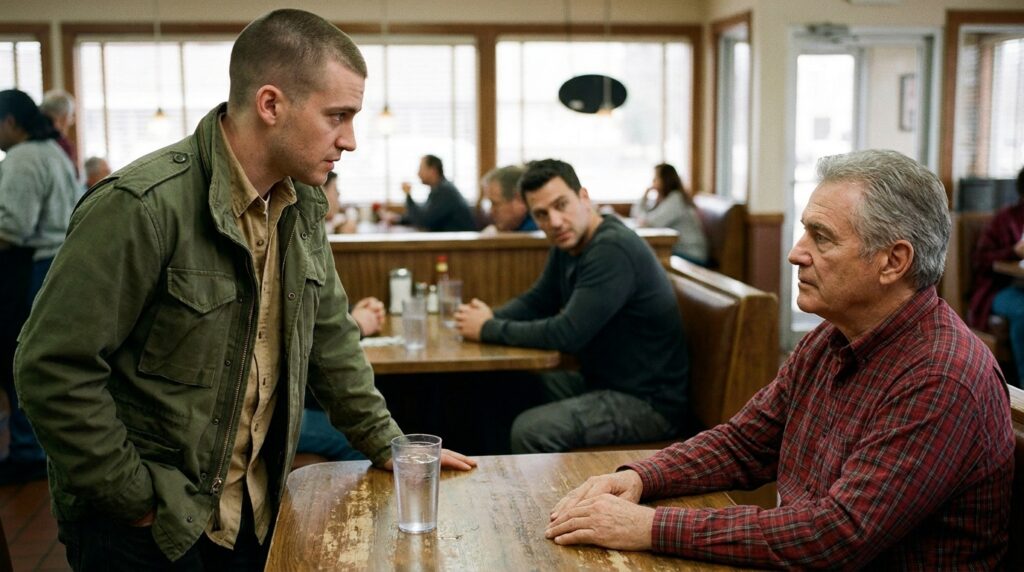
“Look at me, I’m talking to you, answer me now,” the kid said, his palms flat against the grease-filmed oak of the booth.
Thomas did not look up immediately. He kept his eyes on the white porcelain mug between his hands. The coffee had gone lukewarm, a thin skin of condensation forming along the inner rim where the heat met the damp morning air of the county line. The diner smelled of scorched lard, old Formica, and the faint, sweet rot of wet tobacco coming from the vest pocket of the man three booths over. It was an old smell. A heavy one.
The kid’s hands were clean. Too clean for the olive field jacket he wore, which still carried the sharp, machine-pressed creases of a distribution warehouse. He was thick in the shoulders, his jaw line hard from youth rather than labor, his short buzz cut catching the yellow glare of the unbranded fluorescent tube flickering directly overhead. He leaned forward until the nylon of his jacket hissed against the edge of the wooden table, cutting off the grey light coming through the front window.
Thomas let his left hand slide down from the mug. He laid it flat on the wood. His skin was the color of river clay, mapped with purple veins that twined around a heavy silver ring. The metal was dull, scratched by decades of gravel and salt, its central crest worn down to a smooth, unreadable nodule. He didn’t ball his fingers into a fist. He simply pressed down, feeling the grit of spilled sugar beneath his palm, using it to anchor the slow, rhythmic thump of his heart.
Behind the kid, near the cash register where the plastic mint bowls sat, a man in a dark canvas coat paused with his hand inside his pocket. A Background Observer. The man didn’t move toward the door. He didn’t reach for his phone. He simply stood there, his reflection caught in the scratched chrome of the pie case, watching the space between the kid’s shoulder blades and the old man’s chin. The clatter of silverware from the kitchen had dropped an octave, replaced by the low, greasy hiss of the flat-top grill.
“I know what’s in the brown folder, old man,” the kid muttered, his voice dropping into a register meant only for the two of them, though the silence in the room made it carry like grease on water. “My crew is locked out of the north ridge because you’re holding the clearance logs. You think because you sat in an office forty years ago, the county can’t touch you?”
Thomas watched a small flake of dried mud detach itself from the kid’s cuff and tumble onto the table. It rolled twice, then stopped against the base of the salt shaker.
The weight of the folder was heavy against his thigh, wedged securely between his hip and the patched vinyl of the bench. The leather was split along the spine, held together by three wraps of black electrical tape that had turned sticky in the July heat. The kid thought it was about an easement. He thought it was about a gate key and a boundary line drawn by a drunk surveyor in 1984.
The kid’s breath smelled of wintergreen mints and dry panic. He leaned an inch closer, his knuckles turning the color of lard as he put his weight into the table. “You don’t exit this booth until I get the signature.”
Thomas looked up then. His eyes were the faded grey of rain-soaked slate, surrounded by yellowed whites that hadn’t seen a full night’s sleep since the winter the river froze through. He let the silence stretch between them until the kid’s jaw muscle gave a small, involuntary twitch.
“Calm down,” Thomas said. His voice didn’t rise above the hum of the kitchen compressor, but it had the thick, iron resonance of a closing bunker door. “And step back.”
The kid’s fingers stiffened against the wood, his eyes widening slightly as his gaze caught the small, white scar running vertically through Thomas’s left eyebrow—a mark that didn’t belong to a clerk.