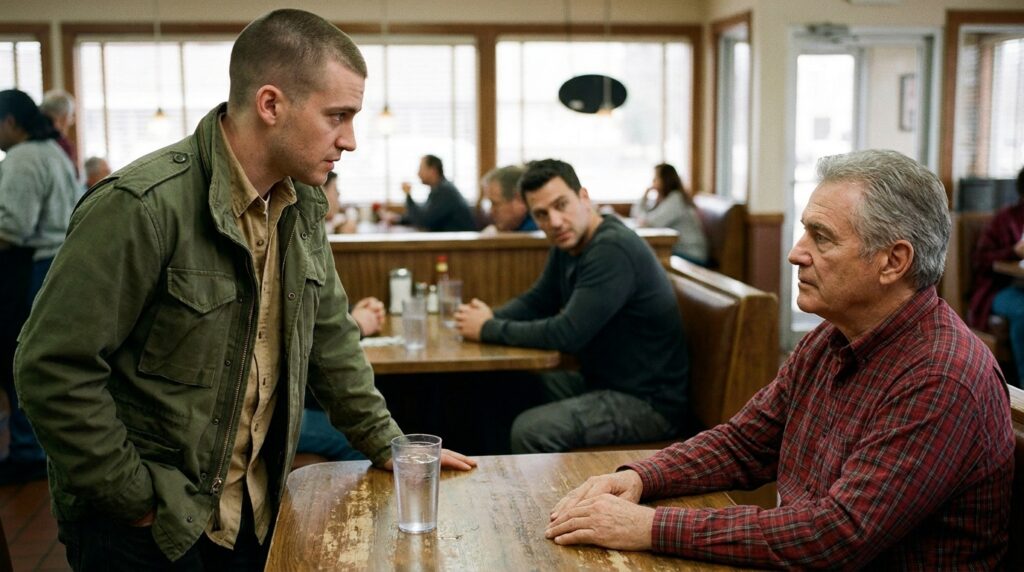
CHAPTER 3: THE DECONSTRUCTION OF AUTHORITY
The name didn’t clear the room; it weighted it. The kid’s fingers slid an inch across the varnished grain, leaving pale streaks in the dust before his joints locked up entirely. His breath came shorter now, rattling against the low pane of the diner window where the first yellow rays of the high-country sun were beginning to bake the dirt into the glass.
“Miller died in ninety-two,” the kid said. His tone lacked its previous weight, though he kept his boots planted, trying to match the old man’s vertical posture through pure skeletal strain. “The records from the third logistics detachment were scrubbed after the reservoir easement was turned over to the county water board. You’re holding a dead man’s identity if you’re claiming that name, old man. And my outfit has the corporate lean to back our entry up. We don’t need to check old graves to drop our drills into the north slope.”
Thomas watched the kid’s knuckles turn from grey to white. The corporate lean. It was the term they used when the land acquisition firms bought up delinquent tax debt from the township to avoid state environmental disclosure laws. If the kid’s firm had the lean, they had the right to run heavy machinery right up to the boundary wire—but they didn’t have the key to the iron lockbox on the ridge pump station. They didn’t have the coordinates for the subsurface shafts either.
“The third logistics didn’t leave graves on the slope,” Thomas said, his fingers remaining perfectly flat against the table. “They left trenches. If your superiors told you the records were scrubbed, they lied to save the cost of a three-mile containment fence. You tell your manager that the five-digit registry is still active at the regional registry, and the gate stays chained until I see a federal environmental stamp on your work order.”
The Background Observer had stopped using his brass key ring. He stood three paces from the booth now, his dark canvas coat unbuttoned just enough to reveal a standard-issue leather belt with a heavy, double-pronged steel buckle. His face remained in the shadow of the low fluorescent fixture, but his chin was tilted down, his attention entirely focused on the leather folder tucked behind Thomas’s hip. He wasn’t tracking the conversation for the sake of the land; he was counting the inches between the old man’s elbow and the edge of the vinyl bench.
Across the room, the driver who had been holding his fork let it drop. The tines clicked against the heavy ceramic plate with a sharp, clear ring that seemed to snap the kid’s focus back into line. He looked over his shoulder once, his jaw tightening as he saw the two older men in the corner booth watching his posture. The small-town diner etiquette was simple: you could argue over a fence line or an unpaid bill until the morning fry-cook cleared the grease traps, but you didn’t corner an elder in a public booth without drawing the room’s collective eye.
“The work order is internal,” the kid muttered, his voice tightening as he leaned down again, trying to reclaim the physical leverage he had surrendered when Thomas spoke. “We’re not clearing brush, Miller. We’re running a seismic core probe through the old limestone culverts to check the bedrock consistency for the pipeline corridor. If you don’t give us the access codes from that file by noon, the county sheriff is going to be the one pulling you out of this booth, not me. This whole county runs on the tax revenue from that corridor, and an old soldier with an unverified pension isn’t going to stall a state project.”
Thomas felt the cold iron of his silver ring pressing into the soft skin of his palm. He knew the limestone culverts. He had overseen the concrete pours himself during the rainy season of ’81, when the trucks came up from the railhead with no markings on their sides and their tailgates draped in wet canvas. The county thought the pipeline was going to carry natural gas from the northern fields. They thought the old logistics depot was nothing more than an abandoned fuel terminal with a few rusty storage tanks buried beneath the scrub pine.
“The limestone under that ridge isn’t bedrock,” Thomas said, his slate-grey eyes catching the flicker of the overhead light as he tilted his chin upward. “It’s a honeycomb of old drainage channels. If you drop a pneumatic drill into those culverts without the engineering maps from eighty-two, you won’t find rock, son. You’ll find out exactly why the state utility consortium waited forty years to touch that land.”
The kid’s hand twitched toward his chest pocket, his fingers brushing against a blue-capped plastic pen before he caught himself. He didn’t have a corporate lean; he had an assignment. His olive field jacket carried the smell of fresh diesel and damp silt—the kind of mud that gathered around the drainage grates at the base of the ridge where the overflow ditches emptied into the county creek. He had already been up there. He had already found the iron gate, and he had found the old brass survey pin that matched the one tucked into Thomas’s shirt pocket.
“The maps are in the folder,” the kid said, his eyes dropping to the taped edge of the leather folder where it showed through the gap in the vinyl booth. “You’ve been keeping them out of the public archive for twelve years. That’s why the easement is tied up. That’s why our title company couldn’t clear the deed last month. You’re not protecting the environment, old man—you’re holding a grudge against the outfit that retired you.”
Thomas let his left hand slide backward, his knuckles brushing against the heavy leather of the folder. He could feel the dry, brittle texture of the older document sleeves inside—the thick, cotton-weave paper that carried the ink stamps of a department that had changed its name three times since the Cold War ended. The kid thought it was about an old soldier’s bitterness. He thought it was about a missing signature on a deed map. He had no idea that the white grease on his cuff was the only thing keeping his lungs from burning before the sun went down.
“A grudge takes energy,” Thomas murmured, his eyes shifting past the kid’s shoulder to the front door where the iron latch began to vibrate against its strike plate. “I’m just an old man trying to finish my breakfast before the coffee goes completely cold.”
The door didn’t open immediately, but the glass pane rattled as a shadow cut off the morning light from the parking lot outside.