CHAPTER 7: THE FINAL DEPLOYMENT
The sun didn’t warm the gravel lot; it bleached it.
The heat coming off the manifold of Thomas’s old truck smelled of baked grease and scorched gaskets, a dry, metallic breath that met him the moment his boots cleared the diner’s wooden threshold. Ahead of him, the kid was already running, his athletic frame silhouetted against the blinding, desaturated white of the low-country sky. The kid’s olive field jacket swung loose, the dry zinc grease on his sleeve flaking off in tiny, white specks that were instantly scattered by the north wind.
Thomas didn’t run. He adjusted the weight of the leather folder beneath his left arm, his fingers digging into the sticky black electrical tape along the binding. His breath came slow, a rhythmic draft that tasted of iron filings and the sour lard from his breakfast. Every stride across the loose limestone stones was a conscious calculation of skeletal leverage—the steady placement of his heels, the flex of his scarred knee, the unyielding posture of a man who had spent his youth clearing supply yards while the world burned around the perimeter.
Behind them, the low, hollow whistle from the ridge shifted. It was no longer a sound; it was a physical pressure that vibrated through the steel panels of the parked vehicles, a rhythmic, mechanical rattle that signaled the failure of the primary concrete vault two miles north. The contractor’s utility truck was running, its diesel engine coughing a thick, grey smoke that settled over the dry ditch weeds.
Thomas reached the driver’s side of his own truck. He didn’t climb in. He reached through the open window, his weathered hand wrapping around the pitted iron shaft of the spare tire iron he kept bolted to the floorboards. The silver ring on his finger clicked against the tool’s unpainted weld, the sound thin and clear against the rising groan from the hillside.
“Get in the truck, son,” Thomas said. His voice didn’t rise to match the wind, but it carried across the gravel with the heavy, unmovable density of an anchor chain falling into mud.
The kid stopped at the bumper of his utility vehicle, his silver radio pressed so hard against his ear that the plastic casing left a red dent in his skin. His eyes were wide, the pupils completely swallowed by black as the speaker emitted a final, high-pitched screech that died into a wet, bubbling gurgle. “The crew… they’re not answering,” the kid whispered, his hand shaking until the radio slipped from his grip, bouncing once off the rusted fender before hitting the dirt. “The pressure valve… it’s completely pinned.”
“The valve isn’t pinned,” Thomas said, his slate-grey eyes settling on the white smoke beginning to vent from the deep drainage culvert at the edge of the lot. “The header pipe has already parted. The mud you’re smelling isn’t lime. It’s the old tallow compound we used to seal the mortar crates when the repository was shuttered.”
He didn’t wait for the younger man to recover his footing. Thomas stepped into the path of the utility truck, his left hand lifting the manual blueprint sheet out of the folder, letting the wind catch the brittle, cotton-weave paper until the red-ink lines of the lower gallery showed clear against the glare. The triple red-stripe mark—the forgotten ordnance boundary—was fully exposed now. It wasn’t an archive file anymore; it was the active layout of a disaster that had been waiting forty years for a diamond-tipped drill bit to break its seal.
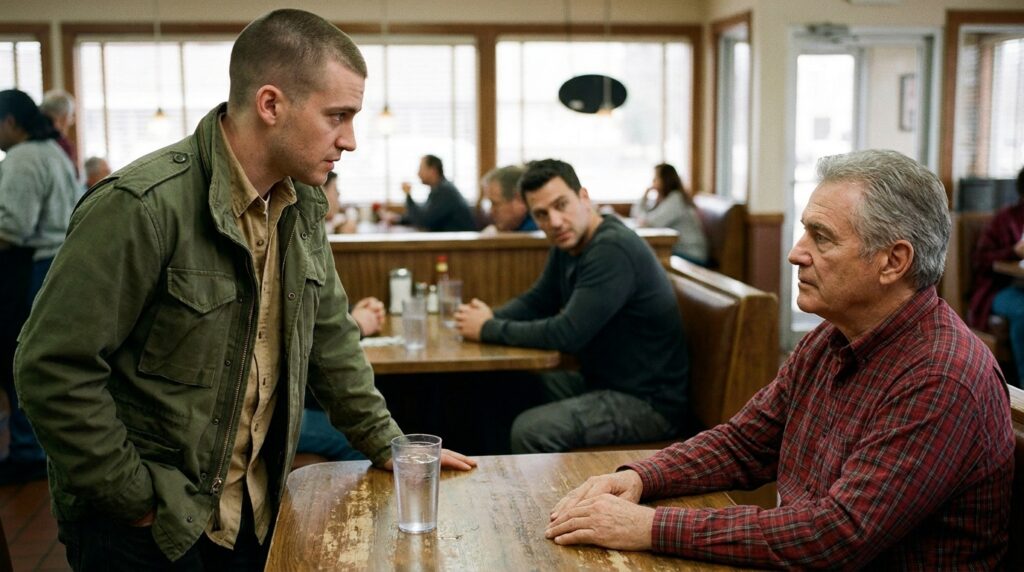
The corporate logic that had brought the kid into the corner booth—the legal maneuvering, the tax leans, the infrastructure revenue projections that had seemed so concrete an hour ago—had evaporated, leaving only the cold physics of two miles of unvented concrete culverts filling with pressurized chemical slime. The kid was no longer an antagonist; he was simply a green private who had dropped his piece in the dirt during his first live-fire run.
“The manual gate is three hundred yards past the boundary wire,” Thomas muttered, his right hand locking around the kid’s arm with the iron restraint of an old command figure. “The override lever has an unindexed iron lock that doesn’t belong to the county. You’re going to help me throw that bar before the backup pressure splits the lower culvert wall under the school yard.”
The kid didn’t speak. He allowed himself to be hauled into the cab of Thomas’s truck, his boots dragging through the loose limestone until his knees hit the rusted floorboards. The engine caught with a harsh, heavy roar—the ungreased clatter of old pistons working against time, against the grey silt rolling down the creek bed, against the ultimate truth that had finally broken through the table and into the morning air.
Thomas shifted the lever into gear. He didn’t look back at the diner windows where the last observer had vanished into the grey morning light. He pressed his heel into the floor, his silver ring cold against the wheel as the old truck surged forward into the dust, driving straight toward the ridge where the white grease was already clearing the line.