CHAPTER 6: THE RUPTURE OF THE DECOY
“Tell them to clear the pad,” the radio squealed again, the signal breaking into a jagged hiss of white noise that sounded like dry sand blown against sheet iron. “The return valve is locked up tight. It’s not water, Chief. It’s coming out grey, and it smells like a battery fire. We’ve got two men down on the staging deck who can’t catch their—”
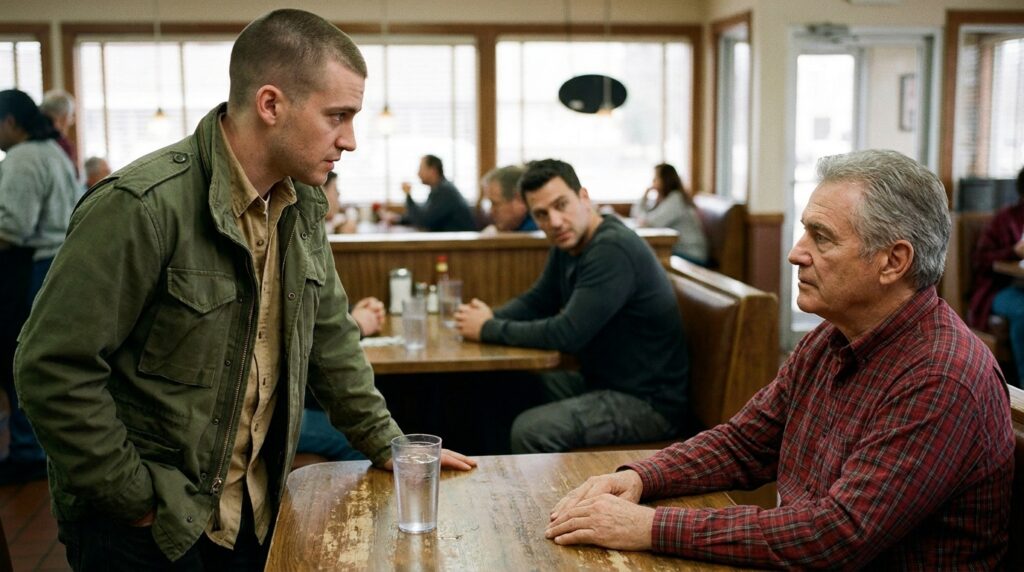
The radio went dead with a sharp, high-frequency pop that left the diner completely silent. The kid didn’t lower the hand holding the silver casing. His arm remained fixed at a rigid right angle, his athletic frame frozen between the wooden edge of the booth and the cold light of the door pane. His fingers were slick with the sudden grease of panic, leaving shiny grey streaks on the tactical finish of the handset.
Thomas didn’t wait for the younger man to drop his arm. He stood up from the vinyl bench, his old knee joints giving a dry, rhythmic pop that seemed to match the low-frequency vibration of the iron water pipes beneath the floorboards. The worn leather folder was tucked beneath his left arm, his heavy silver ring pressing hard against the cracked binding where the black electrical tape had begun to split.
“The title wasn’t theirs to buy, son,” Thomas said, his slate-grey eyes catching the kid’s gaze and locking it into place. “The land board didn’t hide those records to cheat your acquisition firm out of a right-of-way. They hid them because the concrete under that ridge was never designed to be drilled. The third logistics detachment didn’t leave fuel lines up there—they buried sixty tons of unexploded white-phosphorus mortar shells from the sixty-two depot closure.”
The kid’s mouth worked silently for a second, his short buzz cut catching the yellow grease-film reflection from the ceiling fixture. The corporate justification he had carried into the diner—the legal logic of easements, property liens, and county infrastructure development—had shattered down the middle, leaving nothing but the raw, chemical reality of the grey mud drying on his cuff. “The engineers… they checked the core samples from eighty-four,” he whispered.
“They checked the samples the company gave them,” Thomas said, his voice dropping into that thick, iron cadence that belonged to the motor-pool yard, not a retirement bureau. “They didn’t check the lower drainage channel because I had the only copy of the cross-section log buried under three hundred pounds of steel scrap in my barn. Your company didn’t want the access codes to clear the title—they wanted the five-digit ordnance stamp so they could verify the salvage value of the storage hulls before the county park bill passed.”
Behind them, the cook let the coffee pot hit the counter with a loud, hollow clatter that made the two truck drivers slide out of their booths in one simultaneous movement. They didn’t ask for their bills. They moved toward the back exit, their heavy boots making a fast, double-time scrape against the floorboards as the scent of scorched matches and sour metal began to drift through the front air vents. The small-town etiquette had dissolved; the public witness layer was no longer watching a status flip—they were fleeing a perimeter.
Thomas reached out, his weathered right hand catching the kid’s olive field jacket by the stiff nylon collar. He didn’t use a combative grip; he used the short, high-leverage anchor of an experienced sergeant resetting a green private at the firing line. The physics of the movement were clean—a simple weight shift that dragged the younger contractor two inches forward until his chest hit the edge of the shared wooden table.
“You’ve got three minutes before the pressure reaches the lower aquifer,” Thomas muttered, his face so close the kid could smell the cold coffee on his breath. “The secondary intake has a manual sluice gate behind the pump house. If your flatbed is blocking the road, your crew is going to drown in zinc tallow before the state troopers can set a roadblocks.”
The kid didn’t struggle against the grip. His eyes were wide, the pupils dilated until the grey of his irises was nothing more than a thin ring around the dark center. The silver radio in his hand began to click rhythmically—the automatic beacon of a tactical unit that had lost its base station. “The keys… the keys are in the truck,” he stammered.
“Then move your feet,” Thomas said, releasing the nylon with a short forward shove that sent the younger man stumbling toward the door latch.
Thomas turned back to the booth, his hand dropping onto the white porcelain cup one last time. He didn’t drink. He simply picked up the small brass survey pin from his shirt pocket and laid it flat on the grease-filmed oak, right next to the white mud flake that had fallen from the kid’s sleeve. The pin’s serial stamp—the unreadable code that had kept the north ridge locked for forty years—showed clear under the morning light. The decoy secret of the property dispute was gone, paid for by the sudden, hollow whistle from the ridge that was now growing louder with every breath he took.
He didn’t look back at the pie case or the watchful observer who had vanished out the side door. He gripped the leather folder against his ribs and followed the kid out into the dusty, sulfur-heavy glare of the parking lot.