CHAPTER 5: THE CORROSION OF LAW
The grinding step of the man in the dark canvas coat stopped three inches short of the kid’s elbow. He didn’t look at the kid. Instead, he pulled a heavy, square leather wallet from his interior pocket and dropped it onto the wood. The leather was grayed at the corners, the grain rubbed smooth by thirty years of utility belts, but the small brass star pinned to the interior flap still carried the dark green patina of old river humidity.
“The second lock doesn’t take a key because the state police welded the housing shut in eighty-four, son,” the man said. His voice was dry, the gravelly drawl of a retired county investigator whose ears had been ruined by open-cab tractors. “And the county sheriff doesn’t sign off on utility overrides unless the state surveyor signs the environmental variance first. I’ve been sitting in my car listening to the low-band frequency for twenty minutes. Your crew chief didn’t log a pipeline transit with the district dispatcher. He logged an emergency bypass.”
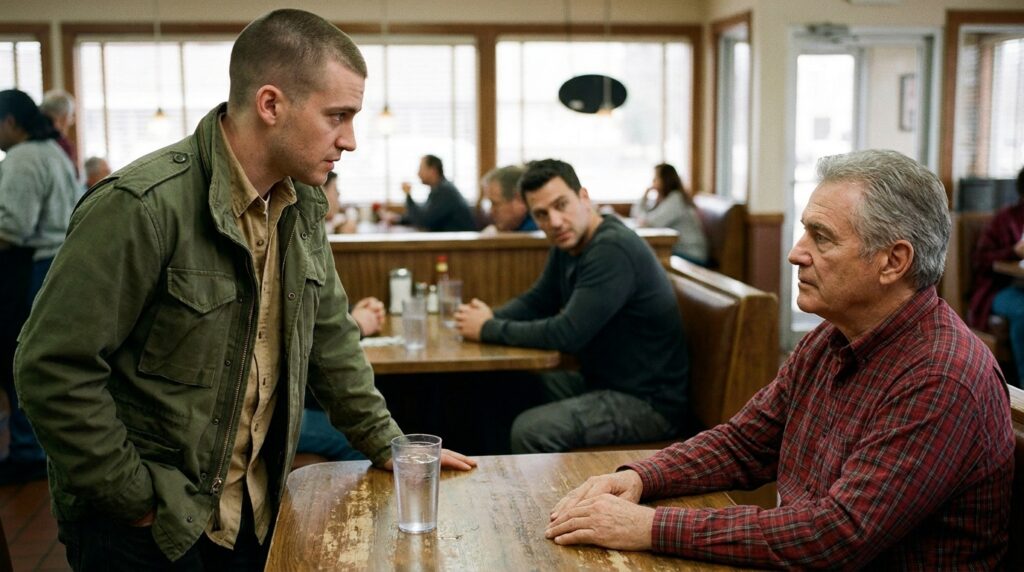
The kid didn’t turn his head, but his jaw gave a hard, visible click. The strategic confidence he had worn like a second skin when he entered the diner was flaking away, leaving only the raw friction of a subordinate who had been handed a bad map and a short deadline. “Vance,” he muttered, his eyes tracking the dark corrosion around the rivets of the retired trooper’s badge. “This isn’t your division anymore. The regional board passed the infrastructure emergency bill on Tuesday. Local jurisdiction was suspended along the ridge corridor.”
Thomas looked at the badge, then back at the kid’s cuff. The white zinc grease was dry now, a chalky residue that left faint white smudges on the dark varnish of the booth. The setback didn’t come from the kid’s words; it came from the low, rhythmic vibration that began to thrum through the soles of Thomas’s boots. It wasn’t the kitchen compressor. It was the deep, sub-surface thud of a six-inch rotary drill hitting the upper limestone cap two miles north. They hadn’t waited for the folder. The confrontation in the diner wasn’t a negotiation—it was a containment action meant to keep Thomas away from the ridge while the heavy equipment broke the seal.
“They’re already past the baseline,” Thomas said, his voice dropping into a flat, iron registry that made the retired trooper look down. “They didn’t want the access codes to clear the title, Vance. They wanted to see if the pressure gauges on the lower culverts were still recording.”
The kid took a full step back now, his boots grinding the salt into the linoleum with an aggressive rasp. He reached into his field jacket, his fingers wrapping around a heavy, silver-cased radio that carried the dark green military-spec stencil of a tactical relay. “The title fraud was just the filing mechanism,” he said, his youth disappearing behind the cold, transactional clarity of a corporate operator who knew his leverage had just been crushed but his objective was already moving. “We don’t need your signature, Miller. The drill went through the upper concrete shelf five minutes ago. If that folder has the drainage cross-sections, you’d better pray our bit doesn’t hit the secondary intake.”
The diner had gone completely cold. The cook remained by the pie case, the coffee pot held at a stiff angle, his eyes locked on the old trooper’s badge. The two truck drivers in the corner were already sliding their maps into their pockets, their faces hardening into the neutral, unreadable masks of local men who knew when a state line dispute was turning into something that would ruin the autumn well water.
Thomas felt a cold weight settle behind his ribs—the familiar, metallic taste of tactical failure. He had spent twelve years keeping the leather folder buried under the spare tire of his truck, believing the county’s bureaucratic inertia would protect the ridge more effectively than a wire fence. He had assumed the acquisition firm was running a standard land-grab fraud to inflate the utility board’s stock. He had calculated his resistance based on the logic of property lines and tax leans.
He had been entirely wrong. The corporate easement wasn’t a decoy to steal the timber; it was a legal shield designed to cover a catastrophic corporate salvage operation.
“Vance,” Thomas said, his fingers tightening against the stickiness of the electrical tape on the folder’s spine until the wood beneath his palm felt like frozen iron. “Get your vehicle. The lower drainage system isn’t connected to the creek. It empties into the limestone aquifer under the township school.”
The retired trooper didn’t ask for clarification. He picked up his square leather wallet, his thumb tracing the green corrosion on the brass star once before he jammed it into his canvas pocket. His face had gone from the weathered red of an old farmer to a dull, flat grey that matched the morning mist outside. “The wind is coming from the north,” Vance muttered, his boots already turning toward the glass door. “The old radio tower on the hill still has the Civil Defense horn on the roof. I can trip the relay if the pressure line drops.”
The kid didn’t follow him. He stood between Thomas and the door, his silver radio humming with a low, white-noise static that sounded like dry sand shifting across a concrete floor. A voice broke through the speaker—thin, metallic, and frantic with the high-country accent of a drilling foreman who had just hit something that wasn’t limestone.
“We’re through the vault wall,” the speaker rattled, the distortion tearing at the small speaker grid. “But the pressure isn’t dropping. It’s climbing. There’s an unmapped header pipe down here, and the mud is coming up white. It looks like zinc tallow, Chief. It’s eating the seals on the return line.”
Thomas didn’t rise from the booth. He opened the taped spine of the folder, his weathered thumb sliding past the old land deeds until it caught the yellowed edge of an engineering blueprint marked with three diagonal red stripes. The paper was crisp, the sulfur smell of old drafting ink rising from the folds like ghost smoke from a dead engine. He didn’t show the kid the map. He simply looked at the lowest line of the cross-section—the one marked with the old five-digit ordnance stamp that matched the pin in his pocket.
“You told your crew to use a diamond bit,” Thomas said to the kid, his voice so quiet it was nearly lost beneath the static of the radio. “You thought you were drilling into a storage vault for old infrastructure records. You didn’t check the weight of the concrete because you thought the county built it.”
The kid didn’t answer. He held the radio to his ear, his short buzz cut glistening with a sudden sheen of cold sweat as the distant thudding from the north ridge stopped entirely, replaced by a low, hollow whistle that vibrated through the diner’s water pipes.