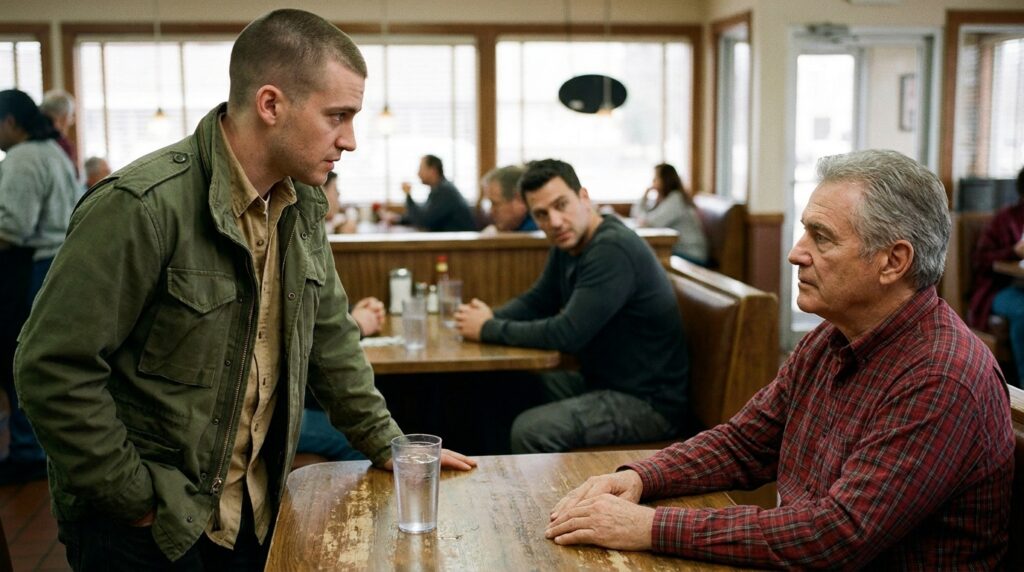
CHAPTER 2: THE FRICTION OF THE REAR GUARD
The kid didn’t drop his hands from the table. Instead, the wood groaned under his shifting weight as he canted his head, his chin jerking back half an inch. The warning had landed like an ungreased iron bolt sliding home in a dry receiver—low, raspy, and solid enough to vibrate through the Formica.
“Step back?” The kid’s laugh was thin, raspy from dry air and tobacco. He didn’t move an inch. “You’ve got a lot of nerve for an old man who doesn’t even own the gravel his truck’s rotting on. That land belongs to the state utility consortium as of midnight yesterday. Your fence is six feet over the line, and that leather wallet next to your hip contains the signed survey exemptions from forty-four years ago. I’m not some local deputy you can spook with that tone, old man. My outfit has a warrant for structural inspection, and we’re taking the ridge by noon.”
Thomas didn’t blink. He watched a faint smudge of pale white grease on the kid’s sleeve—not tractor oil, not grease from the diner kitchen. It was the zinc-based sealant used on military-grade storage lids, the kind that didn’t wash out of synthetic fibers without a kerosene rinse. The kid’s company wasn’t drilling for gas. They weren’t setting telephone poles either.
“The ridge is federal reserve until the county receives the formal deed,” Thomas said. His voice remained in that dead, level space, the cadence of a man who had spent three decades counting supply crates under artillery light. “The county hasn’t seen the papers because there aren’t any papers to show, son.”
“We don’t need your county clerk,” the kid hissed, his knuckles tightening again, his breath leaving a small circle of fog on the dark wood between them. “We’ve got the state clearance. The easement is ours. Now hand over the folder or I’m calling the marshal down from the interstate.”
Behind the young contractor, the Background Observer finally shifted. His boots—heavy, oil-tanned leather with thick Vibram soles that left gray scuffs on the diner’s linoleum—made a dry, rhythmic scraping sound against the floorboards. He didn’t approach the table. He moved toward the counter, his hip brushing against the chrome stools, his eyes locked on the reflection of the kid’s back in the dark glass of the coffee pots. He reached up, his thumb and forefinger lightly testing the weight of a brass key ring hanging from his belt loop.
The kitchen door swung open once, letting out a sharp blast of burnt onion and the harsh, metallic rattle of a dishwasher basket hitting an iron sink. No one spoke. The two truck drivers in the corner booth had stopped looking at their road maps; one of them had his fork held halfway to his mouth, the yolk of his egg dripping yellow onto his paper napkin. The silence in the diner wasn’t the silence of respect; it was the heavy, sulfur-sour quiet that settles over a dry field before the first strike of heat lightning hits the wire fence.
Thomas looked down at his own hand again. The silver ring felt heavy, a cold band of iron against his skin that seemed to draw the remaining warmth out of his fingers. He could feel the thin edge of the document folder pressing through his trousers, the corner of the stiff, linen-backed paper inside cutting slightly into his hip. The kid thought he was holding a property line. He thought he was protecting a few acres of scrub pine and gray shale from a state highway expansion. He had no idea what happened to the soil under those pines when the trucks came through in the dark during the autumn of ’82.
“The marshal knows where the township line ends,” Thomas said softly. He didn’t move his hand from the table, but he let his fingers uncurl, his palm rising just enough for the kid to see the old, white scar tissue thick across the base of his thumb—the kind left by the hot breach of an unvented recoilless rifle. “And he knows who dug the drainage ditches on that ridge before your father was old enough to carry a pocketknife.”
The kid’s mouth opened to reply, his chest expanding as he took in a breath to launch another threat, but his eyes wandered down to Thomas’s hand. He saw the ring. He saw the worn, flat spot where the eagle’s talons had once been engraved into the silver, now nothing more than three parallel gouges in the metal. The kid’s shoulder blades locked. His posture didn’t soften, but the forward lean stopped, his weight shifting back onto his heels as he noticed the small, brass survey pin tucked into the corner of Thomas’s shirt pocket—the old, five-digit serial stamp that hadn’t been issued since the Department of Defense cleared the ordnance depot at the river mouth.
“You’re Miller,” the kid said, his voice losing its edge, dropping into a flat, dry register. “The supply chief from the third division.”
“I’m the man sitting in this booth,” Thomas replied. He reached out with his left hand, his thumb catching the edge of his lukewarm coffee cup, his fingernail clicking twice against the thick porcelain. “And your coat is dirty, son. Zinc grease doesn’t belong on a highway job.”
The kid took half a step back, his boots squeaking against the salt-crusted floor. He didn’t look at the Background Observer, but his hand moved toward his pocket, his fingers twitching against the heavy nylon flap of his jacket as the front door of the diner rattled against its iron latch.