CHAPTER 4: THE THRESHOLD OF RESISTANCE
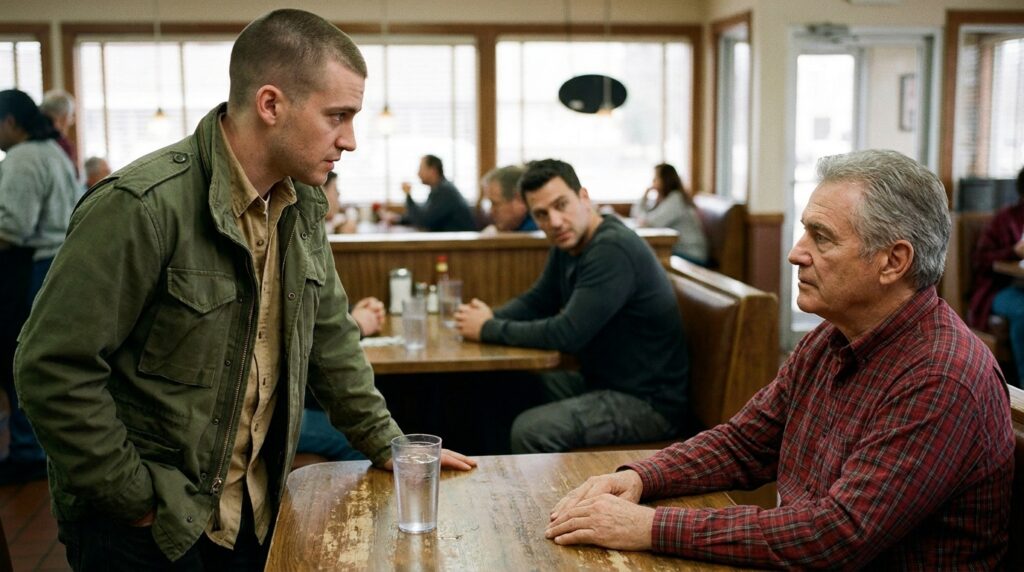
The door latch gave a final, rusted click before the frame gave way. The cold air from the valley floor rolled in across the threshold, cutting through the heavy smell of lard and hot grease like an iron wedge. The shadow that entered didn’t scramble for a table. It moved with the slow, deliberate stride of a man who spent his mornings checking the depth of creek beds and the thickness of boundary wire.
“You’re leaning too hard on that wood, son,” Thomas said, his voice dropping into that quiet, gravelly frequency that made the water glass on the table tremble against its rim. “And you’re standing on ground that doesn’t recognize your boots yet.”
The kid didn’t step back, but his shoulders gave a sharp, involuntary jerk. His fingers, still pressed flat against the scarred oak, left white patches on the grain where his blood had ceased to circulate. His face had gone the color of skimmed milk under the yellow flicker of the ceiling fixture. He was looking at Thomas, but his attention was split by the heavy tread behind him—the dull, regular thud of government-issue rubber soles meeting old linoleum.
“The survey is clear,” the kid muttered, his tone dropping until it was nearly lost in the low, mechanical rattle of the pie case. “We don’t need a township permit for a subsurface probe. The state consortium has a blanket exemption for the reservoir drainage corridor. If we don’t clear the access lines by noon, the regional office is going to drop a non-compliance lien on every parcel from here to the bridge.”
Thomas let his palm rise from the wood. The silver ring caught a momentary glint of cold grey light from the window, its worn crest showing three faint, parallel lines where the old unit engraving had been filed down to a dull plate. Beneath his hand, the blue ink stamp on the corner of the leather folder had begun to bleed through the grease-stained paper—a distinct, five-digit alphanumeric sequence that began with the letters ORD. The kid thought it was a tract code. He thought it was a legal reference for a land easement dispute that could be settled with a court order and a standard wire cutter.
“The state consortium doesn’t own the culverts under the north slope,” Thomas said softly. He didn’t reach for the folder, but his index finger traced the sticky wrap of electrical tape along its spine. “They own the pipe that runs through them. The concrete around that pipe belongs to the engineers who poured it when the county line was still a gravel road. If your manager tells you different, you ask him why the drainage ditch at the base of the ridge has a steel grate three inches thick and a padlock from the Department of Defense.”
The Background Observer had stopped checking his keys. He stood entirely still now, his dark canvas coat hanging straight down, his hands resting loose at his sides just below the level of his belt. He wasn’t watching the kid anymore. His eyes were locked on the small, white scar running through Thomas’s left eyebrow—the specific trajectory mark left by an unvented breach block during a training run at the old depot forty winters ago. He knew what the folder contained. He knew exactly what kind of paper stayed white after forty years in a damp basement.
The kid’s chest rose and fell in short, irregular hitches. He took a single step to the side, his boot heel scraping against the salt-crusted floor with a sharp, dry rasp that made the truck drivers in the corner booth look up from their maps. His hand remained near his pocket, his thumb catching on the heavy nylon seam of his olive field jacket where the pale smudge of zinc grease had begun to dry into a hard, white crust.
“We found the secondary shaft,” the kid said, his voice tightening until it had the thin, brittle ring of cold tin. “The one with the brass seal near the old pump house. The title company said it was an abandoned limestone storage vault from the old quarry crew. We’ve already got the pneumatic compressor on the flatbed at the gate. If we don’t have the clearance sequence by the time the crew chief finishes the daily log, we’re cutting the chain.”
Thomas looked past the kid’s shoulder to the front glass. The sun was fully over the ridge now, throwing long, desaturated streaks of yellow across the gravel lot outside, highlighting the rusted fenders of his old pickup and the sharp, clean lines of the contractor’s white utility truck parked directly behind it. The mud on the utility truck’s wheel wells was grey—not the red clay of the valley floor, but the alkaline silt that gathered only where the deep drainage channels broke through the limestone.
“The brass seal wasn’t put there by a quarry crew,” Thomas said, his grey eyes settling back onto the kid’s face with the weight of an unmovable object. “It was put there to keep the water out of the lower gallery. You drop a pneumatic bit into that limestone, son, and you won’t find a storage vault. You’ll find out exactly why the third logistics detachment didn’t leave a salvage list when they pulled the trucks out of the county in October of eighty-two.”
The kid’s mouth opened to reply, a sharp, angry syllable forming behind his teeth, but the sound died before it reached the air. The heavy latch on the inner kitchen door gave a sharp, metallic click as the cook stepped out with a fresh pot of coffee, his boots squeaking against the slick floorboards. The room had changed its tone; the low, regular hum of the breakfast rush had been completely replaced by the heavy, dry stillness that settles over a trench before the first shell leaves the tube.
Thomas let his fingers rest flat on the taped edge of the folder. He could feel the dry crackle of the inner map sheets—the heavy, cloth-backed vellum that carried the red-ink boundaries of a zone that had never been marked on any county road map. The kid was still looking for a land line. He was still waiting for an old man to give up a signature so he could clear his work order and collect his weekly check from the acquisition firm.
“You tell your chief that the gate has two locks,” Thomas murmured, his fingernail clicking once against the thick porcelain of his lukewarm cup. “And the second one doesn’t take a key.”
The door behind the kid didn’t close, but the man in the dark canvas coat took his first step forward, his boot sole making a slow, grinding sound against the sand on the linoleum.