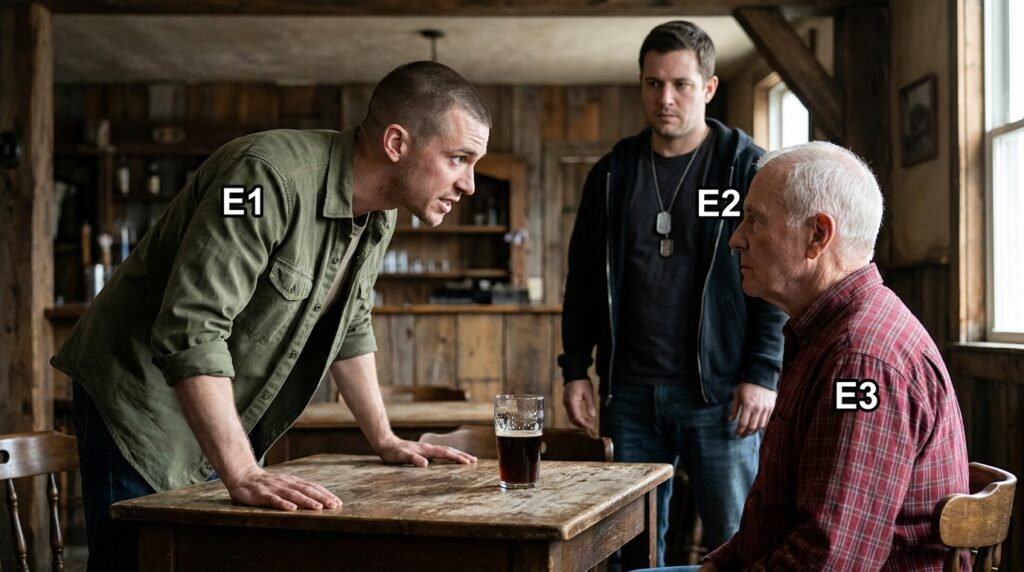
CHAPTER 5: THE CORE REVERSAL
The empty spot on the table was colder than the wood around it.
The manila folder was gone, vanished into the crisp nylon seal of the operator’s document pack, but the world didn’t stop spinning on its axis. General Garret didn’t look down at the bare, scarred oak. He kept his wire-rimmed spectacles locked on my face, the red strobe from the parking lot slicing horizontally across his lenses like a thin line of blood. The tactical detachment was already falling back into a defensive egress formation, their heavy leather soles pivoting on the floorboards with a synchronized, mechanical scrape.
“You built a solid perimeter, old man,” Garret said, his voice dropping into that flat, clipped cadence used by managers who have successfully audited an unlisted line item. “But a perimeter only works if the terrain stays static. You’re still calculating your options based on the ninety-two regulatory framework. The department moved past that architecture before the ink dried on your retirement citation.”
I looked down at the table surface. The cream-colored bond sheet containing the Title 10 seizure warrant remained behind, pinned down by the heavy octagonal beer glass. But beneath the base of that glass, right where the condensation had pooled into the grain, lay something the operator’s fingers had missed in their efficiency—the steel split-pin clasp. It had snapped free from the cardboard folder during the forceful pull, its dual prongs flattened out against the dark varnish like a tiny, silver trapdoor that had just been tripped.
“You should have looked at the clasp, Garret,” I said, my voice cutting cleanly through the rhythmic hum of the tactical vehicles outside.
The General’s left eyebrow twitched, a minuscule hitch in his expression that lasted less than a millisecond. He didn’t order his men to stop, but his boots didn’t take the next step toward the door either. “The clasp is inventory scrap, sir. The data is in the folder. The field logs from the ridge are already entering the incinerator loop at the base headquarters.”
“The field logs from the ridge were the decoy, you fool,” I replied, my right hand slowly moving across the table, my index finger pinning the broken piece of steel to the wood. “Vance thought the folder was an execution order for his career. You thought it was a political liability for the oversight committee. Both of you spent the evening chasing a paper trail because you’ve been trained to follow the ink.”
The room went perfectly quiet again. The three tactical operators in the entryway stack didn’t lower their muzzles, but their postures stiffened, their ears straining against the low hiss of their internal throat-mics. The bartender had vanished beneath the lip of the copper counter entirely, seeking the only cover the structural wood could provide.
I slid the silver split-pin across the varnished oak until it rested directly over the crimson ink of the emergency seizure warrant. Under the raw glare of the halogen searchlight, the inner side of the metal prong showed a micro-engraved, five-digit logistical stamp—501-A. It wasn’t an administrative serial number. It was the original designators code for the black-budget infrastructure that had established the local base’s communication routing array forty years ago.
“The oval stamp on the backing sheet wasn’t an administrative marker from the depot,” I murmured, my gaze remaining locked on the bridge of Garret’s nose. “It was the structural architecture validation. The file didn’t just contain reports on a supply bottleneck at the ridge. It contained the complete, unredacted logic loop for the automated division command network. The network you used to coordinate this tactical box-in tonight.”
Garret’s face didn’t just pale; the muscle beneath his left ear locked up like an over-tensioned cable. He took a single, aggressive step forward, his leather gloves striking the table with a dull, hollow thud that vibrated through the oak. He finally realized the scope of his miscalculation. He had stolen a container of paper, but by bringing his active, network-linked command unit within three miles of this specific coordinates booth, he had brought his entire active infrastructure directly into the target profile.
“The Third Battalion doesn’t operate on an unlisted network,” Garret hissed, his voice losing its dry, administrative drone, replaced by the jagged edge of an officer who has just realized his forward command post is completely exposed. “The encryption architecture is secure.”
“The encryption architecture is yours,” I said, a cold, sharp smile finally touching the corners of my mouth as the tiny silver signet ring on my finger caught the strobe light. “The baseline logic is mine. I didn’t stay in Virginia to archive the past, General. I stayed to ensure that when the younger generation started using my tools to cover their rot, I could turn the power off from the basement.”
A high-pitched, metallic whine suddenly tore through the tactical operators’ headsets, followed instantly by the sharp, electric pop of an unshielded circuit blowing in the lead vehicle outside. The white halogen searchlights cutting through the windows flickered twice, then died, plunging the tavern back into the dim, cold amber of the failing Edison bulbs as the deep thrum of the diesel engines choked out into absolute silence.
Garret stared at me through the gloom, his wire-rimmed spectacles reflecting nothing but the darkness closing in around his perimeter. The decoy layer had shattered, and the ultimate truth was finally turning its teeth toward the room.