CHAPTER 4: THE SHIFTING LINE
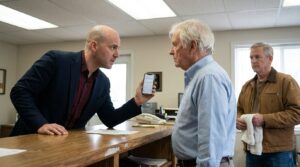
The rhythmic click of leather heels against polished stone rose from the glass-walled concourse. Preston Vance did not move his fingers from his frozen tablet; he stayed locked in a fixed lean, his eyes tracking a three-man detail cutting through the wide-open expanse of the lower rotunda.
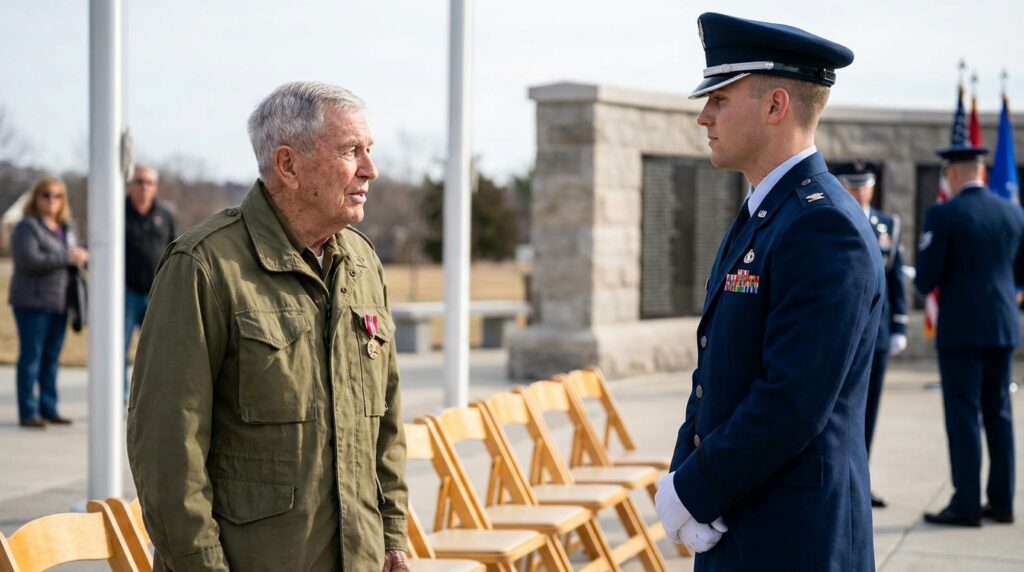
At the center of the detail walked an active-duty lieutenant general. His service dress coat was pinned with rows of ribbons that caught the cold vertical down-lights of the atrium, but he carried himself without the stiff, rehearsed grandeur of the political brass Arthur had spent forty years avoiding. He walked with a heavy, left-sided hitch—a limp earned on iron soil, not behind an office desk. In his right hand, the general gripped a scuffed leather document case, its brass security latch conspicuously missing its lower hinge pin.
Arthur didn’t turn around to watch the approach. He kept his eyes on Preston’s hands, tracking the precise moment the young man’s fingers began to sweat against the synthetic casing of his sleek device. Arthur knew the general’s stride before he heard the voice. He knew the timing of the boots on stone.
“Report status on the perimeter lock,” the general said. He did not yell. He spoke with the quiet, devastating clarity of a man who assumed every wall in the building was listening to his command frequency. He stopped exactly two paces from the velvet rope, his eyes skipping past the security team, past the line of waiting junior staff, and stopping directly on the faded olive sleeve of Arthur’s jacket.
Preston cleared his throat twice, his bureaucratic shield dissolving into a frantic search for vocabulary. “General Miller, sir. We have a registration discrepancy. The digital interface flagged a high-level procurement credential carried by an unlisted civilian. We applied the baseline security protocol to isolate the boundary threat—”
“The software didn’t lock this room, son,” General Miller interrupted. He took a single step closer to the desk, placing the leather document case on the glass partition with a heavy, solid thud that made the tablet rattle. “I did. From the vehicle console five minutes ago.”
The sergeant in white gloves stepped forward, his posture hitting a perfect ninety-degree snap as he presented the torn manila envelope. “The documents from the St. Louis archive are verified, General. The physical manifest matches the historical logistics log for Sector Four. The signature lines are clear.”
Preston’s eyes darted between the general and the torn paper, his logic loop failing to find an exit path. “Sir, with respect, the regulations on modern data integration are absolute. If we allow paper overrides from unverified personnel without a current cryptographic profile, the entire foundational event loses its compliance certification. I am simply enforcing the administrative parameters established by the board.”
“The board didn’t sign the field orders that pulled my father’s battalion out of the valley near the border in seventy-one,” Miller said. His voice remained conversational, but the sharp edges of his gaze locked onto Preston’s face until the younger man shifted his eyes back to the floor. “And the man who did sign those orders doesn’t need a cryptographic key from your company.”
Arthur finally pulled his right hand out of his pocket. His fingers were dry, holding the scuffed brass lighter by its flat edge. He placed it next to the general’s leather case on the counter. The metal-on-glass click sounded exactly like the plastic card had two chapters earlier, but the weight of the sound was entirely different.
“You’re late, Thomas,” Arthur said simply.
The line of junior officers behind Arthur went rigid. A captain near the back actually took a half-step away from the rope, his face settling into an expression of profound, professional shock. To address a three-star commander by his first name without a title was an institutional sin that usually ended a career before the afternoon briefing.
General Miller looked down at the brass lighter, his mouth tightening into a thin, grim line. He didn’t offer a handshake; he didn’t lower himself to a public display of sentiment for the benefit of the room. He picked up the lighter, turned it over once to check the stamped serial number on the base, and slid it into his own pocket.
“The transit from the airfield was delayed by civilian traffic,” Miller replied, turning back to Preston. “Open the gate lane. Now.”
Preston’s hand shook as he reached for the manual release override beneath the counter lip. “Sir, the name on the digital placeholder card… it still points to Captain Donald Vance. If the security log reflects a mismatched entry, the audit trail—”
“The audit trail is closed,” Miller said, his voice dropping into the cold register that signaled a permanent operational decision. “Captain Vance is the logistics officer who pulled this specific file from the secure vault on my authority. The card was issued to ensure Arthur Vance could pass through the automated exterior gates without being forced to explain fifty-five years of unclassified history to a machine. But it seems the machine isn’t the problem here.”
The velvet rope dropped with a loose, soft thud against the carpet. The path into the main hall was clear, the long rows of aligned ceremonial chairs visible through the tall double doors just twenty feet away. The light inside the hall was softer, amber, completely detached from the cold halogen glare of the registration lobby.
Arthur stepped across the perimeter line, his faded boots leaving a faint trace of damp street dust on the plush burgundy rug. He didn’t look back at Preston, nor did he look at the security guards who had spent the last ten minutes calculating his removal. He walked with his head up, his frame upright, moving with the slow, measured pace of a man who had already survived the worst things the world could throw at him.
But as General Miller picked up the leather case to follow, the scuffed leather flap shifted, revealing a small, typed label pasted inside the inner pocket—a label bearing an official security designation that Arthur’s peripheral vision caught instantly. It didn’t say Department of the Army. It said Defense Intelligence Agency – Retraction Bureau.
Arthur’s stride didn’t break, but his fingers tightened against the empty fabric inside his pocket. The decoy of a simple historical medal presentation had just collapsed, leaving a deeper, colder structure visible beneath the ceremony.