
CHAPTER 8: THE SEVENTH BLIND SPOT
The transition was not marked by a change in location, but by a sudden, violent drop in visibility. Cole did not wait for the rain to slacken; he led the fireteam back toward the concrete blockhouse with his teeth clamped tight against the cold. His squad moved behind him in a low, compressed wedge, their high-tech optic visors flipped up into the wet air, their hands gripping the knurled steel shafts of manual crowbars and iron breaching blocks.
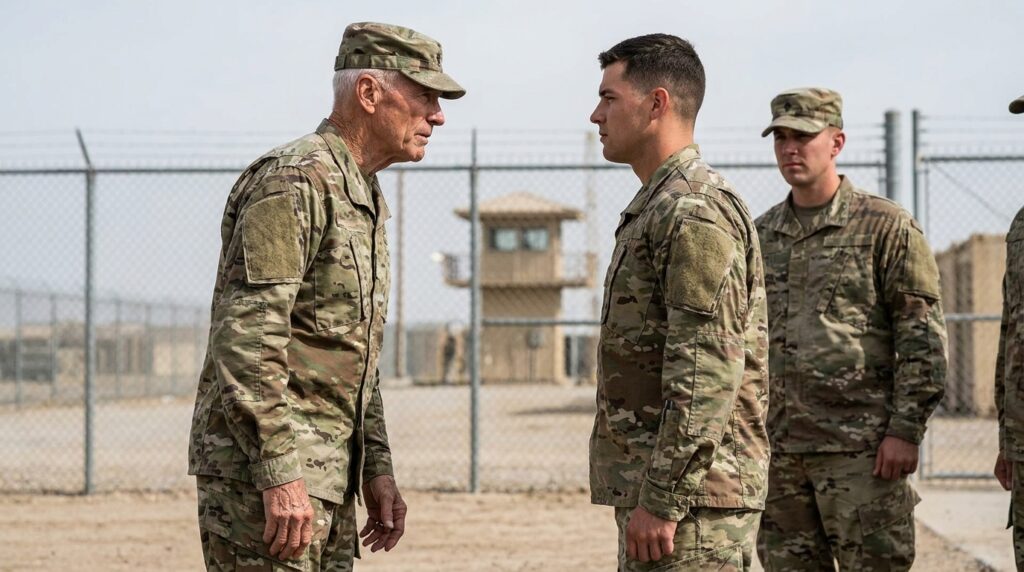
The old man moved at Cole’s left shoulder. He did not carry a tool, yet his long, lean stride carried an innate sense of physical leverage that seemed to split the storm. His white hair was plastered flat against his temples now, his weathered cap held low against a sharp gust of wind that smelled intensely of deep subterranean silt and sulfur.
“The seal isn’t on the rim,” the veteran said, his gravelly rasp dropping into Cole’s ear over the click of boots on basalt. “It’s four inches down, behind the secondary flange. If you try to wrench the top plate from the hinges, you’ll split the internal alignment pins and lock the core from the inside. Arthur, get the torch team to the rear vent.”
General Vance did not reply. He had stripped off his heavy wool trench coat, leaving his three-star insignia exposed to the driving downpour on his wet digital uniform. He was kneeling in the mud beside the blockhouse foundation, his leather-gloved fingers sliding into a narrow, dark crevice where the concrete met the native granite stratum. With a dull, grinding screech of metal against stone, the general pulled back a heavy, rusted plate that had been entirely concealed by layers of wild moss and silt.
“It’s clear,” the general baritone echoed from the ground. “The linkage is still dry.”
Cole dropped onto his knees beside the general, his plate carrier hitting the wet gravel with a hard, flat thud. The interior of the exposed recess didn’t contain wires or electronic terminals. It was a purely mechanical scale—a series of interlocking iron levers, heavy as rail track, covered in a thick layer of dark lithium grease that had turned gray with decades of dust. Scratched directly into the granite wall behind the primary lever was a small, hand-stenciled Roman numeral: VII.
“The seventh,” Cole whispered, his internal monologue matching the geometric precision of the machinery. He didn’t look at his tablet; the broken casing lay twenty yards behind him in the mud. “This isn’t a bypass. This is the master balance for the entire sector’s air pressure.”
“It’s the choke,” the old man said, standing over them like a lean, vertical monument against the gray sky. He reached down and gripped Cole’s shoulder harness with his left hand, his fingers anchoring with a bone-crushing intensity that forced Cole to look up into the clear, washed-out blue of his eyes. “The rogue sergeant didn’t cut the grid because he wanted to hide his position, Captain. He cut it because he’s waiting for you to pull the manual lever. The moment you throw that iron weight, the vacuum switches to the lower vault, and the main hatch becomes an active pneumatic trap.”
Cole’s chest went perfectly still under the nylon webbing. His strategic pursuit logic, the hyper-focused lens through which he viewed every deployment as a chess match, suddenly expanded to encompass the entire design. The red transponder indicators that had populated his screen moments ago weren’t locations of enemy combatants; they were automated pressure sensors. The rogue sergeant wasn’t sitting in a room waiting for an assault; he had turned the entire subterranean facility into a single, kinetic weapon that would crush the fireteam using the weight of their own intrusion.
“The decoy,” Cole said, the words cutting through the rattle of the rain. “The master roster, the amber error code, the red targets—the rogue sergeant wanted us to find them. He wanted us to trace the frequency to this specific blockhouse so we’d throw the manual release to clear the air for our squad.”
“He knows how you think, son,” the veteran said, his voice dropping into a low, terrifying whisper that seemed to stop the wind. “He knows you value an entry metric over a structural truth. If you had run your textbook breach, you’d have thrown the lever from the observation room, and your nine boys would have been dead before their boots touched the third rung.”
Cole looked at the iron lever. The handle was cold, its surface pitted with the deep, fine scars of manual use. He could feel the eyes of Staff Sergeant Miller and the entire squad on his back, their breath coming in short, tense plumes of white vapor against the dark concrete wall. They had spent six months preparing for a war of electronic optics and rapid-fire dynamics, yet they were standing in the mud, waiting for a single, flawed decision on an obsolete piece of cast iron.
“We don’t throw it,” Cole said, his voice hardening as he stood up, his posture squaring directly against the general’s shoulder. He reached down and wrapped his fingers around the knurled shaft of a manual iron block, bypassing the lever completely. “We breach the outer masonry. The wall behind the drainage grate isn’t load-bearing; it’s an acoustic baffle he installed to hide the intake hum in seventy-four.”
The old man’s expression didn’t soften, but the unyielding grip on Cole’s shoulder loosened by a micro-inch. The deep lines around his eyes seemed to settle into a cold, grim satisfaction.
“Miller,” Cole commanded, his voice clean of any promotional hesitation. “Bring the sledge and the wedges. We’re going through the stone.”
Before Miller could step forward, a heavy, dull thud vibrated through the basalt beneath their feet—a deep, pneumatic hiss that originated from the center of the blockhouse floor, signaling that the pressure inside the shaft was already beginning to shift on its own alignment.








