
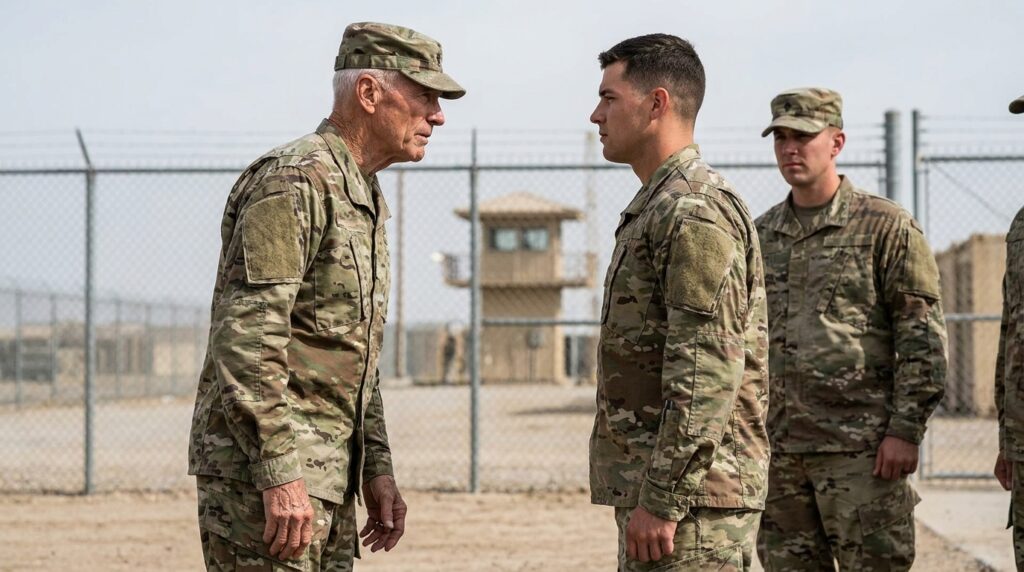
CHAPTER 7: THE ENCRYPTED THRESHOLD
The data feed on Cole’s terminal didn’t scroll; it clicked into existence like a row of glass panes shattering in sequence. Thirty-two crimson icons burned against the desaturated mapping grid, each one tagged with a sharp, geometric vector line that pointed back toward the exact coordinates of the mock compound’s northwest corner.
Cole did not drop his eyes from the display. His fingers, numb from the cold rain, tightened around the composite frame of the pad until the plastic seams bit into his palm. “The system isn’t running a projection,” he said, his voice dropping into the flat, hollow tone of a tactical commander recognizing a live threat vector. “These are active transponder returns. Every target is broadcasting on a low-frequency military band—eight-eight-four point two megahertz. That’s an old tactical loop from the expansion era.”
“It’s the loop we used before the satellites were launched, son,” the old man said, his gravelly whisper slicing through the sound of the rain. He stepped closer to the terminal, his shadow falling across the glass like a long, dark beam. He didn’t point at the indicators. He merely stared through them, his washed-out blue eyes focusing on the empty grid lines that represented the subterranean drainage shafts. “The rogue sergeant didn’t change his frequency because he knows the concrete walls down there are too thick for anything else. He’s sitting in the dark, waiting for you to walk into his blind spot with your digital arrays turned on.”
General Vance did not lower his head, but his leather-gloved hands came together behind his back, the fingers interlocking with a dry, scraping sound against the stiff wool of his trench coat. “The evaluation manifest you signed this morning, Captain—it wasn’t an inspection of your administrative readiness. It was an authorization filter. Every squad leader who has run this lane over the last six months has cleared the mock compound using the default textbook mechanics. They used the flash-bangs. They trusted the network. And every single one of them would have been dead within forty seconds of crossing the threshold.”
Cole’s jaw tightened until the muscle in his cheek felt raw. He looked down the long, rain-slicked tarmac toward the secondary assembly bay. His men were still there, clustered under the steel overhang of the motor pool, their digital gear glowing with small, useless blue indicators in the gray mist. They were fast, they were strong, but they were entirely blind to the architecture beneath their heels.
“The real deployment next week,” Cole said, his internal monologue calculating the geometric risks of a deep-shaft entry. “The objective isn’t a foreign installation. We’re going down into the closed sectors under this base. The rogue sergeant never left the wire.”
“He never left his hole,” the veteran corrected flatly. He reached out and snatched the terminal from Cole’s grip with a sudden, metallic force that rattled the younger man’s harness. The old man didn’t look at the tactical vectors. With a single, sharp motion of his thumb, he struck the side of the casing against the heavy zinc latch of the perimeter fence, cracking the plastic shell open until the lithium grease on the inner circuitry was exposed to the rain. “The screen tells you where he was five seconds ago, Captain. The ground tells you where he’s going to be when you open the hatch.”
“Sir,” Staff Sergeant Miller stepped forward, his boots sliding through the wet gravel, his voice trembling slightly as he looked at the shattered remains of the multi-thousand-dollar device in the old man’s hand. “The command grid is completely down. Without those transponder vectors, we have no line-of-sight to the lower corridors.”
“You don’t need sight when the walls are twenty-four inches of solid granite,” the old man said, his gravelly voice dropping below the volume of the wind, carrying the absolute, chilling authority of a master builder. He reached down to his lapel, his scarred fingers tracing the raw, frayed green threads where his legendary citations had once been sewn. “You need to know how the air moves through the pipe. Arthur, tell him what happens when the manual breaker is pulled from the lower well.”
The general turned his pale face toward Cole, his eyes empty under the dark brim of his cap. “The lower level loses its oxygen seal within four minutes, Captain. If you aren’t out of the bottleneck before the pressure drops, the air in your lungs becomes the vacuum.”
Cole looked at the old man’s hands. The silver-plated Zippo lighter was gone, tucked back into the stiff canvas pocket, but the smell of cold iron and dry static lingered on the old man’s fingers like a physical stain. The dynamic had completely shifted. The younger soldier was no longer defending his rank; he was standing on the narrow edge of a paradigm shift that threatened to swallow his entire squad before they could draw their weapons.
“The seventh blind spot,” Cole said, his voice dropping into a hard, competitive register that matched the veteran’s pace. “Show me where it is on the stone. Not on the pad.”
The Elderly Soldier looked at him for three long, unbroken seconds, the pale blue of his eyes as clear and unyielding as ice. “Get your squad out of the motor pool, Captain. Bring your manual tools. Leave the tablets in the mud.”








