
CHAPTER 2: THE BLACKOUT PROTOCOL
The siren did not merely sound; it cut through the damp air like an iron blade scraping across stone. The tone was low, a rhythmic, mechanical growl that vibrated through the soles of Captain Cole Vance’s boots long before it registered in his ears. On the surrounding towers, the high-intensity halogen arrays—usually reserved for midnight breaches—flickered once and then died, leaving the training sector bathed in the flat, bruised light of a rainy Maryland afternoon.
“Command override,” Staff Sergeant Miller said, his voice dropping an octave as he moved instinctively toward the Captain’s flank. His boots crunched hard on the wet gravel, a sharp, ragged sound against the uniform wail of the horn. “That’s a tier-one grid isolation, sir. They only pull the plug on the auxiliary lanes if there’s a perimeter breach at the mainframe.”
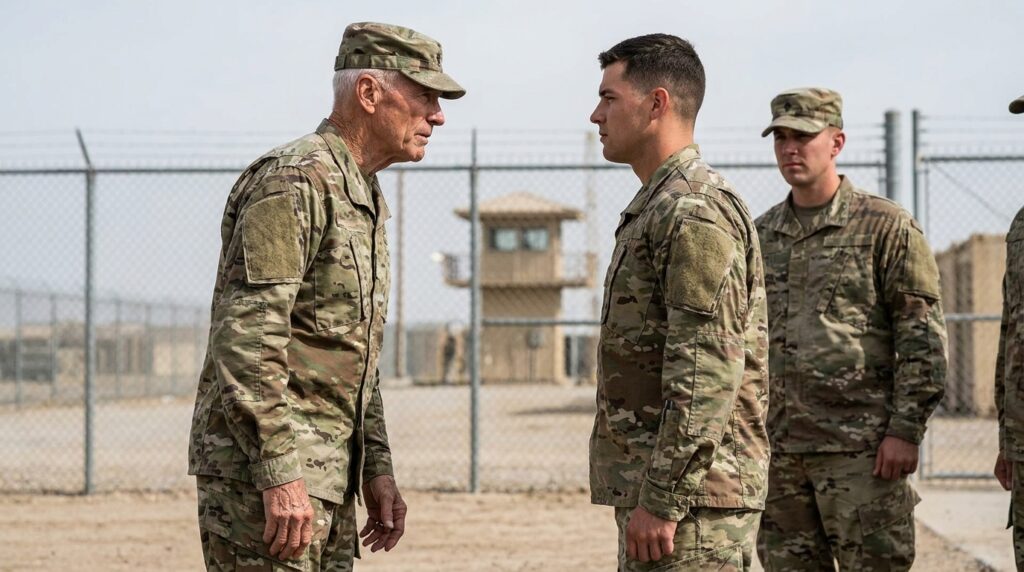
Cole didn’t answer. His eyes were still pinned to the old man standing twenty-four inches in front of him. The silver-plated Zippo lighter remained flat in the veteran’s palm, its polished casing catching the dim, metallic sheen of the wet fence links. The small click of its lid closing had been perfectly timed with the first pulse of the alarm, a coincidence that felt less like luck and more like a trigger being pulled.
“Your hand,” Cole said, his voice tight, focusing on the sharp edge of the lighter rather than the klaxon overhead. “Where did you get that uniform?”
The Elderly Soldier didn’t flinch from the proximity. The white hair beneath his cap cap rim remained perfectly dry, shielded by an angle of posture that seemed engineered to resist the elements. Up close, Cole could see that the camouflage pattern wasn’t standard active-issue; the digital blocks were smaller, the lines sharper, the fabric carrying the heavy, stiff weight of treated canvas that had been kept in a vacuum seal for decades. There were no unit patches, no airborne tabs, and no name tape across the breast—only the raw, dark green threads where a label had been meticulously picked away with a razor blade, leaving behind a ghost-imprint of stitches.
“The uniform stays the same, Captain,” the old man said, his gravelly tone sliding under the noise of the siren with a practiced, chilling clarity. “It’s the skin underneath that rots. Your men are breaking format. Look at your perimeter.”
Cole tore his gaze away, his jaw working as he looked back at the tactical lane. The three fireteams had abandoned their high-low spacing. They were clustering near the aluminum threshold of the simulated compound, their weapons lowered, their heads turning toward the communication shack where the red warning beacons were spinning in silent, bloody circles. The discipline he had spent six months hammering into them was fraying under the simple pressure of the unknown.
“Miller, get them back into the box,” Cole snapped, the administrative weight of his rank returning in a sharp, defensive burst. “We are in the middle of an evaluation cycle. Until the tower drops the flags, the lane is live.”
“The lane was dead before you stepped onto it,” the veteran whispered flatly. He moved his arm—a single, fluid motion that lacked the jerky speed of youth but possessed the heavy, unyielding momentum of an iron rod. He pointed a scarred index finger toward the northwest corner of the concrete blockhouse. “The drainage grate. Twelve inches of reinforced steel over a six-inch clear channel. If your logistics team had read the structural blue-lines from seventy-four, they’d know that channel connects directly to the sub-station basement. A four-man fireteam with standard oxygen kits doesn’t need to breach your front door. They’re already under your floorboards.”
Cole’s chest hardened against the nylon straps of his plate carrier. “That channel was filled with concrete twenty years ago during the base reconstruction.”
“Then why is the moss on the iron rim green, son?” The old man lowered his hand, his fingers resting steady against his side. “Concrete doesn’t sweat. Water only moves through a clear pipe.”
A cold spike of adrenaline hit Cole’s spine, sharper than the rain. He knew every inch of the Fort Meade training grid—or he thought he did. He had memorized the digital schematics on his tablet until his eyes bled. But looking at the old man’s finger, looking at the dark, wet shadow beneath the concrete blockhouse where the weeds grew thick and undisturbed, he saw the fault line. The old man wasn’t guessing; he was remembering.
Behind them, the gravel exploded.
Miller came sprinting back from the communication line, his face pale under the brim of his helmet, his fingers trembling slightly as he held out a handheld radio that was spitting static. “Captain. We’ve got a problem. The master terminal isn’t accepting our lane logs. When I tried to input the evaluator’s initials from the morning gate manifest, the system locked the whole sector down. The tower sergeant says the order came from the big house. Not the colonel—the general.”
Cole looked from the static-choked radio back to the old man. The veteran hadn’t shifted an inch. He stood against the wire fence like an integrated part of the barrier, his pale blue eyes tracking the clouds rolling in from the east, calculating the barometric drop with the silent precision of an old barometer.
“Who are you?” Cole demanded, his voice losing its transactional edge, replaced by a raw, tactical focus. His fingers hovered instinctively near the side of his belt, his posture shifting from an arrogant officer to a predator realizing he was sharing the pen with something older and much larger.
The old man turned his head slowly, the deep lines around his eyes shadowing his expression until his face looked like it had been carved from the same gray granite as the guard towers. He stepped forward, closing the remaining distance until the bill of his cap brushed the edge of Cole’s helmet, his breath cold against the younger man’s face.
“I’m the man who dug the well you’re drinking from,” the veteran said, his voice dropping below the static of the radio. “And right now, you’re leaning over the edge.”








