
CHAPTER 11: THE SILENT INGRESS
The pitch-blackness did not yield to the pressure of Cole’s shoulders; it resistance deepened as his boots ground into the loose flakes of rust below.
He did not call for Miller or the torch team. He threw the entirety of his body mass against the left rim of the three-foot iron wheel, his gloved palms catching the sharp, flaking cross-hatching of the casting. For a heartbeat, the dead-weight friction of fifty years of subterranean stasis held firm, the heavy iron spindle locking his elbows until the composite plate carrier on his chest groaned against the nylon straps.
“Hold the flank, Miller,” Cole ground out through his teeth, his internal monologue measuring the mechanical drag with a chess player’s focus. “The shaft isn’t dead yet. The counterweights are moving.”
With a sudden, metallic shriek that sounded like an iron rod splitting down its center, the valve yielded three inches. A rush of foul, freezing air burst through the unsealed packing gland, smelling heavily of sulfur, stagnant river silt, and the unmistakable, sweet chemical signature of old machinery grease. The black-space around them became a chamber of echoes, the sound of water rushing somewhere three levels further down accelerating into a low, uniform roar.
Beside him, the sudden, high-frequency chirp of a digital receiver punctured the silence.
It didn’t come from his fireteam’s cached equipment. It came from the ceiling line behind them—a crisp, synthesized notification tone that signal-pulsed three times before dropping back into static.
“Uplink tracking,” Specialist Briggs whispered, his voice hitching as his body moved instinctively into a defensive crouch in the dark. “That’s not our network, Captain. Someone just pushed an external query through the auxiliary terminal on the surface. The civilian contractor from Washington—he’s forcing the digital relays from the main gate office.”
“He’s tracing the line elements,” Cole said, his knuckles scraping the jagged edges of the wheel as he forced the iron spindle through its second complete rotation. The darkness was no longer a shield; it was a race track. His strategic pursuit logic recognized the signature of an external override. The supervisor from the bureau wasn’t monitoring their progress; he was trying to reset the system to Layer One before Cole’s fireteam could locate the manual bottleneck. If the digital relays fired now, the automated pressure gates would seal the corridor permanently, trapping the squad between thirty tons of concrete and an unyielding vacuum.
“Briggs, find the copper lead behind the primary junction box,” Cole commanded, his breath coming in short, ragged bursts that misted invisibly against the cold iron rim. “Don’t use your blade. Snip the main trunk with your pliers. Kill the signal wire before the surface terminal completes the handshake.”
“I can’t see the casing, sir,” Briggs’s voice carried the sharp, defensive heat of a technician stripped of his optics.
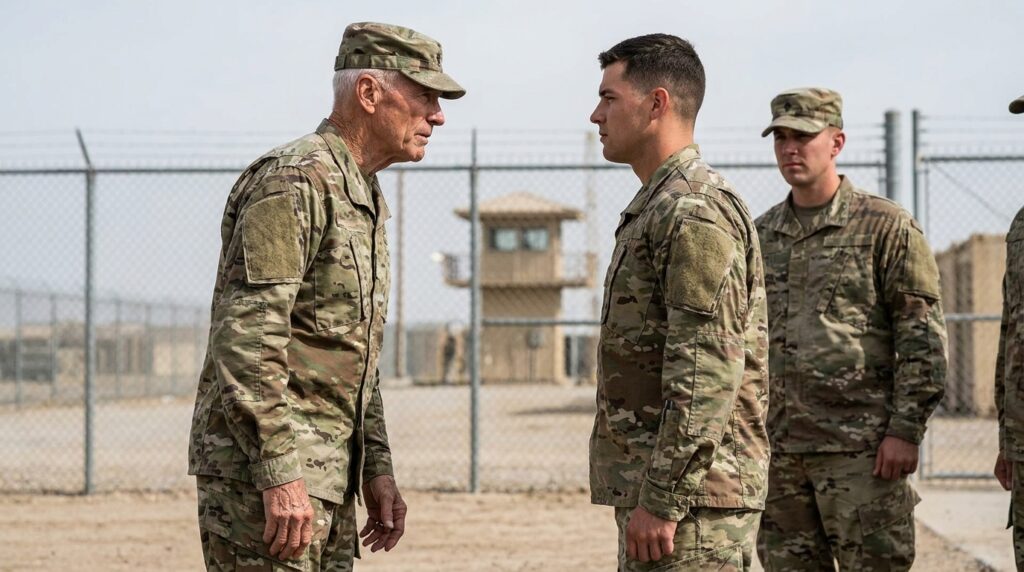
“Feel the weight of the conduit,” Cole snapped, his voice dropping into the gravelly cadence he had stolen from the veteran by the base fence. “The data lines are light, synthetic jacketed. The old command lines are three-quarter-inch galvanized iron pipe. Trace the rust until you find the soft wrap.”
The darkness grew heavy with the kinetic sound of labor—the ragged scrape of nylon gear against wet brick, the wet hiss of water spraying from the unsealed flange, and the rapid, desperate clicking of Briggs’s multi-tool hunting through the dead space behind the junction housing. Every second was a micro-metric calculation of failure.
Above them, through three hundred feet of solid masonry and earth, a dull, subterranean thud vibrated through the chamber walls—the first automated safety latch on the surface gate dropping into its lock sequence as the Washington supervisor’s script overrode General Vance’s manual isolation.
“I have the line,” Briggs grunted. A sharp, metallic snip clipped through the chamber’s roar, followed instantly by the clean, physical drop of the high-frequency hum in the ceiling. The digital pulse died mid-sequence, leaving only the raw, ancient sound of the valve opening into the dark.
With a final, shattering thud of forged iron against the stop-pins, the wheel locked open.
A sharp, linear draft of cold air pulled through the chamber, tearing the heat from Cole’s cheeks as it moved down into the newly opened channel. Through the empty valve sleeve, three levels down, a tiny, steady point of green fire emerged in the absolute blackness.
It wasn’t a chemical stick. It was the glow of an old tactical indicator panel from seventy-four, its manual elements still burning on a closed, non-networked mercury cell. The light didn’t illuminate the path; it merely framed the massive, circular silhouette of the seventh hatch—and the shadow of a man standing completely motionless beside the locking ring.








