
CHAPTER 14: THE JURISDICTIONAL STANDOFF
The outer bulkhead door didn’t yield to a key; it buckled under the raw physical thrust of a multi-stroke hydraulic ram.
The three-inch solid steel plate groaned, its original 1974 weld-seams snapping with a series of loud, metallic pops that sounded like high-caliber fire echoing down the stone corridor. A thick cloud of dry, abrasive granite dust exploded into the vault, instantly hanging in the heavy, humid air like a sheet of gray wool. Through the haze, the beams of high-intensity halogen tactical lights sliced through the dark, their cold blue glare reflecting off the pooling black water on the floorboards.
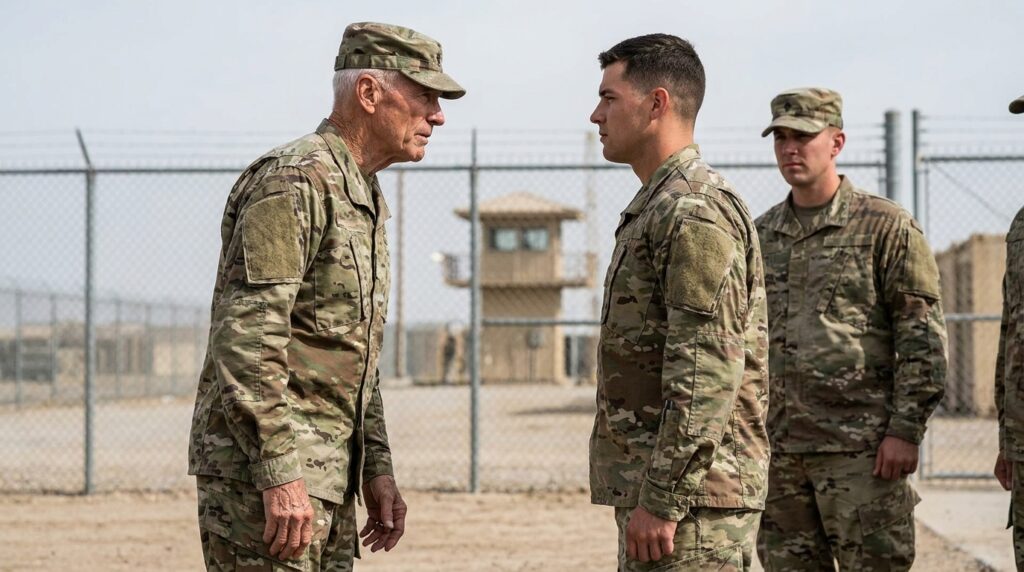
Cole didn’t lift his arm. He stood perfectly vertical behind the iron field desk, his palms resting flat against his thighs, his posture matching the unyielding geometry of the stone walls. His canvas uniform was stiff with dried silt, but his eyes, clear and steady in the harsh glare, locked instantly onto the lead silhouette stepping through the fractured frame.
“Stand down, Captain,” a sharp, administrative voice sliced through the ringing silence left by the breach.
The man who stepped into the center of the vault did not wear digital camouflage. He wore a crisp, tailored foul-weather coat with a high corporate contractor logo stitched neatly into the collar—a sterile, geometric design that looked entirely alien against the rusted iron of the facility’s foundations. Behind him, four administrative escorts in unmarred black tactical armor moved into a tight, professional sweep, their short-barreled carbines held at a rigid low-ready, their movements fluent with the mechanical confidence of men who believed their printed credentials held more weight than structural physics.
The supervisor from Washington, a man whose features were sharp, thin, and entirely devoid of field lines, held out a digital tablet. The screen was flashing a top-tier executive override sequence, its blue light washing over Cole’s weathered boots.
“Your sector authorization was revoked three hours ago by the core bureau,” the supervisor said, his tone carrying the flat, frictionless arrogance of a man who managed deployments from a climate-controlled office in the capital. “You have intentionally compromised a critical infrastructure node by severing the data trunks. Move your men away from the manual levers. My technical team is here to re-establish the Layer One network bridge.”
Cole did not look at the tablet. He reached into his chest pocket, his fingers sliding over the cold, scratched casing of the silver cartridge, using its heavy weight to anchor his pulse against the low-frequency drone of the emergency systems.
“Your technical team hasn’t looked at the pressure lines, sir,” Cole said, his voice dropping into the low, gravelly rasp that belonged to the architecture beneath their heels. “You’re running a continuous high-frequency digital scan on that pad. You think you’re hunting for a network loop. But the old copper mesh inside these floorboards is currently acting as an inductor. Every packet your transmitter throws into the wire is heating the internal solenoid seals on the drainage blockhouse twenty yards behind your heels.”
The supervisor’s brow twitched, a micro-inch of administrative certainty cracking beneath his smooth skin. He didn’t lower the device. “This facility is regulated under the standard military infrastructure act of ninety-four. The overrides are automated.”
“The overrides were automated for a world that stays on the grid,” Cole countered, stepping around the edge of the steel desk. His boots left deep, deliberate tracks in the stone slurry on the floor, his massive frame blocking the civilian’s line of sight to the massive iron wheel of the seventh hatch. “The man who laid this concrete didn’t design a fallback loop for your bureau. He built a manual bottleneck. If your technical team completes that handshake sequence, the pneumatic pressure inside the shaft won’t equalize. It will reverse.”
“He’s stalling,” the lead escort muttered from the supervisor’s flank, his gloved finger tightening slightly against the guard of his carbine, his posture shifting into the aggressive, short-range stance of a close-quarters sweep team. “Captain, step behind the line or my team will detail you under administrative containment protocols.”
Miller shifted his weight behind Cole, his iron breaching bar resting flat against his knee, the raw weight of his squad’s silence hardening the space between the two eras of authority. They were nine elite soldiers who had spent six months learning how to run a textbook ingress, but looking at the civilian’s tablet, looking at the blinking blue light that threatened to drop thirty tons of concrete onto their position, they had stopped calculating their metrics. They were looking at the iron.
“Briggs,” Cole said, his eyes never breaking contact with the supervisor’s face. “Tell the specialist what the barometric pressure in the lower vault is doing right now.”
From the dark corner of the junction box, Specialist Briggs didn’t look up from his manual pressure gauge, his fingers holding a cold mechanical needle steady against the scale. “It’s dropping, sir. Point-four bars every thirty seconds. The upper lock-gate is starting to draw the water.”
The supervisor took one step forward, his polished leather shoe striking a rusted iron bracket with a sharp, hollow clink. “This is your final warning, Captain. Hand over the manual logs.”
Cole let out a short, cold breath that misted in the halogen glare. He didn’t offer the ledger. Instead, he let his hand drop to his side, his fingers brushing the cold, cross-hatched edge of the manual breaker lever.
“The log is locked, sir,” Cole whispered. “And the key is already down the well.”








