
CHAPTER 1: THE FAULT LINE
The rain did not fall so much as it clung to the galvanized links of the perimeter fence, turning the zinc wire into a line of gray, shivering teeth.
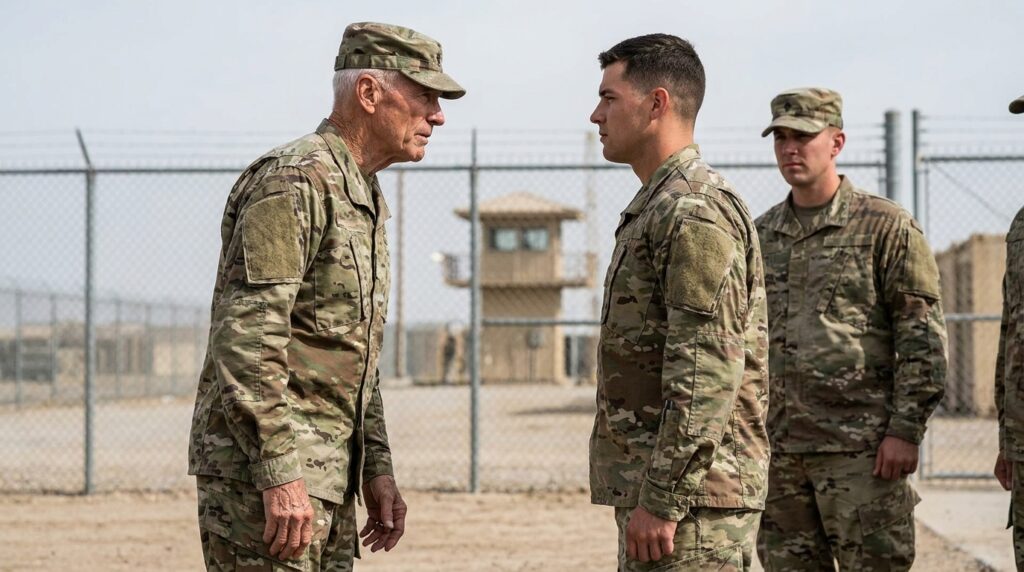
Colonel Jonathan Vance—though the uniform he wore carried no brass, no stars, and no name tape across the crisp digital fabric—did not shift his weight. He stood flat-footed on the crushed river stone of Fort Meade’s northern tactical lane, his palms resting flat against his thighs. To a boy in his late twenties, a man whose muscles were still thick from creatine and the structured violence of the modern infantry pipeline, Vance looked like an old tree that had dried out before it could fall. His hair was a stark, scrubbed white beneath the damp brim of his patrol cap, and the skin around his jawline was webbed with deep, pale creases that looked less like wrinkles and more like old stitch marks.
Ten yards away, across the blacktop of the simulated village breach point, the active-duty squad was resetting. They moved with the aggressive, jerking momentum of men who believed the world was an engineering problem to be solved with hydraulic rams and thermal optics.
“He’s still standing there,” Staff Sergeant Miller muttered, his voice barely lifting above the rhythmic, idling thrum of an armored utility vehicle fifty yards out. Miller kept his head down, pretending to check the battery housing on his night-vision rig, his cap partially obscuring his eyes. “Old man’s been there since the zero-five-hundred muster. He hasn’t taken a drink of water once.”
Captain Cole Vance—no relation, though the shared name had already caused a minor bureaucratic hiccup at the gate—didn’t look up from his tactical tablet. Cole was twenty-eight, his chest broad under the pristine weight of his plate carrier, his jaw locked in the permanent, defensive square of a man who had never lost a peer review. He swiped a thumb across the glass, clearing a smudge of grease.
“He’s a tourist,” Cole said, his tone flat, transactional, and short on grease. “Some retired bureaucrat from Logistics who wanted to see how the active side lives before they hand him his pension watch. Ignore him. We’re running the third ingress in two minutes.”
“He’s not looking at the tablets, Captain,” Miller said. The silence between them grew heavy, filled only by the wet crunch of gravel as a guard tower watchman shifted his boots on the platform above. “He’s watching your heels.”
Cole stopped his thumb. He raised his head slowly, his eyes narrowing through the gray drizzle until they locked on the lean, perfectly vertical silhouette by the wire. The old man hadn’t blinked. His eyes, a pale, washed-out blue that looked almost clear against his wind-burned skin, were fixed precisely on the left flank of Cole’s formation—the exact point where the third fireteam had crossed the threshold three inches too wide, exposing their hips to the dead space of the simulated stairwell.
A minor discrepancy. A micro-metric flaw that modern sensors didn’t register.
Cole handed the tablet to Miller with a sharp, metallic click of the plastic casing. “Hold this.”
He walked across the gravel, his heavy combat boots tearing into the stones with a rhythmic, intentional weight. With every step, he let his shoulders widen, his athletic chest rising against the tactical nylon of his harness. He stopped exactly twenty-four inches from the veteran’s bill, using his height to throw a shadow over the old man’s weathered face.
“Sir,” Cole said, the title carrying the distinct, hollow ring of mandatory military courtesy rather than genuine deference. “This is an active-fire lane. The simulated frag variables are live on the grid. If you don’t have an escort badge visible on your outer layer, I need you to step behind the concrete barriers.”
The Elderly Soldier did not move his hands from his sides. His thumbs remained hooked slightly forward, perfectly aligned with the seam of his trousers—a posture so old-fashioned it belonged in a black-and-white training film from the Monongahela. He looked down at Cole’s boots, then up to the pristine, scratchless finish of the younger man’s helmet.
“Your third man,” the veteran said. His voice was a low, dry rasp, like a piece of heavy canvas being dragged over rough timber. “He’s carrying his weight on his toes when he transitions the frame. If that sill were reinforced timber instead of hollow aluminum, the rebound would have shattered his clavicle before he got the muzzle through.”
Cole’s jaw tightened, a small muscle leaping beneath the skin of his cheek. He let out a short, dry breath that smelled of cold coffee and MRE mints. “With all due respect, pop, things have changed since your time. We don’t clear rooms with timber logic anymore. The pressure wave from the flash-bang renders the threshold soft before the team ever breaks the plane.”
The old man didn’t move. He simply stared into Cole’s eyes, his expression as flat and unyielding as the concrete tower behind them.
“The mud doesn’t care about your flash-bang, son,” the veteran whispered.
Cole stepped closer, his chest nearly brushing the old man’s faded lapel, his eyes dark with the sudden, sharp heat of a younger man whose authority had been clipped in front of his squad. “I hear you,” Cole said, his voice dropping into a hard, competitive edge. “But I still disagree. Now step behind the line.”
The old man reached into his right pocket, his scarred fingers closing around a heavy, silver-plated Zippo lighter. He didn’t strike it. He just let the lid click open and shut once—a small, metallic snap that seemed to stop the sound of the rain entirely.
From the communication shack fifty yards away, a high-frequency siren began to wail, its steady, unbroken scream signaling an unannounced, command-level override of the entire sector’s grid.








