
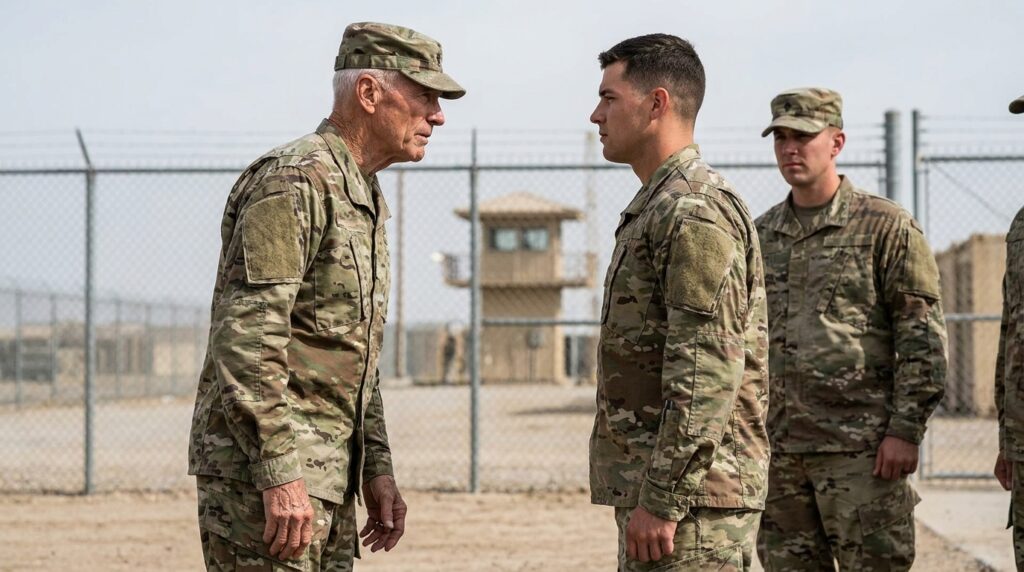
CHAPTER 3: THE FRICTION LINE
“Back away from the fence, Captain,” Miller said, his boots sliding through the wet gravel as he wedged his physical frame between Cole and the elder. The handheld radio in Miller’s grip was a dead weight now, its speaker humming with a steady, high-frequency whine that set Cole’s teeth on edge. “The command post just blacked out our transponders. We are completely dark to the network.”
Cole did not yield an inch of the blacktop. His eyes remained fixed on the white hairs protruding from the old man’s collar—rigid, needle-sharp, untouched by the freezing rain. Every tactical instinct he possessed told him to seize the old man’s wrist, to locate the entry credentials that had crashed a multi-million-dollar training grid. Yet, the absolute stillness of the veteran’s stance acted like a physical barrier. The old man hadn’t raised his chin, yet he seemed to look down at Cole through the sheer weight of structural dominance.
“The radio,” Cole commanded, his voice cold, stripping away any lingering administrative pretense. He reached out and snatched the plastic receiver from Miller’s hand, his fingers tracking a strange, dark ring of industrial grease near the auxiliary input seal. It was fresh, viscous, and smelled faintly of lithium and cold machinery. “Who gave you access to the northern grid protocols? That’s an off-network sequence.”
The Elderly Soldier allowed a slow, mechanical breath to escape his nostrils. The cold vapor didn’t dissipate; it seemed to cling to the bill of his weathered cap. “You look for a key because you only know how to open doors that have locks, Captain. When we poured the foundations for these blockhouses in the winter of seventy-four, we didn’t use digital relays. We used iron conduits and gravity valves. If you kill the power to the main terminal, the overflow gates default to manual pressure. Your network didn’t crash because of an entry code. It crashed because three thousand gallons of rainwater just hit the intake box behind the guard tower.”
“That’s a classified structural blueprint,” Cole said, his fingers tightening around the radio casing until the composite material creaked. He could feel the eyes of his entire fireteam on his back—nine elite soldiers frozen near the mock compound entrance, their weapons held at a useless low-ready, their confidence dissolving into the dark gray rain. “The only people with access to those schematics are listed under the Department of the Army’s architectural core. You’re an evaluator from logistics. That’s what the gate manifest stated.”
“The gate manifest states whatever the current office clerk needs to see to keep his rubber stamp moving,” the veteran replied flatly. He turned his torso toward the concrete guard tower, his movement deliberate and heavy, like the rotation of an old tank turret. His boots left deep, sharp impressions in the gravel, cutting straight through the shallow mud. “Look up at the second platform. Tell me what you see.”
Cole looked. The tower cut into the low sky like an unpolished tooth. On the narrow metal catwalk, thirty feet above the gravel lane, the silhouette of the watchman was no longer moving along the rail. He was standing completely rigid, his arms pressed tight against his sides, his face obscured by the dark visor of his helmet, but his posture was turned directly toward the old man. Not toward the Captain. Not toward the active-duty squad.
“He’s not checking the perimeter,” Miller muttered from Cole’s flank, his breath hitching. “He’s watching the old man’s hands.”
“Silence, Sergeant,” Cole snapped, though the cold iron in his own stomach was expanding. He stepped into the veteran’s path, his chest carrier brushing against the old man’s faded green lapel. The smell of cold canvas and gun oil rolled off the fabric, sharp and ancient. “You’re disrupting a live operational exercise. If you don’t produce a physical identification voucher within five seconds, I will have my third fireteam detail you to the security detachment by force. I don’t care who you cleared paths for fifty years ago. This is my lane.”
The old man’s mouth didn’t twist into a smile. The lines around his lips merely deepened, catching the gray light like small, dry gorges. He reached down to his belt, his hand moving with a calculated lack of haste that defied the frantic wail of the siren. He didn’t pull a weapon. He didn’t pull a badge. Instead, he gripped the heavy wire of the base fence, his fingers locking around the cold zinc with enough force to turn his knuckles a pale, bone-white.
“You have nine men in the box, Captain,” the veteran said, his gravelly voice dropping into a rhythmic, instructional cadence that felt ancient and absolute. “Their spacing is perfect for a textbook. But this isn’t a book. The wind is coming from the northeast at twelve knots. The exhaust from your utility vehicle is pooling in the dead space between the two storage containers. If a real adversary were sitting in that blockhouse right now, they wouldn’t use lead. They’d drop a thermal canister into the vent, and your entire line would be blind before they could clear their holsters.”
“We carry sealed filters,” Cole countered, his voice rising against the steady hum of the alarm.
“Your filters are rated for sixty minutes,” the veteran whispered, his washed-out blue eyes locking onto Cole’s pupils with a terrifying, unblinking intensity. “But the seals on those modern masks are synthetic rubber. They degrade at one hundred and forty degrees. A standard magnesium flare burns at over three thousand. You’re teaching these boys how to die with style, son. I’m trying to teach them how to walk out of the room.”
Cole opened his mouth to deliver the order to detail the old man, his tongue forming the first syllable of Miller’s name, when the heavy steel security doors of the main command building—three hundred yards down the tarmac—thudded open. The sound was a dull, industrial boom that echoed off the wet concrete walls of the blockhouse, instantly killing the static on Cole’s radio.
Through the rain, four silhouettes emerged, moving not with the tactical haste of an intervention team, but with the synchronized, rigid precision of a ceremonial guard. At the front was a short, thick-shouldered man whose olive-drab trench coat carried three silver stars on the shoulder tabs, glistening like wet ice under the gray sky.
General Vance. The Base Commander.
“Stand down, Captain,” the old man said, his grip releasing the fence with a dry, scraping sound. He didn’t look toward the approaching officers. He kept his eyes on Cole’s face, watching the younger man’s posture crack as the realization began to set in. “The master of the house is coming out to check his traps.”








