
CHAPTER 18: THE ARCHITECTS FINAL ALIGNMENT
The silence that rushed into the lower drainage grid after the surface drill snapped did not feel empty; it possessed the cold, immense density of a vault that had finally rejected the sun.
Cole did not drop his arms from the auxiliary valve lever. He stood balanced on the vibrating steel catwalk, the freezing water vapor from the overflow box clinging to the gray canvas of his sleeves until the fabric felt stiff as wood. In the low, orange flicker of Miller’s hand-lantern, the black water churning below the grating began to settle into a flat, glassy sheet that perfectly mirrored the sharp, unpolished edges of the granite ceiling blocks.
“The pressure on the intake line has equalized, Captain,” Staff Sergeant Miller said, his boots leaving dark, wet half-moons in the calcified stone dust as he stepped toward the center of the platform. He lowered the lantern, its flame whistling once inside the glass chimney before dropping into a quiet, uniform hum. “The northern perimeter rig has completely shut down their pumps. They aren’t trying to clear the casing anymore. They’re pulling their steel back to the surface.”
Cole slowly let go of the iron ring, his fingers uncurling with a dry, stiff click of cold joints. He didn’t look up toward the snapped bore-hole. His strategic pursuit logic, tracking the hidden variables across thirty years of systemic purges, was fixed entirely on the narrow shadow behind the seventh hatch.
The rhythmic tapping had stopped. In its place stood a physical presence—a lean, vertical silhouette that had emerged from the dead-space cavity without breaking a single copper trip-wire or displacing a single micro-inch of white stone dust along the structural seam.
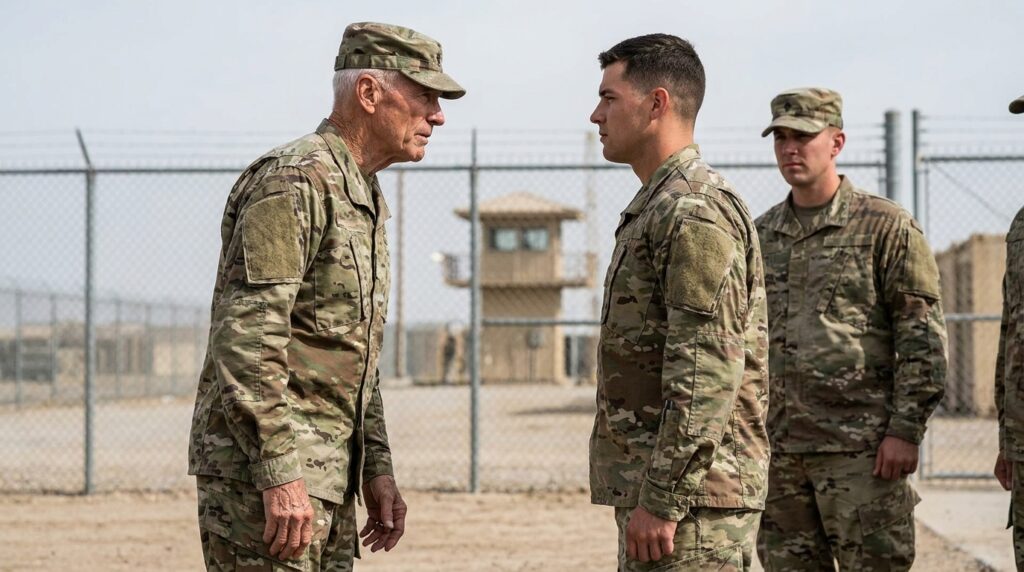
The Elderly Soldier did not raise his chin beneath the brim of his faded cap. He stood exactly thirty inches from Cole’s shoulder, his upright stance so rigid it seemed to be carved from the same native rock as the blockhouse foundations. The pale blue of his eyes caught the orange lantern light, clear, unblinking, and entirely devoid of the administrative weariness that had broken the general on the surface.
“You used the weight of the water, young man,” the veteran said. His voice was a low, dry rasp that slid under the sound of the dripping water with an absolute, terrifying resonance. “Most squad leaders try to hold the line with a lock-pin. They think if they use enough steel, the door stays shut. But the ground always finds a way to breathe through a hard pipe.”
Cole reached into his chest pocket, his fingers tracking the scratched cylinder of his silver cartridge shell. As he pulled his hand out, he noticed a tiny, secondary object resting flat against the metal casing—a notched brass key-pin, identical in gauge and gauge-spacing to the phantom needle holes where his name tape had been picked away forty years ago. It had been left inside the auxiliary valve housing during the midnight watch, hidden behind the backward-wrapped copper safety wire.
The old man reached down to his belt, his long, scarred fingers closing around his own silver-plated casing. He didn’t drop it into the mud this time. He held it flat across his palm, his eyes tracking the geometric vector lines Cole had drawn across the leather-bound 1974 ledger on the field desk.
“The third man didn’t leave the shaft because he was ordered to stay, Captain,” the veteran whispered, his gravelly tone dropping the final layer of the decoy architecture into the dark. “Arthur thought he was isolating a threat when he turned the valve in ninety-four. He thought he was saving his career by erasing the file. But the containment wasn’t built to keep an enemy out. It was built to keep the watch alive.”
Cole looked from the brass key-pin in his palm back to the white-haired legend. The true parameter of the self-inflicted exile hit his chest with the cold, unyielding weight of an iron ram. The rogue sergeant wasn’t a rogue; he was the first watchman. And the evaluation that had broken his squad’s administrative status on the tarmac had been the final coordination—a clean, multi-phase handoff designed to ensure that the seventh blind spot would never be opened by a digital command from a surface office.
“The lane is clear, sir,” Cole said, his voice dropping into the hard, competitive register that left no space for administrative compromise. He didn’t look back at Miller or the fireteams frozen along the catwalk. He brought his heels together, his spine snapping into a rigid, vertical line that matched the general’s replica coat on the blacktop six months ago. He brought his right hand upward, his fingers flattening into a sharp, trembling line against the brim of his gray cap.
He was saluting the architect.
The Elderly Soldier did not return the gesture with brass or ceremony. He slowly brought his right hand up to the brim of his weathered cap, his fingers locking into the same cross-hatched alignment for one microsecond before his arm dropped back to his seam with a dry, canvas whisper.
“Keep the iron dry, son,” the old man rasping low.
He turned his torso sixty degrees toward the unmapped conduit behind the seventh bulkhead, his lean form sliding into the absolute blackness of the lower cavity with a fluid, silent momentum that left the white stone dust entirely undisturbed. The orange light of the lantern caught only the empty zinc wire of the safety housing, where the brass key-pin had finally been restored to its original mechanical slot.
Cole lowered his hand, his fingers tightening around the silver cartridge casing as the heavy steel doors of the deep core settled into their final, permanent isolation.








