
CHAPTER 10: THE COLD IRON DESCENT
The darkness three floors below the basalt aggregate did not feel like the absence of light; it felt like a weight pressing flat against the lenses of Cole’s unpowered tactical goggles.
He had ordered the fireteam to leave their battery housings in the secondary assembly bay. Now, the only illumination inside the narrow, brick-lined utility vault came from a single, low-intensity chemical stick that Staff Sergeant Miller held flat in his palm. The faint, radioactive green glow caught the wet edges of the masonry walls, turning the condensation into thousands of tiny, silver beads that looked like teeth.
“The digital relays died twenty feet above the hatch line, Captain,” Miller whispered. His voice was a flat, dry shadow of its usual administrative clip, bouncing instantly off the low concrete ceiling before dissolving into the steady, distant hiss of water moving through ancient pipes. “The auxiliary transponders are dead. If we blow a knee down here, the command post won’t even see our locator flags drop off the grid.”
“They aren’t looking for our flags, Sergeant,” Cole said. His voice was cold, his internal monologue running the strategic pursuit variables with a sharp, geometric precision that had grown more intense since the vehicle had vanished through the perimeter gate.
He was sitting on a rusted iron battery box, his heavy boots tucked back against the reinforced frame. In his right hand, his fingers were tracing the deep, abrasive scratch on the silver-plated cartridge casing the old man had left behind. In the green chemical light, the blank base of the shell looked almost black, but the density of the metal felt absolute—a heavy, forged truth that didn’t require an interface to verify.
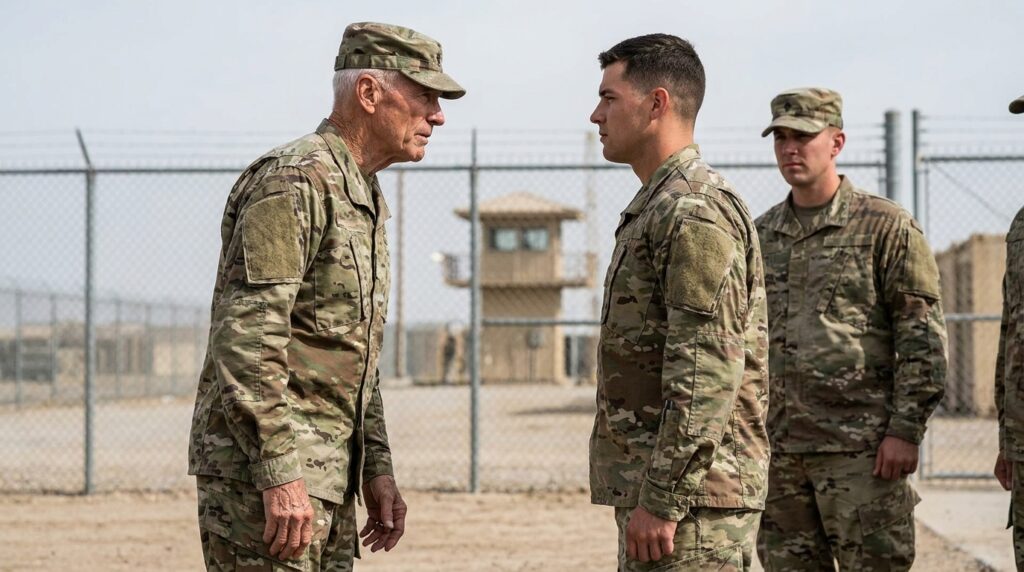
The nine men of his first fireteam were arrayed along the damp walls of the vault like geometric shapes carved from the rock itself. Their athletic frames were hunched, their shoulders narrowed to fit the twenty-four-inch clearance of the old seventy-four corridor. They weren’t checking their tablets; their hands were clamped onto the cold, cross-hatched grips of mechanical trench knives and solid iron prybars.
“Look at the bracket behind the main valve,” Cole commanded, pointing the blunt nose of the silver casing toward the center of the chamber.
Miller shifted his hand, the green chemical stick casting long, vertical shadows across a massive, three-foot iron wheel that controlled the intake line for the lower drainage grid. The metal was covered in a thick, flaking skin of red iron oxide that came away in sharp, razor-like scales whenever the air shifted. Scratched deeply into the center of the mounting plate, beneath fifty years of oil sludge, were two distinct sets of initials: A.V. and J.V.
Cole’s thumb tightened against the cartridge. Jonathan Vance. The old man hadn’t just built the foundations; he had signed the iron before the concrete was poured over his name. And the initials beside his belonged to Arthur—the three-star general who had stood in the freezing rain, holding a manual counterweight until his shoulders shook, just to keep the pneumatic guillotine from cutting his own lineage in half.
“The general didn’t send us down here for a readiness index,” Cole said, his voice dropping into a hard, low register that fixed every head in the room toward his position. “He sent us down here because the rogue sergeant isn’t an intruder. He’s the third man who signed that log. He’s the one who stayed in the shaft when the file was purged in ninety-four.”
“Captain,” a voice cut through the damp silence from the back of the line.
It was Specialist Briggs, the squad’s senior technical advisor—a man whose entire career had been built on the hyper-fast processing speeds of modern encrypted networks. He had a secondary satellite uplink unit strapped to his chest carrier, but the digital display was flickering in rhythmic, useless gray pulses, its internal antenna humming with the dead, blind frequency of the granite walls.
“We have a jurisdictional conflict on the upper line,” Briggs said, his fingers tapping the dead glass of his housing with a defensive, frantic speed. “Before the terminal locked down, a red-level authorization directive was routed through the Washington bureau. They’ve designated an off-site tactical supervisor to monitor the ingress. A civilian contractor from the defense logistics core. He’s already at the primary gate manifest.”
Cole didn’t raise his chin. He let the silver cartridge click once against the iron lid of the battery box—a small, sharp sound that stopped Briggs’s fingers instantly.
“The gate manifest is a piece of paper for clerks, Specialist,” Cole said, his pale eyes catching the green light as he locked his gaze onto the technician’s face. “The man from Washington is looking for an entry metric. He thinks this grid is an engineering problem he can solve with a satellite override. But the walls down here are twenty-four inches of solid granite, and the air moves through gravity valves. If he touches the digital relays from the surface, he won’t open the door for us. He’ll drop the weight.”
He stood up, his boots crunching flatly on the loose rust flakes covering the floor. He walked to the center of the chamber, his shoulder carrier brushing the wet brick until the canvas fabric left a dark, clean track in the slime. He gripped the iron wheel with both hands, his scarred fingers finding the deep, notched grooves where the old man’s palms had once sat.
“Miller,” Cole whispered, his muscles hardening as he prepared to throw his weight against the dead friction of the gear. “Put the chemical stick in your pocket. From here on out, we move by the feel of the iron.”
The green light vanished into Miller’s fist, leaving the chamber in an absolute, suffocating blackness that smelled of cold grease and fifty years of stone.








