
CHAPTER 4: THE GEOMETRY OF PRESSURE
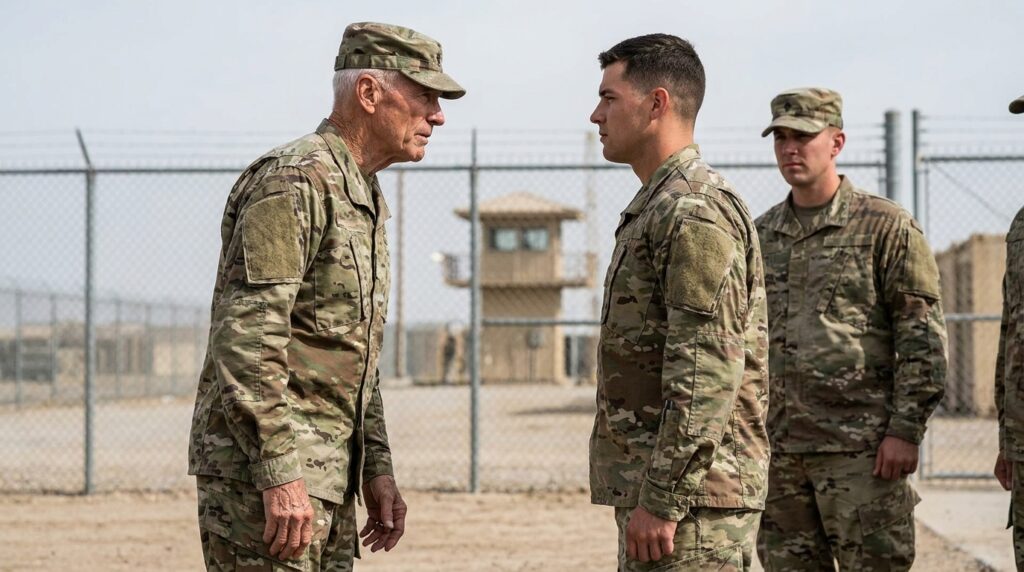
The boots of the three-star general did not splash through the pooling rainwater. They struck the blacktop with a sharp, flat crack, each heel-strike perfectly measured against the low, heavy hum of the isolation siren. General Vance moved with his chest thrust slightly forward beneath the stiff, wet wool of his trench coat, his eyes locked not on Captain Cole Vance, but on the unyielding spine of the elderly soldier leaning against the chain-link wire.
Cole shifted his weight, his fingers sliding away from his belt line as the proximity of higher command forced his spine into a mandatory, rigid posture. His chest carrier felt suddenly restrictive, the molded composite plates pressing hard against his ribs as he filled his lungs with the damp, iron-scented air.
“General,” Cole began, his voice cutting cleanly through the drone of the alarm as he prepared to offer his formal operational summary. He took one step forward, intending to put his physical frame back between his squad’s training line and the unverified visitor. “We have a structural security anomaly on the northern sector grid. The master terminal rejected the manifest entries, and this individual—”
The general did not pause to acknowledge Cole’s position. He bypassed the captain’s extended shoulder by less than two inches, the stiff edge of his wet sleeve brushing past Cole’s nylon harness with a harsh, dry whisper. The three senior staff officers trailing the general split into a flawless flank formation, their eyes fixed strictly on the gravel beneath their boots, their expressions frozen behind masks of pale, bureaucratic neutrality.
“Get your hands out of your pockets, Jonathan,” General Vance said. His voice was different from the gravelly rasp of the veteran; it was a smooth, heavy baritone that carried the calculated resonance of a man who had spent forty years dictating budgets and deployment schedules from concrete boardrooms.
The elderly soldier did not lower his eyes. He slowly slid his right hand out of his jacket pocket, letting the heavy silver Zippo lighter slip into the palm of his hand with a dull clink against a metal button. The pale blue eyes of the old man remained pinned to the three silver stars resting on the general’s shoulder tabs, tracing the cold, sharp edges of the metal insignia with a slow, discerning gaze.
“The stitching on your coat is off, Arthur,” the veteran said, his voice dropping below the volume of the rain, yet carrying enough weight to make Staff Sergeant Miller freeze behind them. “The quartermaster’s office is using the synthetic nylon thread from the Pennsylvania depot again. It rots under the armpits after three weeks in the humidity. I told you that in eighty-two.”
The general stopped precisely thirty inches from the old man’s bill. For a fraction of a second, the absolute stillness of the courtyard was so absolute that Cole could hear the distinct, heavy drops of water striking the hollow aluminum framework of the simulated blockhouse ten yards out. The general’s jawline, typically set in an unyielding, pristine square, twitched twice, a tiny pocket of tension leaping beneath his sun-baked skin.
Then, with a sudden, metallic snap of leather and brass, General Vance brought his right hand upward, his fingers flattening into a rigid, trembling line against the brim of his starched cap.
He was saluting.
He wasn’t saluting an office. He wasn’t saluting a rank visible on the fabric. He was saluting the lean, weathered frame of a man whose name had been systematically scraped from the base registers before Cole’s father had even signed his initial enlistment contract.
Cole’s breath caught in his throat, a dry, metallic taste rising from the back of his tongue. He looked from the general’s stiff, raised elbow down to the old man’s unadorned chest. The faint ghost-imprint of the picked-away name tape seemed to darken under the rain, the tiny, empty needle holes forming a dark, geometric shadow across the green canvas. He noticed, for the first time, that the pristine double-threaded hem on the general’s custom trench coat utilized the exact same spacing and gauge as the phantom stitches on the old man’s lapel. It wasn’t standard issue. It was a replica.
“The sector is locked down as per your directive, sir,” the general said, his baritone voice tightening, dropping the conversational familiarity entirely. He held the salute, his eyes locked straight ahead, looking over the old man’s shoulder toward the concrete guard tower. “The auxiliary grid has been isolated to Layer One parameters. The active-duty squad is cleared for administrative relocation.”
The old man didn’t return the gesture. He kept his steady, scarred hands held flat against his sides, his thumbs hooked slightly forward along the trouser seams. “The captain thinks the drainage channel under the blockhouse is filled with concrete, Arthur. He tells me his digital filters can handle a magnesium thermal spike.”
The general slowly lowered his hand, his fingers clenching into a fist inside his leather glove, a dull, scraping sound against the wool of his coat. He turned his eyes toward Cole, the cold, administrative gaze of a three-star commander returning with the weight of an anvil.
“Captain,” General Vance said, his voice flat and devoid of warmth. “Your fireteams will immediately cache their live variables and retire to the secondary assembly bay behind the motor pool. You will hand your tactical tablet and the sector gate manifest to Staff Sergeant Miller. You are no longer commanding the evaluation lane.”
Cole felt the muscles in his legs lock, his boots sinking a fraction of an inch into the river stones. “Sir, the squad’s readiness metrics are—”
“Your squad’s readiness metrics are currently being evaluated by the man who calculated the casualty ratios for the entirety of the seventy-four expansion,” the general cut him off, his voice dropping into a hard, competitive register that matched the old man’s logic. “If he says your third man is on his toes, your third man is a liability. Move your people out, Captain. Now.”
Cole didn’t move his head, but his eyes darted to the old man’s face. The veteran was no longer looking at him. He had already turned back toward the blockhouse, his pale blue eyes tracing the sharp, linear shadows of the concrete walls, analyzing the fatal flaws of the structure with the quiet, predatory satisfaction of a chess player who had seen the mate-in-three sequence before the first piece was moved.
“Miller,” Cole whispered, his voice sounding thin even to his own ears against the uniform wail of the siren. “Take the log.”
He unclipped the heavy, composite tablet from his harness, the plastic tabs releasing with a sharp, wet pop that sounded like a bone fracturing in the silence of the rain.








