
CHAPTER 6: THE COMMAND RECKONING
“They stayed in the shaft, Captain.”
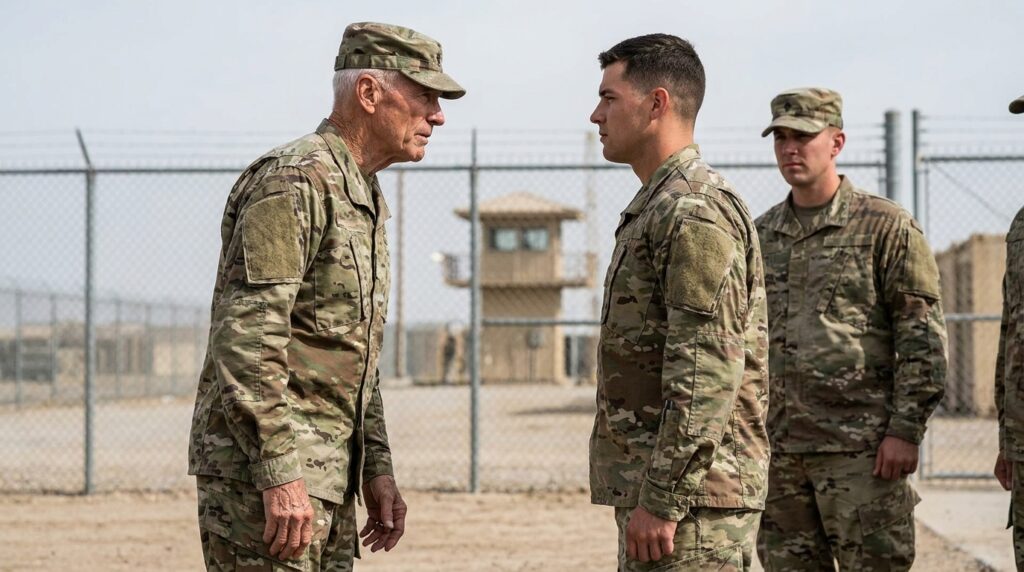
The general’s words did not drop through the rain; they sat on the blacktop with the blunt, cold finality of iron weights. General Vance had still not broken his rigid alignment, his chin held parallel to the wet gravel, but his voice carried a faint, rhythmic tremor that matched the low-frequency drone of the emergency klaxon.
Cole felt his boots go stiff against the stone. He did not look back at Miller, nor did he look toward the motor pool where his squad was vanishing into the gray curtain of the facility’s secondary line. He kept his eyes locked on the space between the general’s starched lapel and the veteran’s shoulder, where a tiny, notched brass key-pin sat tucked behind the collar plate—fused directly into the wool, hidden from any standard inspection protocol. It was the old manual release for the subterranean valves. It wasn’t an ornament; it was a structural tool.
“Nineteen hundred and ninety-four,” Cole said, his voice flat, his internal logic grinding the years down like gears. “The year the deep shafts were sealed with concrete. The official report said it was a gas leakage. An environmental closure.”
“The official report was typed by a clerk who wanted to sleep at night,” the veteran whispered. He stepped away from the chain-link fence, his canvas boots making no sound as they crossed the gravel. He reached out and tapped the glass of the terminal Cole was holding. The amber text—DECEASED / PURGED RECORD—flickered against the scarred skin of his knuckle. “Arthur was a major then. He was the one who turned the manual pressure valve from the observation room. He turned it because I told him to.”
Cole looked at the general. The three stars on the man’s shoulder didn’t move, but a thin line of red water was tracking down the side of his neck, running from the brim of his cap straight down into his wool collar. The commander of the base, a man who held absolute authority over three active brigades, looked entirely paralyzed by the mere physical proximity of the old man.
“He cleared the line, Cole,” General Vance said, his baritone voice dropping into a guarded vulnerability that Cole had never heard in six years of service. “The blueprint you’ve been studying on your digital pads for the upcoming deployment—it isn’t a mock-up of a foreign compound. It’s a direct replication of the blockhouse system we are standing on right now. The original blueprint has seven blind spots. Your tech team only identified six.”
“The drainage channel,” Cole said, his chest carrier tightening as he breathed in the sharp, chemical tang of the facility’s room tone. “The moss on the iron rim. It isn’t an intake overflow. It’s a physical exit point from the lower vault.”
“It was an exit,” the old man corrected, his pale blue eyes narrowing as he looked toward the northern guard tower. “Until the reinforcement teams laid thirty tons of structural slag into the center junction. Now it’s a bottleneck. If you put nine men into that corridor with modern digital packs, the signal reflection off the reinforced walls will fry your transponders in forty seconds. You won’t be blind because of smoke, Captain. You’ll be blind because your own gear will drown you in static.”
Cole felt a heavy, physical exhaustion drop onto his shoulders, the sheer weight of his tactical vanity splintering under the old man’s analysis. The chess match wasn’t happening on the tarmac; it had been played and decided thirty years before he was born. The entire training exercise—the live variables, the high-intensity halogens, the gate manifest—had been a filter. A false flag designed by the general to expose the exact failure point Cole had just demonstrated: structural arrogance.
“Why am I still on the blacktop, sir?” Cole asked, his voice sharp, transactional, directed straight at the old man’s weathered cap. He didn’t ask the general. The three stars on the trench coat had lost their functional leverage. “If my fireteam is a liability, and my spacing is a textbook error, why aren’t we in the brig?”
The Elderly Soldier reached into his jacket, his fingers wrapping around the smooth casing of the Zippo. He didn’t open the lid this time. He just held it flat against his palm, using its hard edge to anchor his balance against the rising wind.
“Because the people inside the actual compound next week aren’t using blanks, son,” the veteran rasping low, his face inches from Cole’s helmet brim. “And the man who built their blockhouse was my sergeant before he went rogue. He knows the seventh blind spot because he helped me dig it.”
Behind them, the high-frequency siren suddenly cut out, leaving a massive, ringing vacuum in the gray afternoon. In that sudden silence, the static on Cole’s handheld terminal cleared, replacing the amber code with a fresh, red-level data feed that began to populate the map grid with thirty-two distinct, unclassified target markers.








