
CHAPTER 5: THE PHANTOM ROSTER
The text on Staff Sergeant Miller’s unencrypted sub-terminal didn’t drop out; it vibrated. Across the scratch-resistant glass of the handheld unit, the data lines containing the northern grid manifests began to unspool chronologically, rewritten by an automated cryptographic script that originated from the subterranean server vaults under Building Four.
Cole did not run toward the communications shack, but his stride was long, the rubber heels of his boots slicing through the thin mud layer until they hit the solid, basalt aggregate beneath. He left General Vance and the white-haired phantom standing by the fence line, their silhouettes overlapping like two rusted blades stuck into the same patch of earth.
“Show me,” Cole said, his voice catching the dry, flat rhythm of an officer demanding a localized casualty tally. He reached over Miller’s shoulder, his wet thumb leaving a smear of grease across the edge of the frame.
“It’s not an administrative lock, Captain,” Miller whispered, his teeth clicking together once from the chill. He pointed a flat fingernail at the primary data column. “Look at the master payroll interface. Look at the retirement ledger for the seventy-four construction corps.”
The screen was flashing a single, low-frequency amber warning code: DECEASED / PURGED RECORD FILE-74. Below the alphanumeric designation, where the name, rank, and security clearance of the unannounced evaluator should have been logged into the base housing registry, there was only a flat line of zeroed out binaries. The master registry wasn’t denying the individual’s presence; it was declaring that the individual had ceased to exist within the continental command structure precisely thirty-two years ago, during the quiet decommissioning of the original subterranean testing chambers.
“He’s dead on the books,” Cole said, his voice dropping into the calculated silence of a tactical calculation. His thumb traced the edge of the terminal frame, feeling the tiny, sharp ridges of the casing where the original factory seals had been sheared away by a technician’s pick. “The general isn’t saluting a guest. He’s saluting a ghost that has the authority to drop the grid.”
“The general isn’t the one who initiated the isolation, sir,” Miller said. He held up his secondary radio, its small monochrome display completely blank, showing only the red warning light of a hardware-level battery short. “The signal came from inside the blockhouse we were just clearing. The drainage channel. Someone pulled the physical breaker from the dry well.”
Cole turned his torso sixty degrees, his eyes tracking back across the tarmac toward the simulated concrete compound. His squad had already begun their administrative retreat, their figures moving like dark, geometric shapes through the gray curtain of rain, heading toward the secondary assembly bay by the motor pool. They looked small from this distance, their athletic frames burdened by the dead weight of non-functional gear, their expensive tactical arrays rendered useless by a simple barometric drop and twenty inches of clear iron pipe.
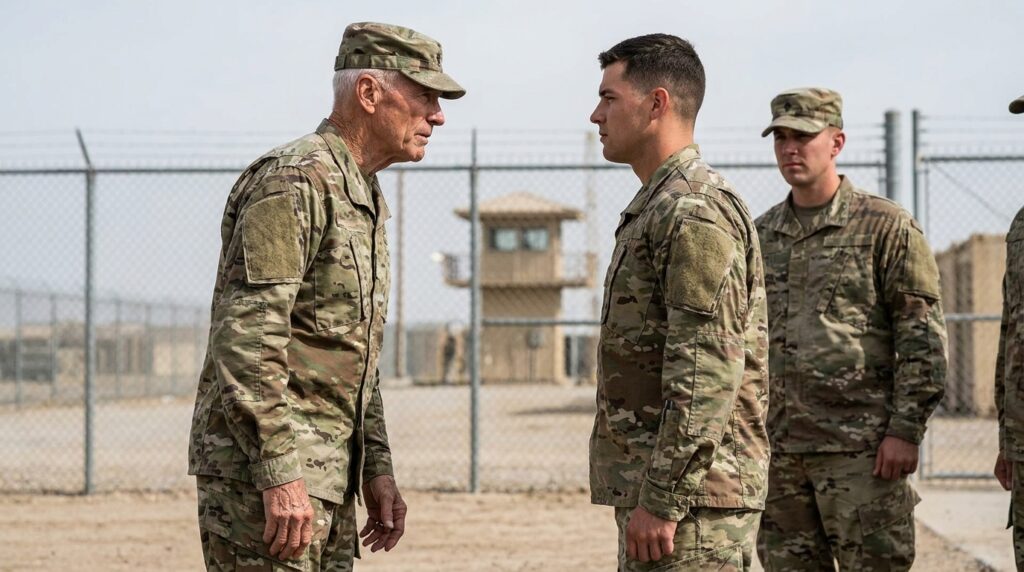
He looked back at the fence line. The old man hadn’t shifted his heels. He stood flat against the wire, his lean fingers still loosely curled around the silver Zippo lighter, while General Vance remained at rigid attention three paces away, his face pale under the brim of his starched cap. The dynamic between them wasn’t one of a commander and a retired subordinate; it was the precise, geometric posture of an apprentice waiting for the final mark from an unyielding engineer.
“He built it,” Cole muttered, the realization hitting his chest with the cold, flat impact of a kinetic round. “The northwest corner. The blind spot in the spacing. He didn’t flag a defect in our training; he flagged a design feature he left in the concrete fifty years ago.”
“Sir?” Miller asked, his fingers tightening on the terminal.
“The decoy,” Cole said, his internal monologue running the strategic variables like chess lines. “The base commander isn’t running an evaluation exercise for the squad’s readiness index. He brought this old man back to see if we’d notice the pipe. If we don’t notice the pipe here, in the mud, under a standard three-knot drizzle, we won’t notice it when we cross the fence line in the dark next week.”
He didn’t wait for Miller to respond. He took the handheld terminal from the sergeant’s hands, his fingers locking onto the cold composite edges as he walked back toward the fence line. The rain was getting heavier now, the water coming down in thick, straight lines that hissed against the hot exhaust vents of the idling utility vehicles fifty yards out.
As he closed the twenty-foot gap between himself and the two elders, Cole didn’t lead with his chin or his rank. He kept his shoulders flat, his posture low and compact, his eyes focused entirely on the old man’s weathered cap brim. He had stopped looking at the veteran as an anachronism; he was looking at him as an operational threat with an infinite range.
“The record was purged in ninety-four, sir,” Cole said, addressing the white-haired soldier directly, his voice clean of any promotional arrogance. He held out the flashing amber terminal, letting the screen reflect against the old man’s clear, washed-out blue eyes. “According to the Department of the Army, the engineer who laid the conduits for Sector Three died during the technical closure of the deep shafts. But you’re standing on my blacktop, and your lighter has the same lithium grease on the hinge as the main breaker link.”
The Elderly Soldier didn’t look down at the glass. He reached out with his left hand, his long, scarred fingers closing around the terminal frame with a grip that was surprisingly heavy, the bone beneath his thin skin as rigid as an iron bar.
“A soldier who looks at a screen to find out if his enemy is alive is already three seconds behind the trigger, young man,” the veteran whispered, his gravelly tone sliding under the roar of the rain with a slow, devastating authority. “Arthur, tell the boy what happened to the last squad that tried to breach the northwest corner without checking the well.”
General Vance didn’t turn his head. His eyes remained fixed on the concrete tower, his jaw locked in a hard, pale line. “They stayed in the shaft, Captain.”








