
CHAPTER 9: THE INTERGENERATIONAL HORIZON
The iron drop-bolt gave a sudden, high-register shriek as the structural stone behind the kitchen partition settled another millimeter. It wasn’t a loose gasket or a dry fan belt this time; it was the distinct, wet groan of a concrete foundation losing its grip on the sub-grade earth. A two-inch geyser of gray, silt-choked water breached the rubber seal at the base of the kitchen door, spraying across the security sergeant’s boots and spreading across the linoleum floorboards in a greasy, dark fan.
“Specialist, double-time that bar,” the sergeant barked, his fingers slipping on the wet, rust-pitted handle of the main bolt. His tactical vest creaked as he threw his full body weight against the lever, his boots sliding back through the dark muck now pooling in the tray tracks.
The young soldier didn’t wait for a written authorization or a digital signal from the management node. He dropped his polymer meal tray onto the counter with a loud, hollow rattle, bypassed Captain Miller completely, and dove into the maintenance corridor. Within five seconds he returned, carrying a five-foot steel pinch-bar, its hexagonal shaft nicked and dark with generations of black gear grease. His knuckles, raw from the morning wire detail, locked onto the iron bar alongside the sergeant’s gloved hands.
“Get under the bracket,” Mac directed, his voice remaining low, unhurried, and anchored to the slab while the alarms on Miller’s shoulder monitor began a frantic, three-tone pulse. Beep-beep-beep. He didn’t step back from the spreading water. He reached down, his blunt, scarred fingers sliding into the silt to guide the sharp wedge of the pry-bar directly into the frozen seat of the sluice valve housing. “The gate’s a three-quarter slide, son. If you force the top flange without clearing the lower groove, you’ll shear the bronze pins and lock the channel for good.”
“This is an unmapped violation of active maintenance safety baselines,” Miller said, her voice dry and thin as she retreated three paces up the dry side of the serving aisle. She held her clipboard vertically against her throat now, her eyes tracking the red LED throughput monitor as it flickered from 00 to a flashing system failure code. “Security, report to the hub that the infrastructure grid has experienced an uncoordinated structural breach. The deployment trucks must be re-routed to the north grid immediately.”
“The north grid’s running on the same clay vein, Captain,” the specialist said through his teeth, his shoulder muscles knotting beneath his damp camouflage jacket as he threw his bulk against the steel bar. “If this floor shifts, the north line drops its pressure before the trucks can even prime their pumps.”
Mac leaned his palm onto the top of the pinch-bar, adding the slow, calculated leverage of his own heavy frame to the young men’s effort. He didn’t look at the flashing monitors or the officer’s clipboard. His eyes were fixed on the point where the tool met the rusted iron bracket, watching for the micro-second the metal began to white-out from stress.
“Now,” Mac murmured. “Give it the weight.”
The iron bolt gave way with a sound like a pistol shot echoing through a concrete pipe. The rusted shaft sheared cleanly at the lower weld, and the kitchen security door swung back six inches, released from the immense hydraulic back-pressure of the blocked culvert. A six-inch wall of brackish, sulfur-scented river water surged over the threshold, carrying with it decades of settled limestone gravel, rotting leaves from the creek bank, and old, hand-forged iron spikes from the original 1976 retaining wall.
The security sergeant stumbled back, his boots splashing through the flood as it leveled out across the seventy-foot width of the dining hall. The kitchen workers retreated into the dishwashing bays, their blue nylon gloves raised as the water claimed the lower storage shelves.
But the floor stopped groaning.
The sudden release of the pressure through the manual valve had cleared the sub-grade backup, sending the volume down the historical overflow channel Mac had notched into the granite bedrock fifty years before. The low-frequency thrum beneath the tray tracks died out, replaced by the steady, hollow roar of water rushing safely through the dark stone channels toward the flats below.
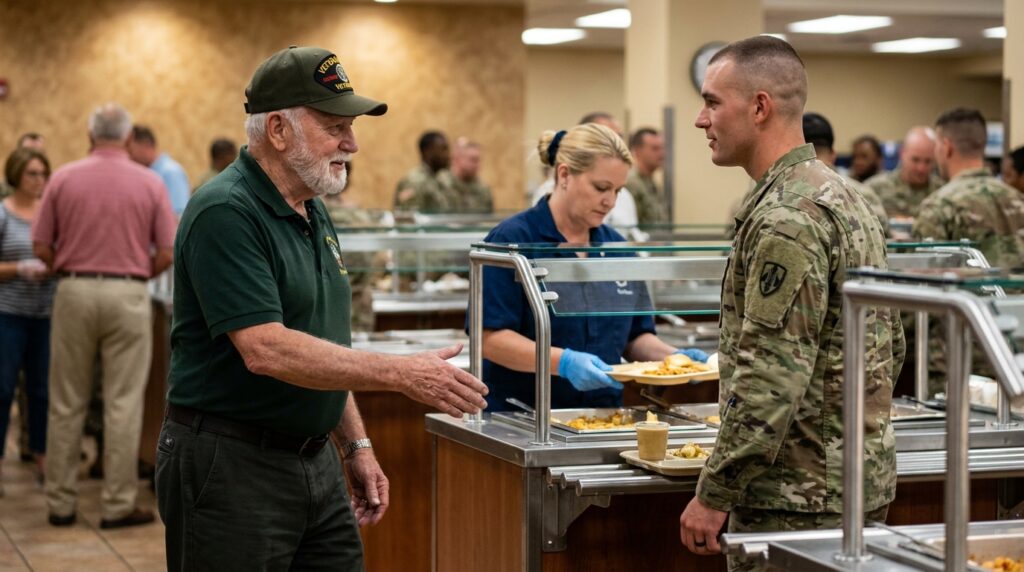
The security sergeant wiped a streak of gray silt from his chin, his gaze dropping to the old blue linen blueprint that still lay on the stainless steel counter, its edges soaked through with the very water they had just released. He looked at the specialist, then back at Mac, whose faded veteran cap was the only dry thing left within twenty feet of the line.
“The line held,” the sergeant said quietly. He didn’t use the garrison title. He stood up straight, his hands dropping to his sides in an unprompted, instinctive position of attention that no digital protocol had commanded.
The weapons platoon behind them remained perfectly still, thirty sets of muddy boots submerged in two inches of rushing silt water, their faces locked in absolute, reverent silence as they looked at the old commander who had known the depth of the stone before their names were ever entered into the ledger.
Miller lowered her clipboard, her fingers trembling against the plastic edge as she realized that the forty-four-plates-per-minute metric had been broken by something that couldn’t be calculated by a network node.








