
CHAPTER 4: THE DIALECT OF EFFICIENCY
“The intake fans are pulling five hundred cubic feet per minute too fast,” Mac said, his boots catching the textured aluminum transition strip at the entrance of the dining hall. The threshold was worn to an unsafe sheen, the cross-hatched traction lines ground down by thousands of standard-issue heels until the metal was bright and slick as winter pond ice.
Captain Miller didn’t check her stride. The door behind them hissed shut, an oversized hydraulic cylinder slamming into its housing with a dull, oil-muffled thud. “The ventilation metrics are calculated automatically by the central infrastructure node, sir. It accounts for thermal loading when the heavy companies rotate off the transport lines. I don’t adjust the belts.”
“They aren’t adjusting the belts either,” Mac muttered. He adjusted the manila envelope under his arm, his fingers feeling the distinct ripple of the copper-plated brads holding the heavy paper backing together. “They’re just letting the bearings dry out. You can hear the high-register chatter over the steam tables. Two more weeks of three-shift operations and that intake motor is going to freeze solid, and you’ll be feeding five hundred infantrymen in a room that smells like burnt copper and old cabbage.”
The interior of the facility was a vast, low-ceilinged vault of institutional gray. The air was a thick, moving wall of pressurized cold, smelling of bleached linoleum, scalded metal, and the heavy, lard-thick scent of automated gravy warmers. It was an environment designed to discourage lingering. The tables were long, unyielding banks of molded gray polymer, bolted directly to steel stanchions that were chemically anchored into the slab. There were no chairs, only circular tractor seats that swiveled exactly ninety degrees before hitting an iron stop.
Miller walked two paces ahead of him, her black clipboard resting against her hip like an extension of her pelvic bone. As she pulled ahead, the harsh fluorescent overheads caught the back of the board. Mac’s eyes, trained by forty years of reading part numbers off pitted cylinder blocks, locked onto a small, hand-scrawled sequence stenciled in white paint marker across the black plastic: RE-EXP-GRID-44-B. It wasn’t an army logistics code. It lacked the standard federal stock prefix, looking more like an internal project marker from a contractor’s field ledger.
“Your office isn’t back by the welding shop,” Mac noted, his stride remaining slow, rhythmic, and heavy despite her attempt to stretch the distance between them. “And that’s not a standard supply manifestation on your board. That’s an asset clearance ledger.”
Miller stopped so suddenly her heels made a short, dry bark against the non-skid flooring. She turned her head just far enough for Mac to see the rigid muscle under her jaw twitch. “My clipboard contains the operational routing for the afternoon company, Mr. McCall. If you have an issue with the base infrastructure or the regional alignment, you can file a hard-copy complaint at the civilian liaison hub outside the secondary wire. My job here is to ensure this line moves at forty-four plates per minute.”
“Forty-four,” Mac repeated, his voice dropping into a dry, hollow register that seemed to anchor itself in the concrete beneath them while the frantic noise of the cafeteria whirled around them. “In ’75, we fed the whole battalion out of two trench stoves during the spring flood. We didn’t have a clock on the counter, but nobody went back to the line with an empty tin.”
“The modern regiment doesn’t use tin, and they don’t have time for a conversation,” Miller said. She pointed the tip of her black pen toward the long stainless-steel serving track where the first elements of an active-duty platoon were already beginning to filter through the turnstiles. “They have exactly twenty-two minutes from the time their boots hit the log-in pad to the time they load into the automated transport modules for the ridge exercises. Every second you spend standing here with that envelope is a second my staff loses on the wash-cycle transition.”
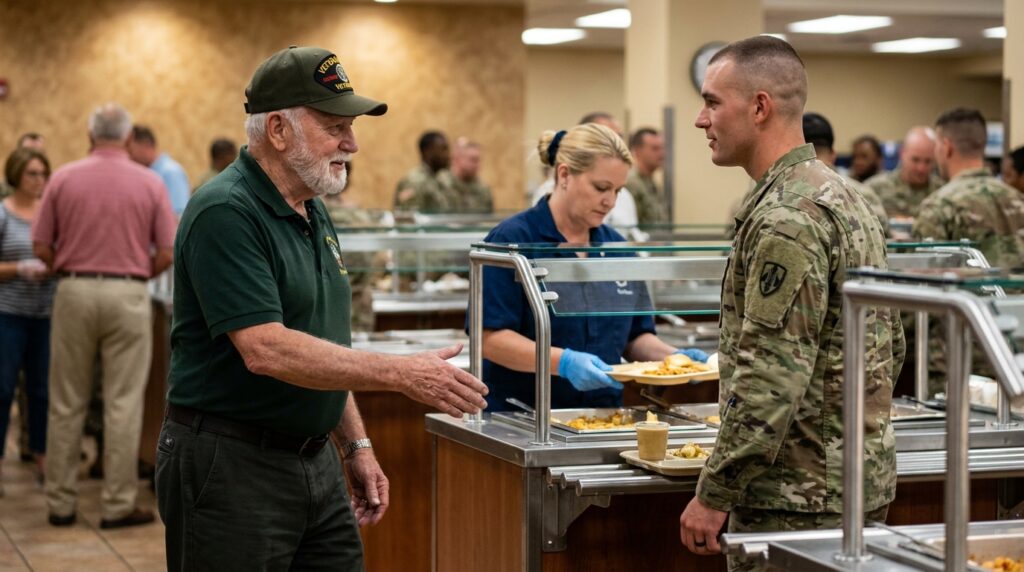
Mac looked past her toward the serving line. The counter was an unvarnished rib of heavy-gauge stainless steel, its surface deeply scored by the longitudinal scratches of millions of metal food trays sliding from left to right. Behind the glass shielding, industrial-sized steam inserts held identical square bricks of yellow egg and gray-brown sausage patties, the heat rising in thin, shimmering waves that blurred the faces of the kitchen staff.
The kitchen workers moved with the mechanical cadence of factory laborers, their blue nylon gloves flashing in the steam as they dropped portions onto the divided polymer trays with a rhythmic splat-clink. There was no talking between the servers and the soldiers. The troops moved in a silent, dense column, their camouflage uniforms damp from the field, their eyes fixed on the back of the neck of the man in front of them. The only sound was the collective, low drone of their boots and the constant, high-pressure scrape of the plastic trays sliding along the steel track.
“They look tired,” Mac said softly, his eyes tracing the line of slumped shoulders and dust-bitten necks. “They look like they’ve been running on dry gears for three days.”
“They’re meeting readiness parameters,” Miller said, her pen clicking twice in rapid succession—a short, sharp signal of absolute impatience. “And you’re blocking the access lane for the heavy weapons platoon. Step out of the corridor, sir. Now.”
Mac looked down at his own old boots, gray with the limestone dust from the gate, then up at the rigid face of the manager. He didn’t step back toward the exit. Instead, he took three slow, deliberate paces forward, his hand reaching out to grasp the cold rail of the serving line, inserting his old, weathered frame directly into the gap between two incoming squads.
The line behind him stalled with a soft, collective rustle of nylon and webbing, the rhythm of the room breaking like a chain hitting an obstruction.








