
CHAPTER 6: THE STONE LINE
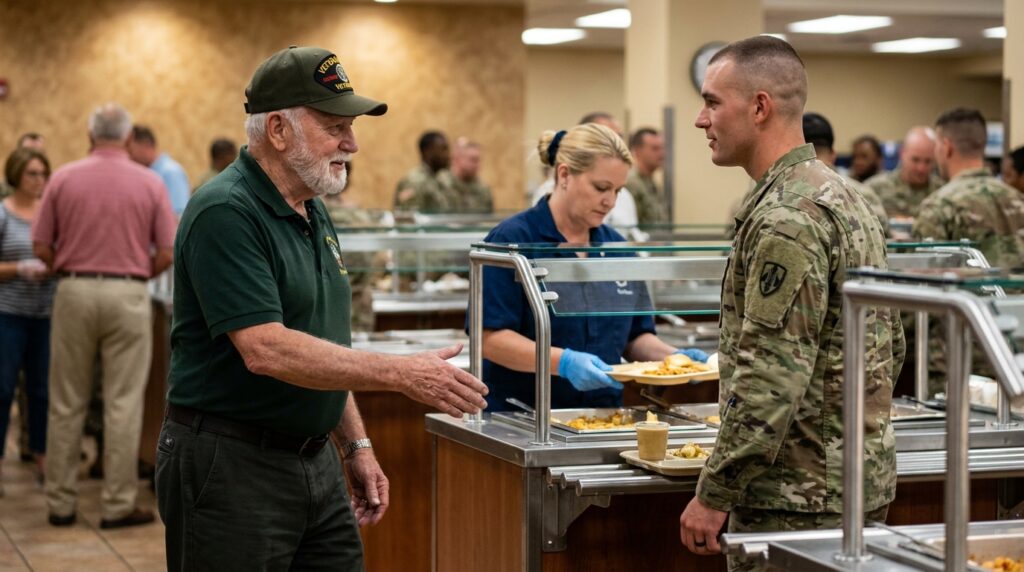
Captain Miller’s hand dropped from her shoulder mic, her fingernails clicking against the hard plastic casing with the short, dry snap of a firing pin dropping on an empty chamber. She didn’t look at Mac’s eyes; she kept her focus squarely on the dark green fabric of his collar, where the oxidized regimental pin sat crooked against the cotton weave.
“The extraction team is clearing the secondary gate block now, sir,” she said, her voice flattening into the dead, uninflected cadence of an automated logistical readout. “They will escort you to the visitor perimeter. If you resist, your vehicle will be impounded under code forty-four baseline protocols. We cannot accommodate history when the transport window is closing.”
Mac didn’t shift his boots. He let his forearm settle more heavily onto the cold, polished lip of the food counter, the rough edge of his manila envelope scraping along the stainless steel with a sound like iron filings being dragged across a saw blade. To his left, the heavy weapons specialist remained stock-still, his breathing slow and heavy, the faint scent of diesel exhaust and damp canvas radiating from his field jacket. On the column behind the kid’s shoulder, a bare patch in the gray paint marker showed where an old, hand-notched iron wrench hanger had been cleanly sheared away from the structural steel to make room for a new, synthetic fiber-optic junction box. The replacement box was clean, blue, and lacked a single scratch, but the steel behind it was pitted with rust that no one had ground out.
“The lane isn’t closing because of my boots, Captain,” Mac said, his gravelly tone slowing the room’s momentum down further, stretching the silence until the kitchen worker behind the glass lowered her ladle completely into the hot mash. “The lane is closing because your digital net is calculating the weight of these boys based on their gear manifests instead of their skin. Look at his left heel.”
Mac tapped his thick, scarred thumb against the metal rail, pointing toward the specialist’s combat boot. The leather near the ankle crease was dark, stained through with a wet, heavy sludge that didn’t belong to the dry limestone quarry outside the fence line.
“He’s been out in the lower creek sector since midnight,” Mac continued, his gaze drifting from the boot back to Miller’s tight jaw. “The drainage channels along the old timber fort are already backing up because your sub-grade contractors dumped six tons of crushed gravel into the natural runoff lane to level the drone pad. The water’s got nowhere to go but under the roadbed. If those heavy transports hit the asphalt three miles out, the whole grade is going to slide into the marsh before your first drone even clears the rail.”
Miller’s fingers tightened around her black clipboard, the plastic backing groaning slightly under the physical stress. Her eyes flicked down toward the specialist’s boots, then rapidly back up to the digital overhead monitor. The throughput counter stayed at zero, its red LED numbers pulsing with a steady, robotic glare.
“The sub-grade leveling was engineered by regional logistics, Mr. McCall,” she said, her transactional tone dropping an octave, becoming sharp as a fresh razor blade. “They use ground-penetrating radar grids to map the shifting baselines. They don’t look at mud on a boot.”
“Radar doesn’t smell the sulfur when the old clay beds break,” Mac murmured. He shifted his grip on the envelope, the paper yielding to the sweat of his palm, revealing the pale blue edge of a surveyor’s stamp from 1976. “The old engineers didn’t use radar. We used two-inch iron rods and three-pound sledges to find where the stone was true. We knew that ridge was sitting on an underground seam that would swallow concrete if you didn’t vent the pressure through the timber ditch.”
The specialist’s head turned three degrees to the right. His eyes, previously bloodshot and fixed on the food trays, locked onto the oxidized brass castles pinned to Mac’s polo shirt. His jaw stopped working the piece of gray gum. A faint, oil-smeared line ran across the kid’s forehead where his helmet liner had rubbed the skin raw, a human detail that no diagnostic software could index.
“You were with the Fourth in ’75, sir?” the specialist asked. The voice was raw, cracked from hours of shouting over the roar of automated earth-movers down by the creek.
“We laid the south culverts,” Mac said, his eyes meeting the kid’s with a slow, unblinking gravity. “We kept the water out of the motor pool before your sergeant’s father had his first set of stripes. And we didn’t leave the grade until the timber was notched three inches deep into the granite bedrock.”
“The south culverts are designated as historical structural surplus under the current expansion ledger,” Miller interrupted, her pen clicking again, the rapid tick-tick-tick sounding like a clock running out of spring tension. She stepped into the narrow gap between Mac and the serving line, her clipboard held vertically like a shield to break the alignment between the old veteran and the young soldier. “Specialist, you are under direct orders to maintain tactical silence during line delays. Move your tray down to the bread station.”
The specialist didn’t move his boots. He looked at Miller’s clean blue uniform, then down at the white marker notation on the back of her clipboard: RE-EXP-GRID-44-B. The kid’s knuckles, thick with dried grease and field dirt, closed around the edge of his molded polymer meal tray until the gray plastic began to white-out under the pressure.
“The water’s already up to the hubcaps on the staging rigs, Captain,” the specialist said quietly, his tone matching Mac’s slow, unhurried weight. “The sergeant told us the pumps were just backed up on the filter line, but the grease pits down in bay three are filling up from the bottom.”
The kitchen worker behind the glass let out a short, muffled breath, her hand dropping the handle of the ladle until it clicked against the stainless steel rim of the potato insert. The low drone of the facility’s central HVAC seemed to drop another gear, the vibration in the floorboards growing more distinct, more mechanical, as the heavy trucks three miles out continued to idle on an asphalt road that was already losing its teeth to the clay below.
Mac didn’t smile. He simply adjusted the manila envelope under his arm, his thumb resting against the rough paper edge like a wedge driven into a split log, waiting for the extraction team to arrive at the door.








