
CHAPTER 8: THE COLD COGNITION
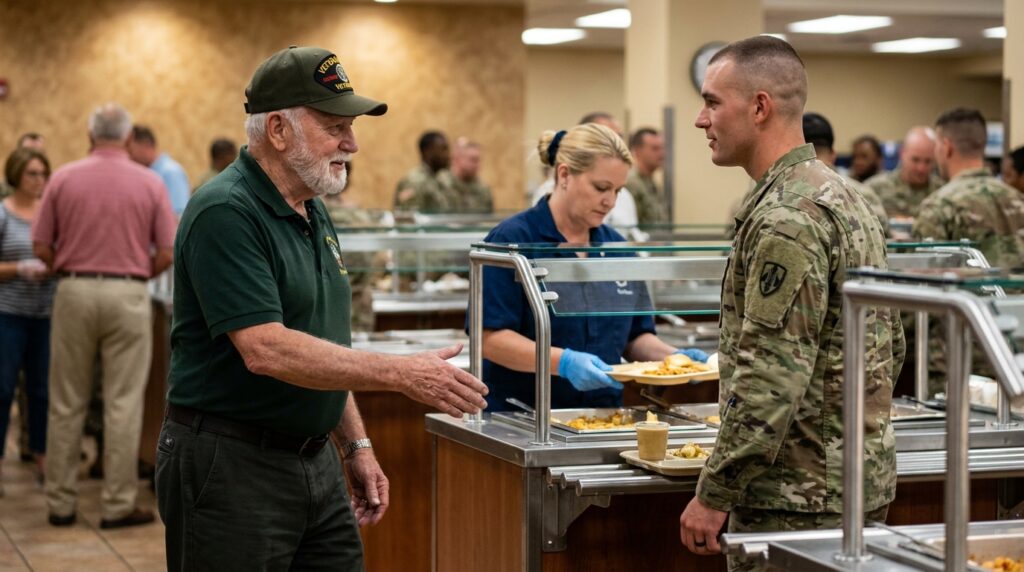
The lead security sergeant’s black tactical boot came down directly on the yellow line, the thick rubber sole making no sound against the non-skid floor, but the weight of his frame altered the shadows across Mac’s unfolded map. His gloved hand didn’t go to his holster; it hung loose near his utility belt, his knuckles thick and scarred from cold field labor. He looked at the blueprint, then his eyes flicked slowly up to the faded olive-drab veteran cap sitting low on Mac’s white-bearded head.
“This sector is closed to civilian transit, sir,” the sergeant said. His voice was a flat, low rumble that carried the rhythm of a man who had spent twenty years shouting over active engine bays. “The manager logged an execution delay. We’re here to clear the corridor.”
“The corridor isn’t the bottleneck, Sergeant,” Mac said, his thumb remaining pressed against the faded blue circle on the linen sheet. Beneath his palm, the paper was damp, absorbing the thick, sulfur-heavy moisture that was beginning to seep through the seams of the stainless steel counter tracks. “The bottleneck is four feet beneath your heels. Your automation is pushing sixty thousand gallons of wastewater back into the lower foundations because the culvert valve hasn’t been cracked since the winter freeze.”
Captain Miller stepped forward, her black clipboard cutting between the sergeant and the map like an iron wedge. “The infrastructure is monitored by the quadrant net, Sergeant. The visitor is using an outdated topographical survey to disrupt the company transit schedule. Execute the extraction protocol so we can clear the redline.”
The security sergeant didn’t reach for Mac’s arm. Instead, his gaze settled on the small, tarnished brass regimental pin attached to Mac’s collar—the twin crossed castles of the 4th Engineers. He didn’t move for three seconds, the silence stretching until the clink of a tray at the far end of the hall sounded like a hammer strike. He looked down at the young weapons platoon specialist standing behind Mac, then reached out with his left hand, his thumb catching the edge of the specialist’s tactical pack.
Pinched into the heavy nylon webbing of the kid’s field gear was a small, hand-filed iron washer, its center stamped with the exact same twin-castle emblem, but the edge was notched with three distinct cold-chisel marks—the signature of the old third battalion maintenance pool.
“Third battalion,” the sergeant said, his voice dropping into a different register, one that lacked the bloodless flatness of the garrison regulations. He looked at Mac again, his eyes narrowing as he read the features beneath the brim of the cap. “McCall. You’re the Mac who laid the deep footings for the old redoubt after the reservoir broke in ’76.”
“We used dry-stack limestone and two-inch anchor iron,” Mac murmured, his voice retaining that slow, deliberate gravel that seemed to drag against the sterile, air-conditioned draft of the hall. “We didn’t use software, son. We used three-pound sledges until the iron bit into the granite bedrock. And we left that drainage loop clear so the hill wouldn’t slide into the motor pool when the flats filled up.”
“The ledger has already processed the clearance order for that acreage, Sergeant,” Miller said, her pen clicking twice, the sound sharp and metallic against the plastic edge of her board. “The historical designations were removed by direct command at midnight. The funding line for the new drone loop is contingent on the physical clearance of that quadrant by the end of the shift. If the extraction isn’t logged within five minutes, the entire sector falls out of readiness parameters.”
“The staging pad’s already bubbling, Captain,” the specialist spoke up from behind Mac, his knuckles turning white as he gripped the gray polymer meal tray. “When we loaded the mortars into the rigs ten minutes ago, the rear axles were sinking two inches into the asphalt. It’s not limestone dust out there. It’s wet clay coming up through the foundation seams.”
The security sergeant looked back toward the kitchen service door, where the heavy steel drop-bolt sat crooked against the frame. A thin, dark line of gray water was beginning to ooze from the base of the metal threshold, pooling silently in the grooved tracks where the stainless steel trays were supposed to slide. The smell of old river silt and iron grease was rising now, thick enough to cut through the synthetic scent of the industrial gravy warmers.
“The quadrant net isn’t logging a structural variance,” Miller insisted, though her thumb was now pressing hard against the small communications handset on her shoulder, her eyes fixed on the red LED counter that remained frozen at zero. “The sensors are calibrated for weight-displacement, not moisture.”
“The sensors are sitting in dry plastic sleeves three feet above the pipe line,” Mac said, his blunt finger tracing the blue ink line down to the kitchen perimeter edge on the linen map. “They can’t see the silt because they’re looking at the voltage, not the stone. If you don’t drop that bolt and clear the old iron gate by hand, the back-pressure from the ridge is going to lift this whole floor slab before the noon trucks can clear the gate.”
The sergeant took his hand off his utility belt. He didn’t look at Miller’s clipboard. He stepped past her frame, his heavy boots making a wet, sucking sound against the linoleum as he approached the kitchen security door. He reached down, his gloved fingers grasping the rusted handle of the iron drop-bolt. The metal didn’t slide; it was jammed tight, held in place by forty years of lime scale and the immense hydraulic pressure of the water building up behind the brickwork.
“It’s locked down under the clearance spec, Sergeant,” Miller said, her voice rising as she followed him. “You don’t have the maintenance override code for that portal.”
“I don’t need a code for old iron, Captain,” the sergeant growled. He looked back at the weapons platoon specialist. “Specialist, drop that tray and get a two-man crowbar from the utility locker behind the grease pits. The old man’s right. The line’s about to blow.”
The dining hall went entirely still, the forty junior soldiers in the queue freezing mid-stride as the chain of command broke in real-time over the counter.








