
CHAPTER 3: THE ECHO CHAMBER
The heavy iron door scraped to a halt, leaving only a narrow vertical band of blinding desert sunlight behind him before the gloom of the old welding shop swallowed Mac whole. It took his eyes five full seconds to find the contours of the floor. The air inside didn’t circulate. It was dense with forty years of settled iron dust, dead birds, and the stale, mineral tang of cold cutting oil that had seeped so deeply into the concrete base it had become part of the foundation.
He took two deliberate steps forward, his boots feeling for the two-inch frost heave the motor pool sergeant had mentioned. His sole found the edge of the cracked slab. He paused, transferring the manila envelope from under his arm to his right hand, adjusting his grip so the paper wouldn’t tear against his thick knuckles.
The cavernous bay was silent, yet it felt loud to Mac. To a young man, the emptiness would look like desertion; to Mac, it was a graveyard of kinetic history. Along the far wall stood the ancient anvil blocks, their iron faces scarred and dimpled from thousands of cold-shaping strikes. Above them hung the empty silhouettes of crescent wrenches and pipe tongs, outlined in pale gray dust where the tools had once shielded the wood from decades of diesel exhaust.
A sharp, metallic snap echoed from the rafters. Mac’s chin lifted.
It wasn’t a structural failure. It was the rhythmic, cooling contraction of the corrugated tin roof under the noon heat, but beneath that sound came another—a faint, rhythmic scratching. Near the central power distribution box, a loose copper grounding strip, four inches wide and thick as a boot sole, hung by a single rusted screw. The desert wind leaking through the broken high-bay windows caught the metal tail, dragging it back and forth across the raw steel casing of the junction box. Scritch. Scritch.
Mac walked toward the junction box, his breath shallow to avoid kicking up the fine soot near his feet. The box was an old Westinghouse model, painted olive drab, its heavy latch secured with a brass padlock that had turned completely green from moisture. He reached out with his left hand, his bare fingers brushing the cold, pitted face of the lock. The metal felt dead, disconnected from the vibrant, humming grid outside.
“They don’t even know it’s ungrounded,” he muttered to the empty room.
Had the automated transport units outside drawn power from this sector, a single spike would have blown the solid-state logic boards to cinder. The new army built grids on software, but they forgot that the earth still demanded a physical path for the lightning. He leaned his shoulder against the damp brick wall, the rough mortar biting through the cotton of his dark green polo shirt. The cold from the stone began its slow crawl into his old joints, a familiar ache that felt more real than the clean, sterile synthetic scent of the gate checkpoint.
He looked down at the manila envelope. The edges were softening from the sweat of his palm. Inside lay the physical survey from 1976—the original hand-drawn blue lines showing the boundaries of the 4th Engineers’ historical redoubt. The base commander’s office had sent a digitized notice to the regimental association’s dead-letter box, a bloodless three-line decree stating the structure was slated for “expedient mechanical clearance” due to tactical grid optimization. They didn’t call it demolition. They called it clearance, as if forty years of hand-fitted timber could be brushed away like loose sand.
A shadow crossed the narrow slit of light behind him.
Mac didn’t turn around. He listened to the weight of the boots. They weren’t the light, synthetic-soled tactical boots the gate guard wore. These were heavy leather, the heels worn down on the outside edge—the walk of someone who spent eight hours a day standing on concrete lines, enforcing schedules.
“You’re trespassing in a condemned sector, sir,” a woman’s voice said from the doorway. The tone was sharp, structured, and entirely devoid of curiosity. It was the voice of a gatekeeper who had already decided the outcome of the interaction before opening her mouth.
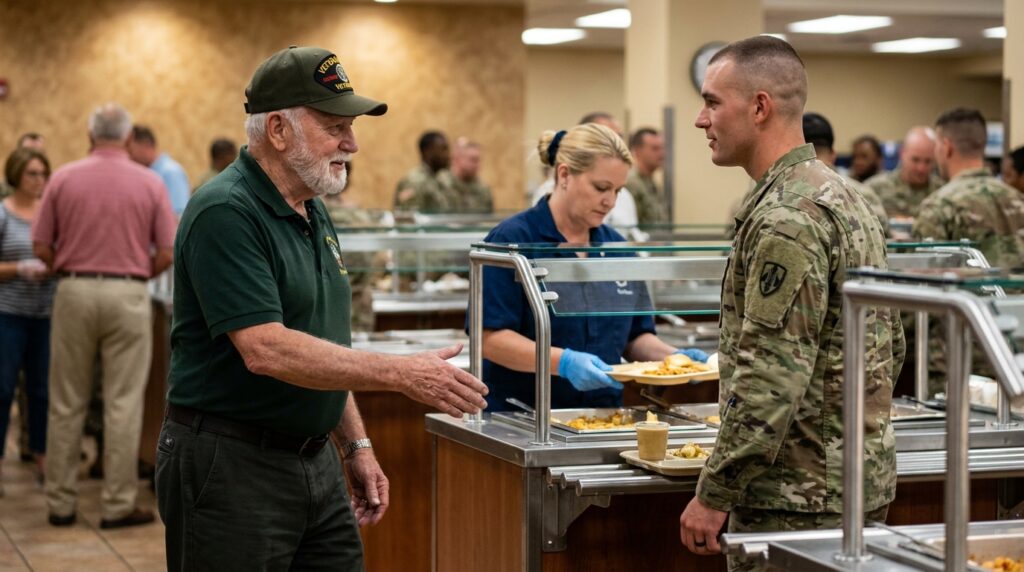
Mac turned slowly, his boots dragging through the dust. The woman standing in the sliver of sunlight was in her late thirties, her blue service uniform immaculate despite the grit of the yard. She held a black clipboard tight against her ribs like a piece of personal armor, her pen clicked open and held between her first two fingers like a weapon. Her hair was pulled back so tightly into a bun that it seemed to pull the skin of her temples taut.
“The door wasn’t locked,” Mac said simply.
“The door is designated as an unmonitored opening within a restricted logistics zone,” she replied, stepping into the bay. Her eyes didn’t look at Mac’s face; they went straight to the old veteran cap, then down to the manila envelope. “The dining facility management office has already flagged your vehicle at the outer gate. This sector is off-limits to personnel without active digital credentials. I’m going to have to ask you to return to the civilian reception area immediately.”
Mac didn’t move. He let his gaze rest on her clipboard, noticing the small, modern barcoded logistics manifestation sheets pinned under the iron clip. “You’re the facility manager from the DFAC.”
“I manage the logistical throughput for the entire third quadrant, which includes the dining facility, the maintenance annex, and the automated staging lanes,” she said, her voice rising slightly to compete with the scritch of the loose copper strip behind Mac. “My name is Captain Miller. And right now, you are disrupting the operational velocity of my noon company rotation. Follow me out, please.”
Mac looked back at the Westinghouse box, then back to her. “Your third quadrant has an ungrounded main line, Captain. If that drone transport out there hits the inductive charging pad while the atmospheric humidity is above forty percent, your whole throughput is going to drop to zero.”
Miller’s jaw tightened, the skin around her knuckles turning white against the plastic edge of her clipboard. “The systems are self-diagnostic, sir. If there was an error, the tactical net would have logged it. Now, for the last time, move toward the exit.”
Mac didn’t answer. He adjusted the manila envelope under his arm, his movements so calm they seemed to drain the kinetic authority right out of her stance. He walked past her, his shoulder clearing hers by two inches, his boots leaving a slow, deliberate trail of heavy prints in the gray dust as he headed out into the blinding glare toward the dining hall.








