
CHAPTER 11: THE EXCLUSION SEQUENCE
The ignition cylinder in Mac’s ’84 GMC didn’t click; it ground through three degrees of cold resistance before the starter caught the flywheel with a sound like iron spikes being rattled in a zinc bucket. The old V8 engine turned over heavily, coughing once through a leaking exhaust manifold before settling into a low, rhythmic rattle that vibrated the rusted floorboards directly under Mac’s left heel. A thin, gray cloud of unburnt fuel drifted past the driver’s side mirror, catching the white glare of the perimeter security floods before the valley wind tore it into the wire.
Mac let his hand rest on the gear shift knob, the black polymer ball split down the center and held together by two wraps of weathered gray duct tape. He didn’t drop the truck into reverse. He looked past the pitted chrome hood ornament toward the primary civilian liaison gate fifty yards ahead, where the dual automated boom arms stood vertical against the gray afternoon sky like iron fingers pointed at the ridge.
On the dashboard, clipped to an aftermarket steel bracket he’d machined himself in the seventies, a small black auxiliary radio receiver began to flash. It wasn’t receiving an audio signal. Instead, the small liquid-crystal display—usually reserved for regional logging frequencies—was pulsing a sharp, three-digit alphanumeric sequence in amber light: ERR-44-DIS.
“They’re fast with the ledger,” Mac murmured, his voice dry as wood shavings inside the vibrating cab.
He reached into the manila envelope on the bench seat beside him, his fingers bypassing the damp blueprint to touch his laminated field pass. The plastic casing was cold, the digital barcode across the bottom edge scratched by twenty years of being tossed into toolboxes. When he had passed through the secondary wire three hours ago, the gate terminal had processed the pass in four-tenths of a second, its blue light confirming his entry into the regimental archive sector. Now, the small terminal at the exit barrier was pulsing a steady, defensive yellow.
He engaged the clutch, the heavy steel pedal resisting his boot with forty pounds of spring tension, and let the truck roll forward along the limestone gravel lane. The tires hummed against the crushed stone, a low, high-pressure crunch that died out the moment the front bumper cleared the inductive loop embedded in the dirt ten feet from the gate box.
The automated boom arm didn’t drop, but the small digital screen on the mounting post didn’t change to green either. As the truck’s shadow crossed the yellow line, a mechanical chime sounded from the gate speaker—a short, digital chirp that lacked any human inflection.
Pass identity 04-McCall invalid for current company cycle, the automated voice stated through the weathered plastic grille. Administrative access has been systematically redistributed under regional development directive forty-four. Please remove your vehicle from the tracking loop.
Mac didn’t put his boots on the gravel. He rolled down the driver’s window, the manual crank sticking twice as the glass scraped against sand trapped in the rubber weatherstripping. The air coming off the flats was turning cold, smelling of the turned clay from the drone tracks and the sharp, chemical tang of the automated line’s curing concrete.
“The pass was signed by the garrison commander in ninety-two, son,” Mac called out to the empty gate booth. The tinted glass of the structure was dark, reflecting nothing but the gray underside of the low-hanging rain clouds. There wasn’t an MP behind the counter; the modern gate was entirely transactional, managed by a central node six miles away in the underground bunker. “It’s a life-tenure variance for the historical oversight team.”
The gate terminal didn’t pause to parse the statement. The amber light on the post shifted to a hard, unblinking red, and a low, pneumatic hiss escaped from the base of the barrier as the secondary spike-strip rose two inches out of the asphalt groove ahead.
Vehicle identification registered as an unmapped obstruction, the speaker droned. The local network has logged a five-minute countdown before automated extraction protocols are engaged. Your presence within the perimeter code is no longer calculated in the unit throughput.
Mac looked at his dashboard receiver. The ERR-44-DIS indicator had stopped flashing; it had turned solid, a permanent digital lockout that didn’t just close the gate—it erased his security profile from every terminal in the quadrant. The base commander wasn’t just hiding the funding ledger anymore; the system was actively cleaning its teeth, removing the one living set of eyes that could identify where the old retaining walls were buried before the machinery arrived to clear the stone.
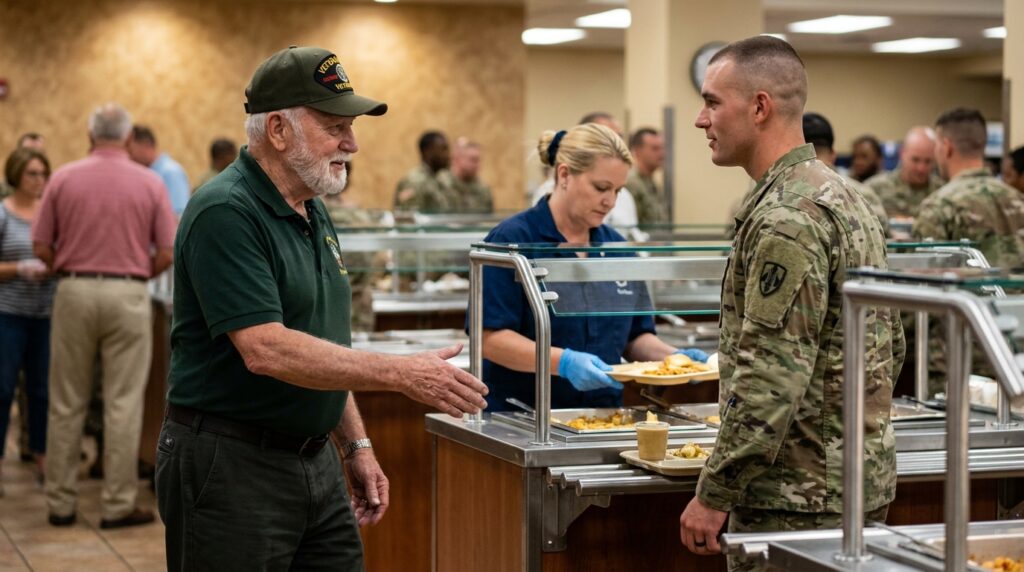
He looked back in his rearview mirror. Behind his truck, past the long gray roofline of the dining hall, the ridge was already beginning to disappear into the evening mist. A single drone, small and black against the clouds, rose from the lower creek sector, its four rotors making a high, angry snarl that didn’t carry the weight of an engine but cut through the air like a knife through canvas. It hovered over the south culvert for three seconds before pivoting toward the north flats, its digital cameras mapping the water that was still draining through the channels Mac had built by hand.
Mac didn’t argue with the machine. He shifted the truck into reverse, the gears clanking home with a heavy, ungreased thud, and backed the GMC off the tracking loop until the red light on the terminal subsided into its defensive yellow rest-state. He turned the wheel hard to the right, heading down the gravel perimeter road that ran parallel to the outer wire—the unpaved lane that led toward the old county road where the network couldn’t reach his spark plugs.
The ledger had isolated the line, but Mac knew the water was still moving underneath the road, and the old iron didn’t need a barcode to rust.








